
How to Repurpose Blog Content for Social Media (Without Burnout)


Here is a confession: for my first two years of blogging, I treated every platform as a separate job. I wrote the blog post, then stared at a blank social feed feeling like I had to invent everything twice. Learning how to repurpose blog content for social media changed everything — one well-researched article now fuels two weeks of posts across three platforms, and I spend less time on social than ever. This guide gives you the exact workflow: how to slice, reshape, and schedule your existing posts so every article works five times harder.
The core idea is simple: you already did the hard work. Researching, structuring, and writing a blog post takes hours; turning its best ideas into social posts takes minutes each. Repurposing is not laziness — it is respect for your own effort. Most of your social followers will never read the full article, so each repurposed piece meets them where they are with a self-contained insight.
How to Repurpose Blog Content for Social Media: The Workflow
Before touching any tool, set up a simple system. After you publish a post, spend thirty minutes running it through the repurposing process below. Batch this work — do it for two or three posts in one sitting — and you will build a content backlog that keeps your social feeds alive even on weeks you do not write.
1. Extract the standalone insights
Read your post with a highlighter mindset. Pull out every tip, statistic-free observation, quotable line, mini-story, and counterintuitive take that works without the surrounding paragraphs. A 2,000-word post typically yields ten to fifteen such nuggets. Write each on its own line in a document. These nuggets are the raw material for everything that follows — and the exercise itself sharpens your sense of what in your writing actually resonates.
2. Turn key points into short-form video scripts
Video gets the reach right now, and your blog posts are full of scripts waiting to happen. Take one nugget, open with the hook (the surprising claim or the common mistake), deliver the insight in under sixty seconds, and end by pointing to the full post for depth. You do not need fancy production — talking to camera with decent light outperforms polished videos with weak hooks. If short video is new to you, our guide on how to grow on TikTok covers the fundamentals that transfer to every short-form platform.

3. Design carousel and image posts from your structure
Your post’s headings are a carousel waiting to happen. Take a listicle or step-by-step post and give each step its own slide: bold headline, one supporting sentence, clean design. Carousels earn saves and shares because they deliver complete value in a swipeable format. Free design tools with templates make this a fifteen-minute job once you have the text extracted. End every carousel with a final slide inviting readers to the full article — the curious will click through.
4. Mine your post for text posts and threads
Some of your best social content is already written — it is your introduction, your conclusions, and your transitional insights. A strong opening paragraph often works as a standalone text post. A post with five lessons becomes a five-part thread, one lesson per post, published across a week. Your FAQ section is a goldmine: each question and answer is a ready-made post that addresses exactly what your audience wonders about. Text posts take minutes and often outperform everything else because they feel personal and immediate.
5. Create quote graphics from your best lines
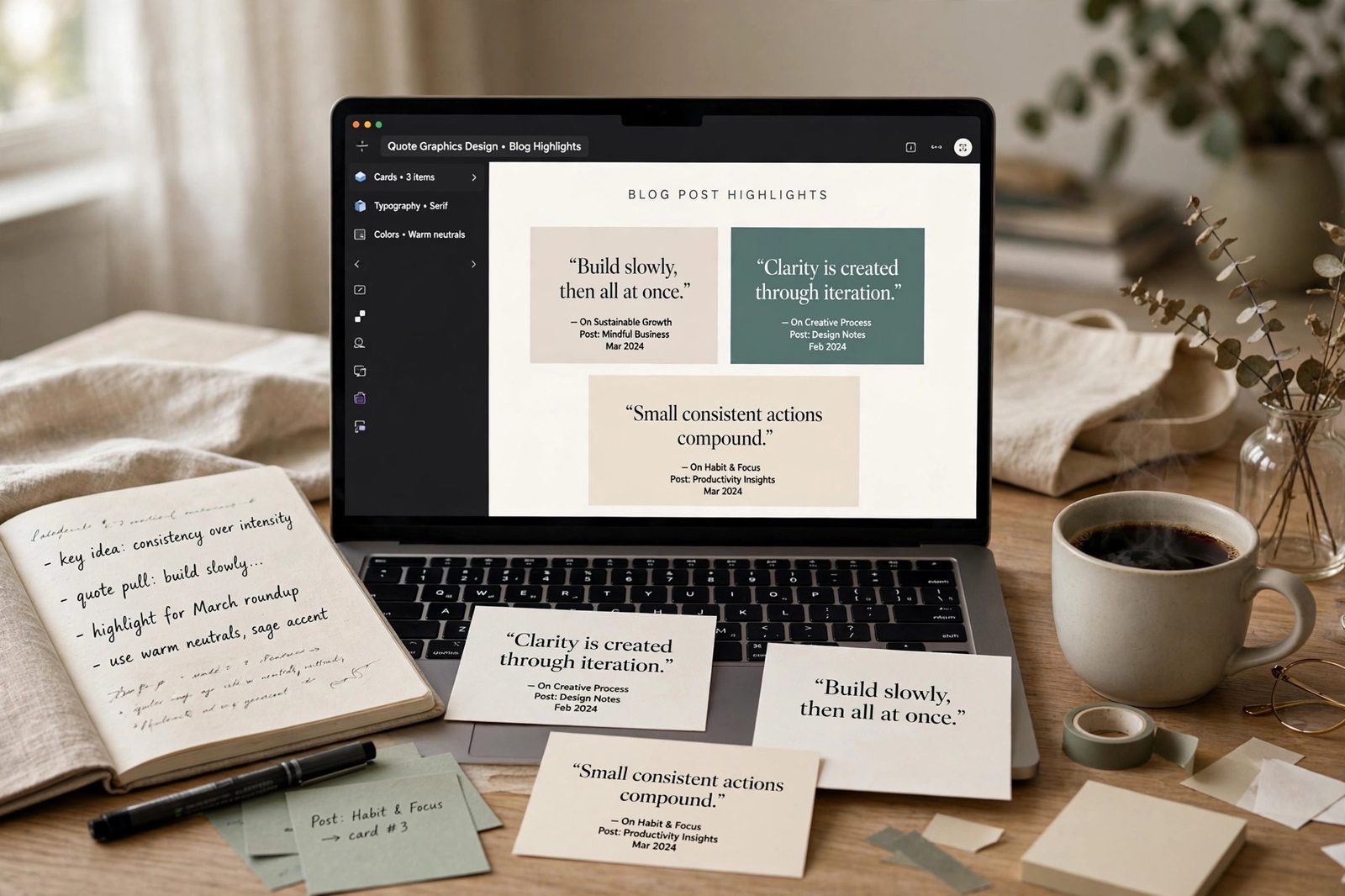
Every good post contains two or three lines that deserve to travel. Pull them out, set them on clean branded graphics, and post them as standalone inspiration. These are the most shareable format you will make — people repost quotes that articulate something they feel. Keep a running file of quotable lines from every post; over months it becomes a library you can cycle through whenever you need content fast.
6. Adapt, do not just cross-post
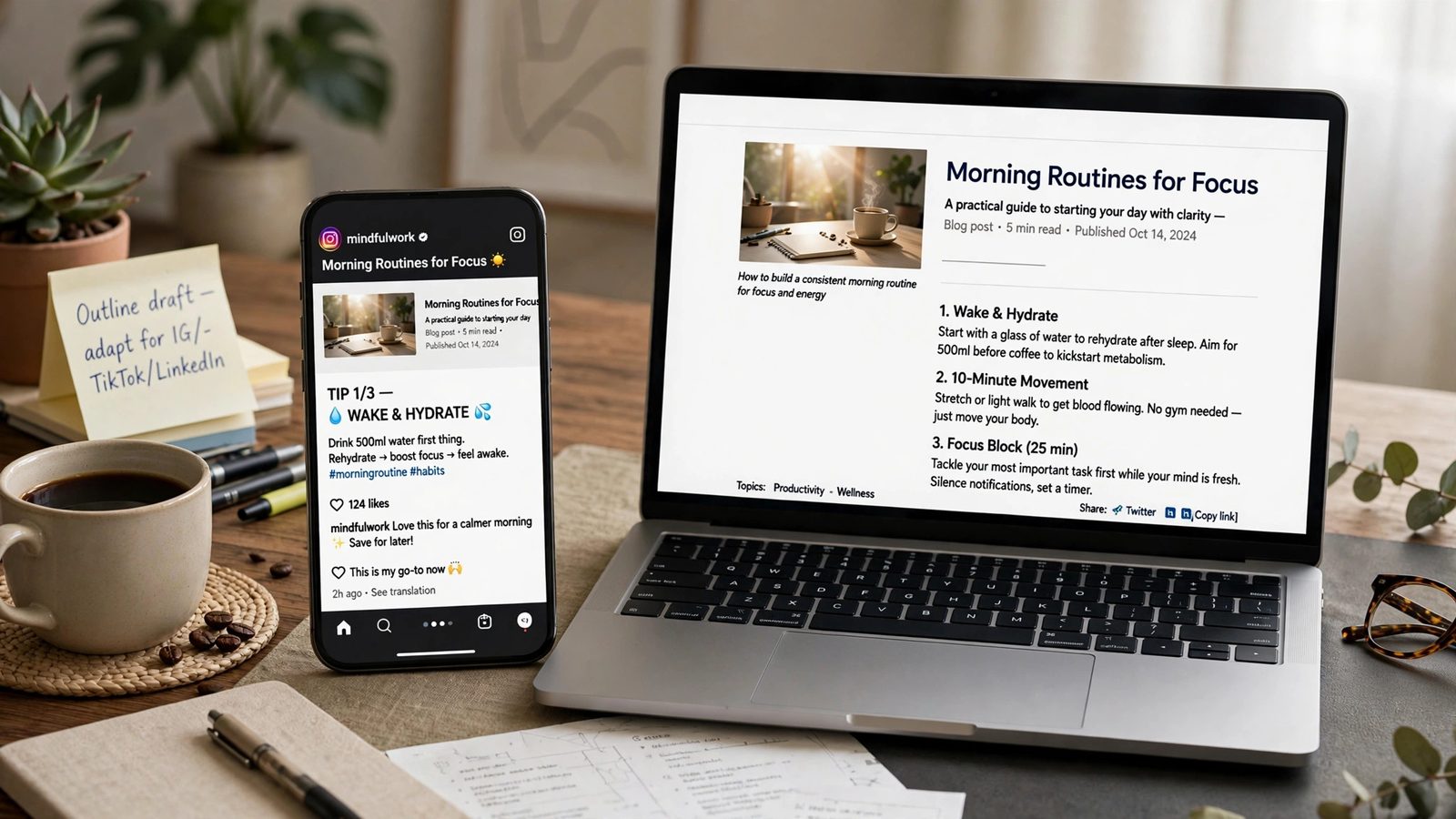
This is where most repurposing fails. Each platform has its own language: what works as a thoughtful thread flops as a video script, and a carousel caption needs different energy than a blog intro. The insight stays the same; the packaging changes. Rewrite hooks for each platform, respect character limits and format norms, and never auto-post identical content everywhere — audiences can smell automation, and algorithms deprioritize it. Ten minutes of adaptation per piece is the difference between content that performs and content that merely exists.
Choosing Which Platforms Deserve Your Repurposed Content
You do not need to be everywhere. Pick one primary platform where your readers actually spend time, plus one secondary for experimentation. For most bloggers, that means one short-video platform and one text-or-image platform. Spreading thin across five networks guarantees mediocrity everywhere; depth on one or two builds real momentum. Our comparison of the best social media platforms for small business will help you choose based on your niche and strengths rather than hype.
Once you choose, learn each platform’s native patterns for a month before judging results. Repurposed content still needs to feel native — a blog excerpt dumped into a video caption will underperform a version rewritten for the format. The bloggers who win at repurposing are not the ones with the most tools; they are the ones who respect each platform enough to adapt.
A Sample Repurposing Schedule for One Blog Post
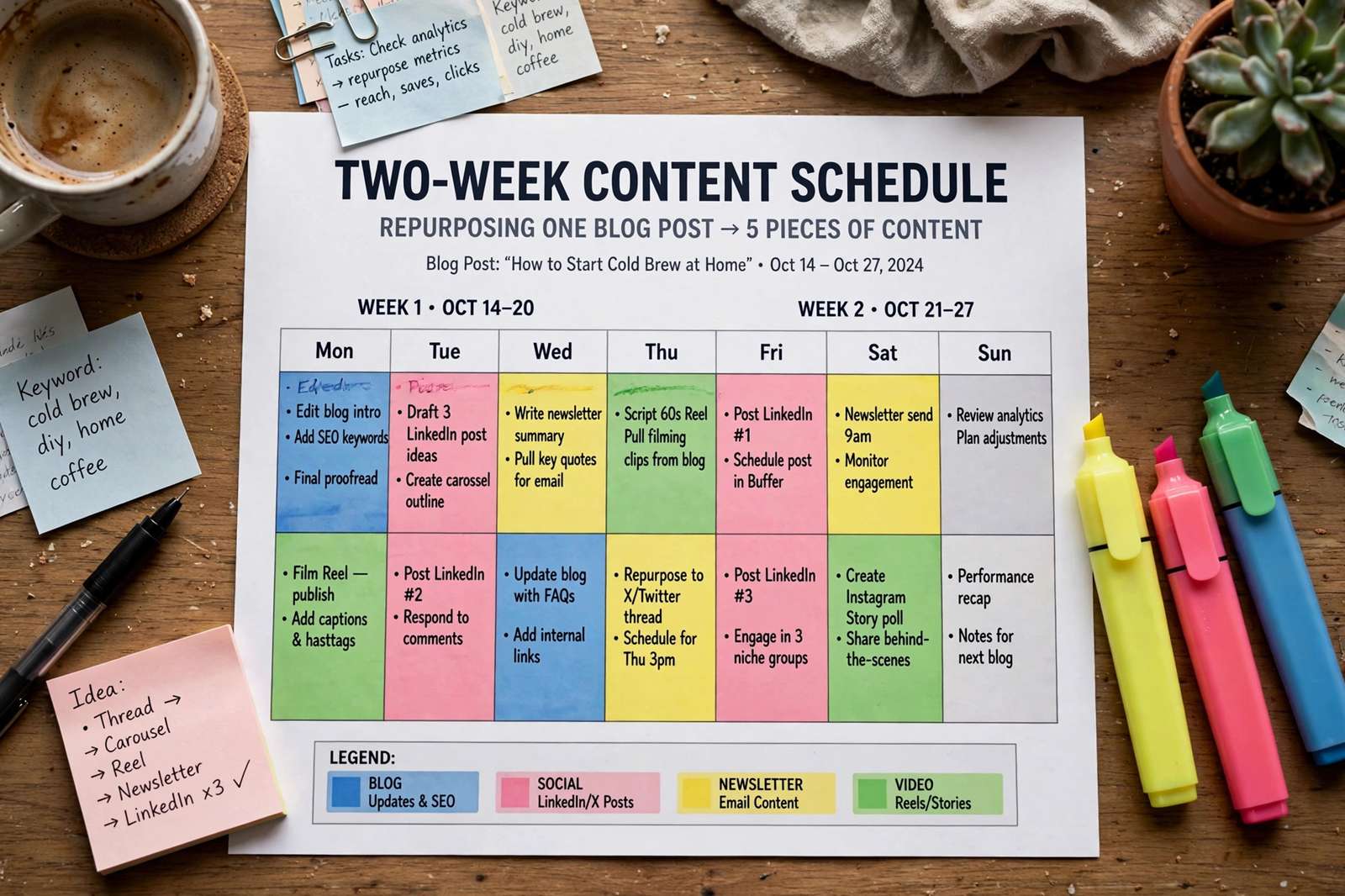
Here is what two weeks of content from a single post can look like. Day one: publish the post and share the announcement with your strongest hook. Day two: post the first carousel covering the post’s main steps. Day four: share a short video on the most surprising insight. Day six: publish a text post expanding on one FAQ answer. Day eight: share a quote graphic. Day ten: post a second video tackling a common objection from the comments. Day twelve: run a thread summarizing all key lessons. Day fourteen: reshare the post with a fresh hook for anyone who missed it. That is eight pieces of content from one afternoon of writing — and none of it required a new idea.
Tools That Make Repurposing Faster
You need less tooling than you think. A notes app for your nugget library, a free design tool for carousels and quote graphics, your phone camera for video, and a simple scheduler so posts go out while you are writing the next article. The highest-leverage habit is the nugget extraction document — maintain it for every post and repurposing becomes assembly rather than invention. Resist the urge to buy elaborate repurposing software before the manual workflow is habit; tools amplify systems, they do not create them.
One more channel deserves mention: email. Your newsletter subscribers are your warmest audience, and a weekly email summarizing your post with one exclusive insight often drives more engaged traffic than all your social posts combined. The principles in our email marketing basics apply directly — treat email as the home base your repurposed social content points toward.
Platform-by-Platform Repurposing Tactics
A quick field guide to adapting one post across the major platforms. On short-video platforms, lead with the single most surprising claim from your post and deliver it conversationally in under a minute — save the nuance for the caption and the linked article. On image-first platforms, carousels rule: five to eight slides, one idea per slide, with the first slide carrying a hook strong enough to stop the scroll. On text-first platforms, threads and standalone insights perform best; open with the problem your post solves, then deliver the answer in plain language.
On professional networks, frame your nuggets as lessons learned or mistakes avoided — that audience rewards practical, career-adjacent wisdom. On community platforms like Reddit or niche forums, do not just drop links; answer a relevant question with a genuinely helpful excerpt and mention the full post only where it adds depth. And on Pinterest, which functions as a visual search engine, turn your post’s key graphics and checklists into pins with keyword-rich descriptions — pins drive traffic for months, sometimes years, long after social posts fade.
Measuring What Works and Doing More of It
Repurposing without measurement is just busywork with extra steps. Once a month, spend twenty minutes reviewing which repurposed pieces earned saves, shares, comments, and click-throughs to your blog. You will quickly see patterns: maybe your carousels outperform your videos, or your FAQ answers drive the most blog traffic. Double down on the formats that work and quietly retire the ones that do not — there is no prize for maintaining a presence on a format your audience ignores.
Track one metric that matters per platform rather than drowning in analytics. For traffic goals, watch click-throughs to your blog. For audience growth, watch follows and subscribers per post. For authority, watch saves and shares, which signal that people found something worth keeping. Over a quarter, these numbers tell you exactly which nuggets deserve to become full follow-up posts — your audience is voting with their attention, and repurposing data is the ballot box.
Frequently Asked Questions
How much of my blog post should I give away on social media?
Be generous. Share the insights freely — the value of a blog post is rarely in a single secret tip but in the depth, structure, and completeness of the whole piece. Followers who love your nuggets become the readers most likely to click through for the full meal.
Will repurposing hurt my blog traffic?
The opposite, when done right. Each repurposed piece reaches people who would never have found the post, and a fraction of them click through, subscribe, or share. Repurposing expands your surface area; it does not cannibalize your blog.
How often should I repost repurposed content?
Social feeds move fast and audiences barely overlap between reposts. Resharing a strong piece after a few weeks with a fresh hook is smart, not spammy. Just avoid posting identical content back-to-back on the same platform.
Do I need to be on video to repurpose effectively?
No, though video currently earns the most reach. Carousels, text posts, quote graphics, and threads can carry a full repurposing strategy on their own. Play to your strengths — consistent text posts beat sporadic, reluctant videos.
What is the biggest repurposing mistake bloggers make?
Cross-posting identical content everywhere without adapting to each platform. A blog paragraph pasted as a caption looks lazy and performs accordingly. Ten minutes of rewriting for the format is the highest-ROI step in the whole workflow.
Repurposing blog content for social media is how small blogs punch above their weight. Extract the nuggets, reshape them for each platform, schedule them out, and let every article you write keep working for weeks. Write once, share everywhere — thoughtfully.