How to Stick to a Daily Routine (Without the 5 AM Guilt Trip)


I have started a daily routine approximately eleven times. Morning pages, meditation, a run before sunrise, inbox cleared by nine — the whole Pinterest board. And every single time, the routine survived about four days before real life (a sick kid, a deadline, a Tuesday that just felt like a Monday) knocked it over. So when people ask me how to stick to a daily routine, I do not hand them a prettier schedule. I hand them the system that finally survived contact with my actual life.
The problem was never my discipline. It was the routine’s design. Most routines are built like glass sculptures: beautiful, rigid, and shattered by the first bump. The routines that stick are built more like a good backpack — structured enough to hold everything, flexible enough to get thrown around. Here is the full playbook: habit stacking, flexible time blocks, shrinking the routine until it is unskippable, and a rule for what to do when you inevitably miss a day.
Why Sticking to a Daily Routine Is Harder Than It Looks
First, a small mercy: if your routines keep dying, you are not lazy. You are probably designing routines for a fictional version of yourself — the one with perfect sleep, no interruptions, and infinite willpower. Real-you has traffic, group chats, and days when the kettle breaking feels like a personal attack. A routine that only works on perfect days will fail on normal ones, which is most of them.
The second issue is all-or-nothing thinking. We treat a routine like a chain, and one broken link ruins the whole thing. Miss the 6 AM workout and the day feels ‘ruined,’ so we skip the reading, the walk, the early bedtime too. Researchers who study habit formation have found that missing one day does not meaningfully derail a habit — what derails it is the story we tell ourselves afterward. The routine did not fail. The streak-fantasy failed.
The third killer is decision fatigue. A routine with thirty steps requires thirty tiny decisions every day, and willpower is a battery, not a bottomless well. The routines that last are the ones that remove decisions: same order, same triggers, same place. Your brain stops negotiating and just runs the program.
The Habit-Stacking Trick That Makes Routines Stick
Habit stacking is the single most useful technique I know for making a daily routine stick, and it is almost embarrassingly simple. Instead of scheduling a new habit at a time (‘meditate at 7:00’), you attach it to something you already do without thinking: ‘After I start the coffee maker, I meditate for three minutes.’ The existing habit is the trigger, the new habit is the rider.
Why it works: your brain already has a well-worn neural path for the trigger habit. Piggybacking on it means you do not need motivation or a reminder — the coffee maker does the reminding. The formula is: After [CURRENT HABIT], I will [NEW HABIT]. Keep the new habit tiny at first. You can expand it later once the slot is automatic.
- After I brush my teeth in the morning, I will write down three priorities for the day.
- After I pour my afternoon tea, I will take a ten-minute walk around the block.
- After I get into bed, I will read two pages of a book before touching my phone.
- After I close my laptop for lunch, I will do five minutes of stretching.
One warning: only stack one new habit per trigger. Stacking three new habits onto your morning coffee turns a gentle on-ramp into a traffic jam. Give each stack two to three weeks to settle before adding the next rider.

How to Stick to a Daily Routine With Flexible Time Blocks
The minute-by-minute schedule — 6:00 wake, 6:15 journal, 6:30 run — is where routines go to die. It assumes every day is identical, and no day is. I switched to time blocks and my routine survival rate roughly tripled. A time block is a chunk of the day with a theme, not a minute-by-minute script.
Mine looks like this: Morning block (wake to 9:00) — movement, planning, one deep-work session. Midday block (9:00 to 1:00) — meetings and reactive work. Afternoon block (1:00 to 5:00) — creative work and errands. Evening block (5:00 onward) — wind down, no screens after ten. Within each block, the order can shuffle. If the gym is packed, I walk instead. The block survives; only the details flex. For a deeper look at building the blocks themselves, my guide to creating a sustainable daily routine walks through the full setup.
Build in explicit slack. If you think a task takes thirty minutes, block forty-five. Routines die in the gaps between optimistic estimates. Two buffer blocks per day — one mid-morning, one mid-afternoon — absorb the spills that would otherwise flood the whole schedule.
Shrink the Routine Until You Cannot Say No
Here is the counterintuitive part: the smaller the routine, the more likely you are to stick to it. A twenty-item morning routine is a fantasy novel. A three-item routine is a habit. When I rebuilt mine, I forced myself to pick only three non-negotiables: move my body for ten minutes, write the day’s top three priorities, and read before bed. Everything else was bonus.
This works because of a simple psychological truth: starting is the hard part, not continuing. A ten-minute walk usually becomes twenty once you are outside. Two pages of reading usually become ten once the book is open. But a one-hour workout you dread will get skipped entirely. Shrink the commitment until skipping it feels sillier than doing it.
Scale up slowly, and only when the small version feels automatic. My rule: a habit has to feel boringly easy for two full weeks before I expand it. Boringly easy is the goal. If it still requires a pep talk, it is still too big.
Track It Simply — and Know What to Do When You Miss a Day
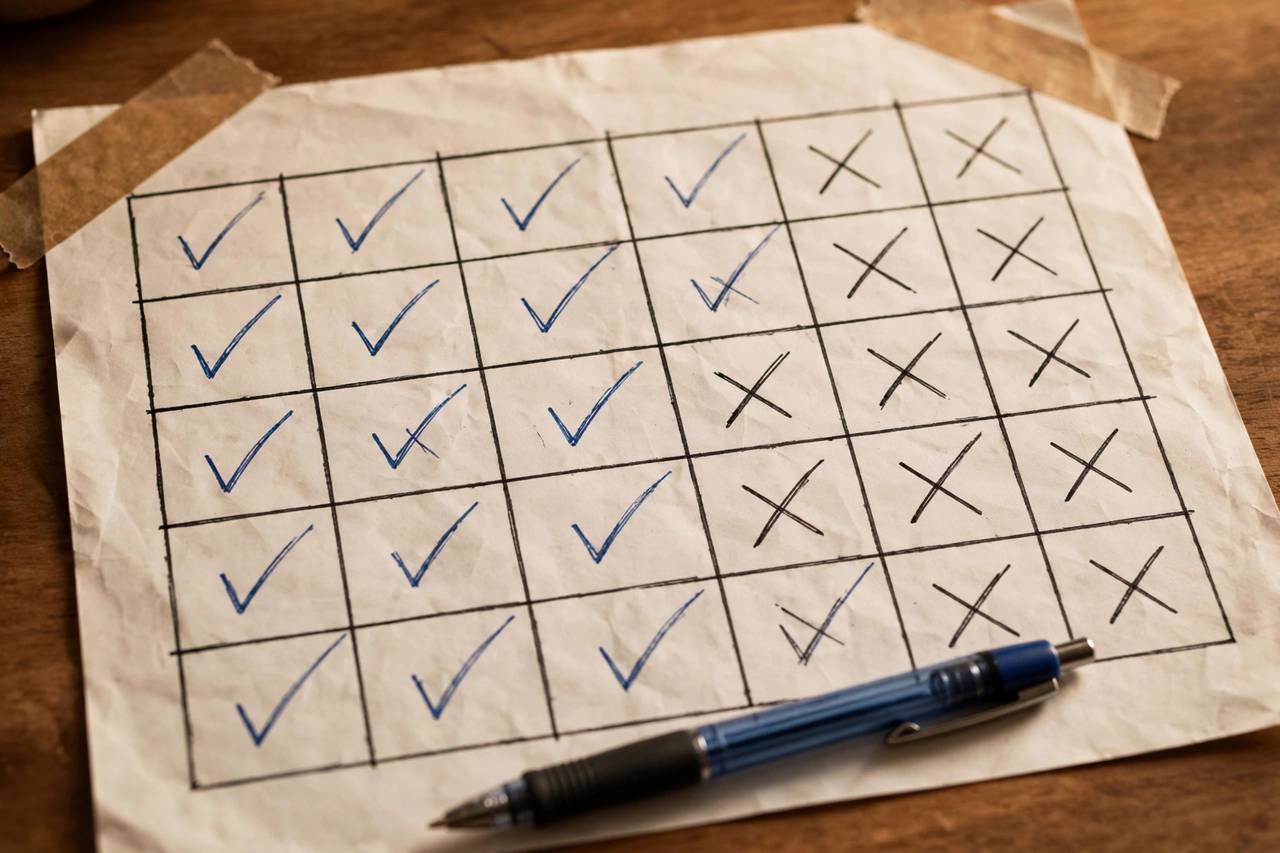
Tracking works, but only if the tracker is simpler than the habit. A wall calendar with a big X each day beats a complicated app you open twice and abandon. I use a paper calendar on the fridge: one X per day I complete my three non-negotiables. The visual chain is motivating, but the real value is data — after a month you can see exactly which days break the pattern.
And you will miss days. The rule that saved my routine is the never-twice rule: you can miss one day, but never two in a row. Miss Monday’s walk? Fine. Tuesday’s walk is non-negotiable. This single rule kills the all-or-nothing spiral, because one missed day is a blip, not a verdict.
When you miss, do a two-minute review, not a guilt session. Ask: what broke the routine — the design or the day? If the day was genuinely chaotic, forgive it and move on. If the same step keeps breaking, the step is badly designed. A habit that fails every Thursday is not a discipline problem; it is a Thursday problem. Redesign the step.
Finally, schedule a monthly routine review — ten minutes with a coffee. Keep what works, drop what does not, add one new thing at a time. A routine is a living system, not a stone tablet. The people who stay consistently productive are not the ones with the perfect routine; they are the ones who keep adjusting an imperfect one.
Make Your Environment Do the Heavy Lifting
Willpower is unreliable; environment is not. Every routine I have ever kept was propped up by some piece of environmental design. Want to read before bed? Put the book on your pillow in the morning and charge your phone in the kitchen. Want to exercise? Sleep in your workout clothes. It sounds silly. It works embarrassingly well.
The flip side is removing friction from the wrong things. If your routine says ‘no phone in the morning’ but the phone is your alarm, you will lose. Buy a ten-dollar alarm clock. If junk food breaks your evening routine, the fix is not willpower at the pantry — it is not buying it. Design the environment for the person you are at 10 PM, tired and weak, not the person you are at 10 AM, full of resolve.
Pair this with a good morning routine structure and you have a system where the right choice is also the easy choice. That is the whole secret. Nobody sticks to a daily routine through heroism. They stick to it because they made the routine the path of least resistance.
Frequently Asked Questions
How long does it take to stick to a daily routine?
Longer than the famous 21-day myth suggests. Research on habit formation, including a well-known study published in the European Journal of Social Psychology, found that new behaviors took anywhere from 18 to 254 days to become automatic, with an average of about 66 days. Plan for two to three months of conscious effort before a routine feels easy.
What should I do when I completely fall off my routine?
Restart small, not big. Do not try to resume the full routine on day one — pick your single most important habit and do just that for three days. Then add the second. Rebuilding in layers prevents the overwhelm that caused the collapse. And run the two-minute review: fix the design flaw, not just the behavior.
Is it better to have a morning routine or an evening routine?
Whichever one you will actually do. Morning routines get the glory, but if you are not a morning person, an evening routine you keep beats a 5 AM routine you abandon by Thursday. Many people do best with a light version of both — a short morning launch and a short evening wind-down.
How many habits should a daily routine include?
Start with three. Three habits you do every day will change your life more than fifteen you do twice. Once the three feel automatic — boringly easy for two weeks — add one more. Slow stacking beats ambitious collapsing.
Should I use an app to track my routine?
Only if you will actually open it. Paper calendars, habit-tracker printables, or a simple notes-app checklist all work. The best tracker is the one with the lowest friction. Avoid apps with streaks that punish you harshly for one missed day — they feed the all-or-nothing spiral.
The Bottom Line: Boring Beats Brilliant
The routines that stick are not the impressive ones. They are the boring ones — three small habits, stacked onto things you already do, inside flexible time blocks, tracked on a piece of paper, with a rule that forgives a missed day but never two. Build that, and you will not need motivation. You will just need a Tuesday.
Start today, not Monday. Pick your three non-negotiables, stack the first one onto something you already do, and put an X on the calendar tonight. That is the whole system. The rest is just showing up.