How to Hang a Heavy Mirror Safely: Hardware Guide


Learning how to hang a heavy mirror is one of those jobs where the stakes are quietly high — a 40-pound mirror falling off a wall at 2 a.m. is not a minor inconvenience. I’ve hung hundreds of mirrors, from small bath vanities to full-length monsters that needed two people and a prayer. The good news: this is entirely a hardware problem, and hardware problems have correct answers. Match the hanger to the weight and the wall, and the mirror will outlive the paint. Here’s exactly how.
First: Know Your Mirror’s Actual Weight
Before you buy a single hook, weigh the mirror. Bathroom scale, mirror in your arms, subtract your weight — it takes thirty seconds and it’s the most important number in this whole project. People consistently underestimate mirror weight by half. A 24×36 inch framed mirror is often 20 to 30 pounds; a big full-length mirror can hit 50 or more.
Write the number down. Every hanger, anchor, and wire you’ll consider is rated for a specific weight, and you need to stay comfortably under that rating — not at it. My rule: the hardware’s rated capacity should be at least double the mirror’s weight. A 25-pound mirror gets hardware rated for 50+. This isn’t overkill; it’s the safety margin that covers dynamic loads, wall imperfections, and the next decade of hanging there.
Know Your Wall Type
The wall matters as much as the weight. The three common types:
- Drywall over studs. The most common. Drywall alone holds almost nothing — the strength is in the wooden studs behind it, spaced 16 inches apart in most homes. A stud finder locates them.
- Plaster and lath. Older homes. Plaster is harder and more brittle than drywall — it cracks if you force fasteners. Studs still exist behind it, and they’re still the best anchor point.
- Masonry/concrete/brick. Common in basements and some apartments. Extremely strong, but you need masonry anchors and a hammer drill — standard screws won’t bite.
If you don’t know what you have, knock on the wall. Hollow sound with solid vertical strips every 16 inches: drywall over studs. Hard, dense, unforgiving: plaster or masonry. When in doubt, drill a small test hole in a hidden spot and look at what comes out.
Hardware Options by Weight: The Honest Breakdown
French Cleats (Best Overall for Heavy Mirrors)
A French cleat is two interlocking beveled strips — one screwed to the wall (into studs), one attached to the mirror back. The mirror hangs by gravity seating into the cleat. It’s the most secure method for anything over 30 pounds, it holds the mirror perfectly flush to the wall, and it distributes weight across a wide area instead of concentrating it on one or two points.
Metal cleats rated for 100+ pounds cost little and install in minutes. If your mirror is heavy, start here and stop shopping. This is what I use for probably 80 percent of heavy mirror jobs.
D-Rings with Picture Wire (Good for Medium Weights)
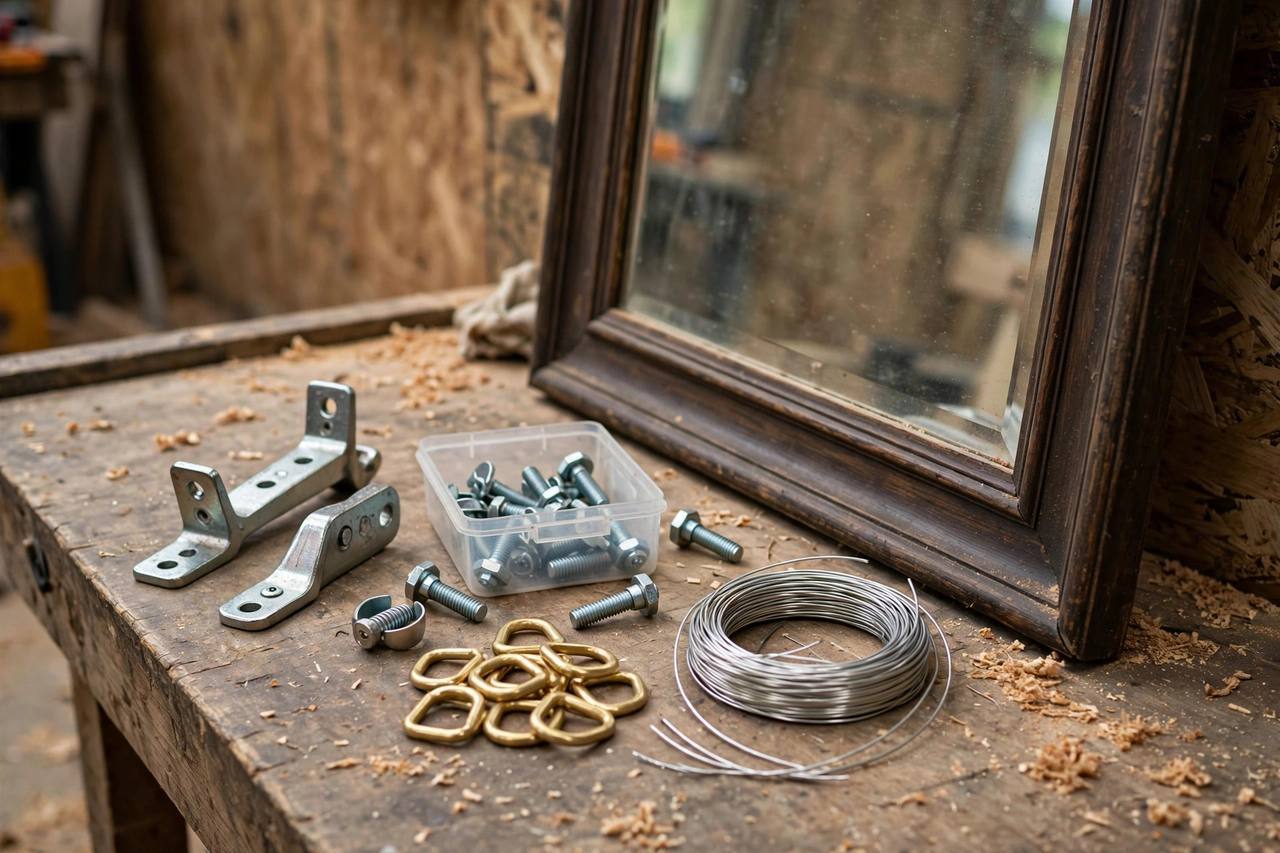
D-rings screwed into the mirror frame, connected by braided picture wire, hung on two wall hooks. The two-hook setup is important — it spreads the load and keeps the mirror level. Use wire rated for at least double the mirror weight, and use two separate wall anchors rather than one, so a single failure doesn’t drop the mirror.
The weakness: wire stretches slightly over time, and the mirror can tilt if bumped. Fine for 15 to 40 pounds; I’d go cleat above that.
Heavy-Duty Wall Anchors (When You Can’t Hit a Stud)
Sometimes the mirror has to go exactly where no stud exists. That’s what heavy-duty anchors are for:
- Toggle bolts: The strongest drywall option. The wings open behind the drywall and spread the load. Rated 50 to 100+ pounds each in half-inch drywall. My pick when studs aren’t available.
- Snaptoggles (strap toggles): Easier to install than traditional toggles and just as strong. The strap lets you position the anchor precisely.
- Molly bolts: Decent for medium weights (25 to 50 pounds). The sleeve expands behind the drywall as you tighten.
- Plastic expansion anchors: Fine for light mirrors under 15 pounds. Do not trust these with anything heavy, no matter what the package claims.
Mirror Clips and J-Channels (For Frameless Mirrors)
Frameless mirrors can’t take D-rings or cleats on a frame — because there’s no frame. Mirror clips (top and bottom) or a J-channel at the bottom with clips at the top are the standard solution. The bottom channel carries the weight; the top clips prevent tipping. Always use clips rated for the mirror’s weight, and for large frameless mirrors, add adhesive mirror mastic as backup — applied in a specific pattern, never covering the whole back (mirrors need to breathe to avoid damaging the reflective backing).
How to Hang a Heavy Mirror: Step by Step
Step 1: Mark your spot
Hold the mirror up (get help for anything over 25 pounds) and mark the top edge lightly with painter’s tape. The center of a mirror typically hangs at about 57 to 60 inches from the floor — gallery height — but bathrooms and over-mantel placements follow their own logic. Step back and look. Live with the tape marks for a day if you’re unsure.
Step 2: Find the studs
Run a stud finder across the area and mark stud edges with tape. Confirm by driving a thin finish nail — if it hits solid wood after the drywall, you’ve got a stud. Patch the tiny hole later; it’s worth the certainty.
Step 3: Install the wall-side hardware
For a French cleat: level the wall cleat, drive screws into at least two studs (three-inch wood screws), and check level again. For hooks or anchors: install per the anchor’s instructions, and don’t skip the pilot holes — especially in plaster, where forcing a screw cracks the wall.
Step 4: Attach the mirror-side hardware
Mount the mating cleat, D-rings, or clips to the mirror frame per the hardware instructions. For D-rings, position them about a third of the way down from the top on each side — this gives the best hang angle. If the frame is thin or fragile, reinforce the attachment points; a heavy mirror pulling on a weak frame point will crack it.
Step 5: Hang and level
Lift the mirror onto the hardware — two people for anything heavy, always. For cleats, lower it until it seats fully. For wire, settle it onto both hooks. Check with a level, step back, and check visually. Small adjustments now prevent years of slight tilt that will bother you every single day.
Step 6: Secure the bottom
For large mirrors, add small bumper pads or a discreet bottom restraint. This prevents the bottom from kicking out if bumped and stops the mirror from slowly walking on the hardware over time. In earthquake-prone areas, this step isn’t optional — use proper seismic restraints.
Where to Hang Heavy Mirrors (and Where Not To)
Mirrors do real work in a room: they bounce light, open up small spaces, and anchor a wall. If you’re decorating a small space, a large mirror is one of the highest-impact moves you can make — it visually doubles the room. Our studio apartment decorating guide has more small-space tricks that pair well with a statement mirror.
Placement rules that matter:
- Opposite or adjacent to windows to multiply natural light — the single best mirror placement in any room.
- Above mantels and consoles at a height where the reflection shows something worth seeing, not the ceiling.
- Never where a door swings into it. Obvious, and yet.
- Not above a crib or in reach of climbing toddlers. Heavy mirrors and small children are a combination to avoid entirely.
- Avoid direct prolonged sun on antique mirrors — UV degrades old silvering over time.
Safety Section: Read This Before You Drill
- Check for utilities. Use a stud finder with AC detection, and never drill blindly where plumbing or electrical might run — especially in bathrooms and kitchens. If you’re unsure what’s behind the wall, stop and investigate.
- Two people for heavy lifts. A 50-pound mirror with glass edges is awkward and dangerous solo. Dropping it risks deep cuts, not just a broken mirror.
- Wear gloves and eye protection when handling large mirrors. The edges can be sharp, and glass dust from drilling is no joke.
- Respect the weight ratings. “Probably fine” is not a load calculation. Rated capacity at least double the mirror weight, every time.
- Check it annually. Give the mirror a gentle tug once a year. Hardware loosens, houses settle, and a five-second check beats a midnight crash.
- Watch for frame stress. If you notice the frame pulling away from the mirror or hear creaking when the mirror is bumped, take it down and re-evaluate the mounting points before it becomes a problem.
Frequently Asked Questions
How much weight can a drywall anchor hold for a mirror?
It depends entirely on the anchor type. Plastic expansion anchors: under 15 pounds. Molly bolts: 25 to 50 pounds. Toggle bolts and strap toggles: 50 to 100+ pounds each in half-inch drywall. Screwing directly into a stud is always stronger than any drywall anchor.
Can you hang a heavy mirror without studs?
Yes, using heavy-duty toggle bolts or strap toggles rated for at least double the mirror’s weight. A French cleat mounted with multiple toggles is the most secure stud-free method. Avoid plastic anchors for anything heavy.
What is the best way to hang a heavy mirror?
A French cleat screwed into wall studs is the best overall method for mirrors over 30 pounds. It’s the most secure, holds the mirror flush to the wall, and distributes weight across a wide area.
How high should a mirror be hung?
The center of the mirror at 57 to 60 inches from the floor is the standard gallery height for living spaces. Above a mantel or console, hang it 4 to 6 inches above the surface. In bathrooms, position it for the users’ eye levels.
Do I need two people to hang a heavy mirror?
For anything over about 25 pounds, yes. Large mirrors are awkward, fragile, and dangerous to handle alone. A second person also helps with leveling — one holds, one checks.