What Is Montessori vs Traditional School? A Parent’s Guide

If you are weighing what is montessori vs traditional school for your child, you are asking one of the most common — and most confusing — questions in parenting. The two approaches look similar from the hallway (children, classrooms, teachers) but operate on genuinely different philosophies about how children learn. I have spent years researching early education, talking to teachers in both systems, and watching my own kids learn — here is the honest, parent-focused comparison I wish someone had handed me at the start.
One framing note before we begin: this is not a contest with a winner. Both systems educate millions of children well. The right question is not “which is better?” but “which is better for my child, at this age, in our circumstances?” That question has a real answer, and this guide will help you find it.
The Core Philosophical Difference
Traditional schooling is teacher-directed: the teacher decides what the class learns, when, and how; children of the same age move through the same curriculum together. The model descends from industrial-era education — efficient, standardized, measurable. It works well for transmitting a defined body of knowledge to large groups.
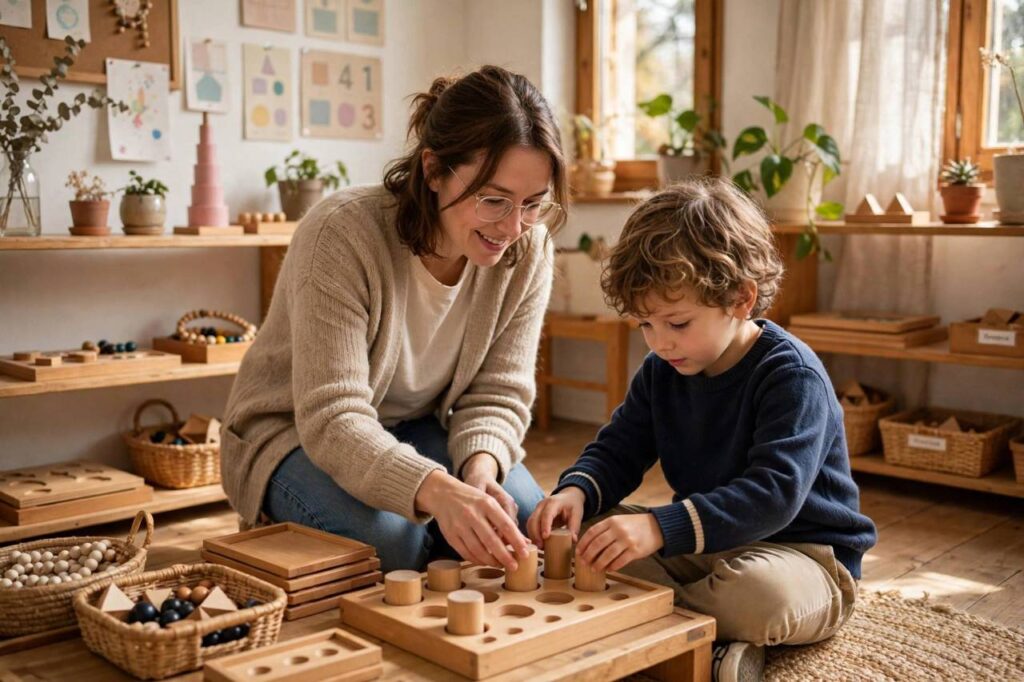
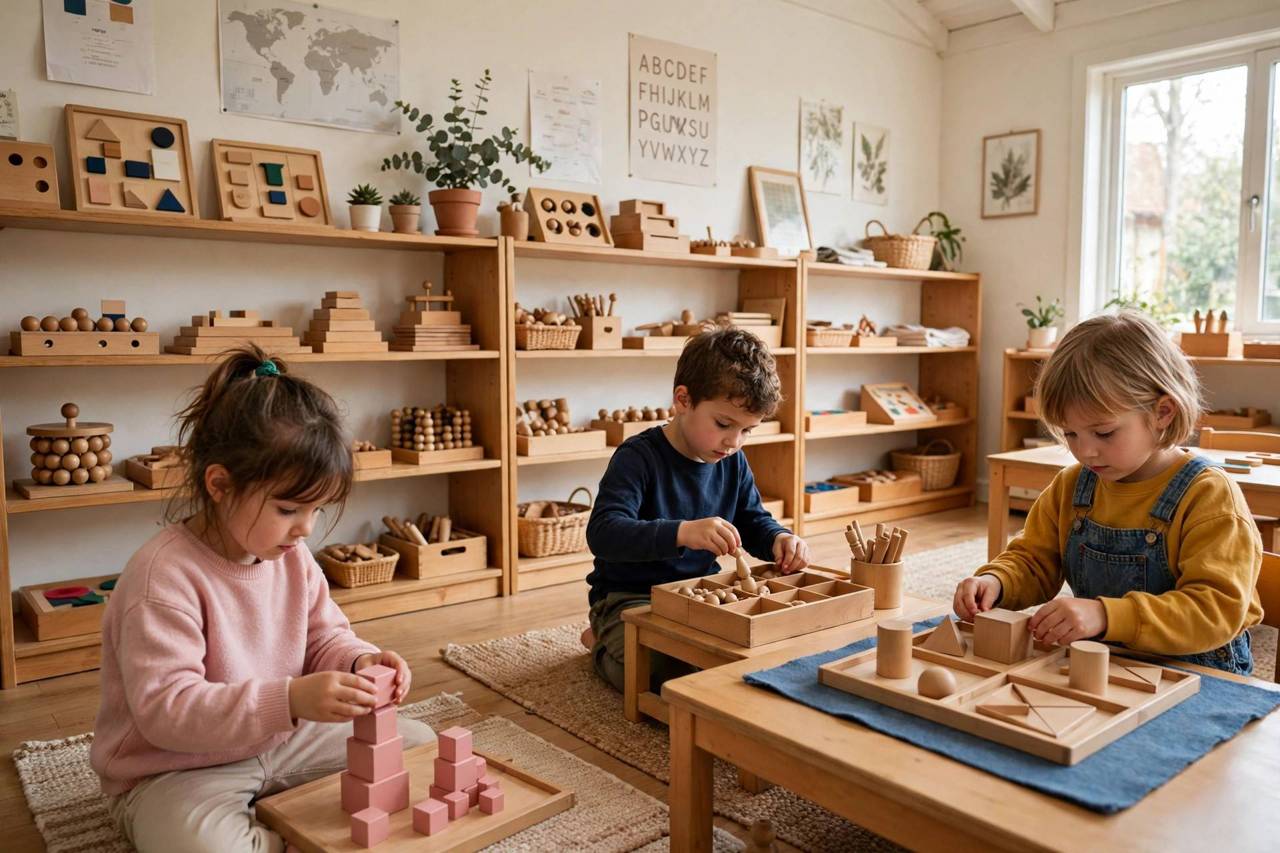
Montessori is child-directed within a prepared environment: the teacher (called a “guide”) sets up the classroom with carefully designed materials, and children choose their own activities, working at their own pace, often for long uninterrupted stretches. The model descends from Dr. Maria Montessori’s observation-based research in the early 1900s — she watched what children actually did and built the method around it. It works well for developing independence, concentration, and intrinsic motivation.
The one-sentence version: traditional school asks “what should children learn?” and delivers it; Montessori asks “how do children learn?” and gets out of the way. Both are simplifications, but they point at the real difference.
Classroom Structure: What You Would Actually See
| Montessori | Traditional | |
|---|---|---|
| Ages grouped | Mixed ages (typically 3-year spans, e.g., 3–6) | Same-age classes, one grade per room |
| Daily rhythm | Long uninterrupted work periods (2–3 hours) | Shorter periods by subject, bell schedule |
| Teacher role | Guide/observer; intervenes minimally | Instructor; directs lessons actively |
| Materials | Specialized hands-on materials, self-correcting | Textbooks, worksheets, varied by school |
| Assessment | Observation, portfolios; usually no grades/tests early | Grades, tests, report cards from early on |
| Pace | Individual — children progress when ready | Group — class moves together |
| Discipline | Freedom within limits; natural consequences | Rules and rewards/consequences, varies widely |
Walk into a Montessori classroom and the first thing you notice is the quiet industry — children working individually or in small groups, choosing their own tasks, often on floor mats. Walk into a traditional classroom and you see the familiar scene: teacher at the front, children at desks, everyone on the same lesson. Neither scene is wrong; they are optimized for different things.
What the Research Says
Parents deserve honesty here: the research is encouraging for Montessori but not as decisive as advocates claim. Studies (including well-known work by Angeline Lillard) have found Montessori students performing as well as or better than traditionally schooled peers on academic measures, with particular strengths in executive function, social cognition, and intrinsic motivation. But researchers also note a major confound: Montessori families self-select — they tend to be engaged, educated parents, which boosts outcomes regardless of method.
The fairest summary: high-fidelity Montessori (properly trained teachers, full materials, full age range) shows real benefits, especially in early childhood. Low-fidelity “Montessori-inspired” programs — a label anyone can use, since the term is not trademarked — show no such advantage. The label on the door matters less than what is happening inside the classroom. Which brings us to the most important section.
Cost and Practical Realities
Let us talk money, because it matters enormously:
- Montessori is overwhelmingly private in most countries — tuition typically runs $8,000–$20,000+ per year depending on location and level. Public Montessori programs exist (and are excellent where they do) but are rare and often lottery-based.
- Traditional school is usually free via the public system, with private traditional schools costing roughly similar to Montessori.
- Availability: you may simply not have a genuine Montessori option nearby, or the waitlist may be years long. Geography decides for many families.
Other practical factors: transitions (switching from Montessori to traditional later, or vice versa, takes adjustment — usually a semester, occasionally longer); special needs (both systems can serve them, but ask each specific school how, with specifics, not philosophy); and your child’s temperament, which matters more than any of the above.
How to Choose for Your Child
Forget the philosophy debate for a moment and consider your actual child:
- The self-directed, focused child who plays independently for long stretches and resists being interrupted often thrives in Montessori — it is built for exactly that temperament.
- The child who loves structure, clear expectations, and group activities may be happier in a traditional classroom with its rhythm and social energy.
- The anxious or slow-to-warm child often benefits from Montessori’s lack of timed tests and public performance pressure in the early years.
- The highly social child who learns through interaction might miss the group instruction of traditional school — though Montessori’s mixed-age mentoring offers its own social richness.
- Consider the specific schools, not the labels. A warm, excellent traditional school beats a mediocre Montessori program every time, and vice versa. Visit. Observe. Ask how they handle a child who is ahead, a child who is behind, and a child having a hard day. The answers tell you everything.
And remember: the decision is not permanent. Children switch systems successfully all the time. Choosing a preschool is not choosing a destiny — it is choosing the next two years.
For a deeper look at the method itself, our Montessori method explained guide covers the materials, planes of development, and what “following the child” means in practice. And if you are considering the home route entirely, see how to start homeschooling.
What Is Montessori vs Traditional School at Each Age
The Montessori-vs-traditional question plays out differently at different ages — the right answer for a three-year-old is not necessarily the right answer for a thirteen-year-old. Here is the age-by-age view.
Ages 3–6 (early childhood): the Montessori sweet spot. This is where the method shines brightest and where the research is strongest. Young children learn through senses and movement; Montessori’s hands-on materials and self-directed work periods match their developmental reality. The absence of grades and timed tests protects early confidence. If you are going to try Montessori, these are the years to do it — and a Montessori preschool followed by traditional elementary is an extremely common, successful path.
Ages 6–12 (elementary): both systems work well. Montessori elementary continues the self-directed model with deeper project work and the famous “cosmic education” curriculum; traditional elementary provides structured skill-building in reading, writing, and math with clear benchmarks. The choice here hinges on your child: the independent learner often flourishes in Montessori elementary, while the child who thrives on clear expectations and group energy may prefer traditional. Transitions in either direction are very manageable at these ages.
Ages 12+ (secondary): traditional usually wins on practicality. Genuine Montessori secondary programs are rare, and the teenage years bring needs — transcripts, standardized tests, college admissions, team sports, large peer groups — that traditional schools are built to serve. Most Montessori families transition by middle school, and adolescents generally adapt within a semester. The independence and self-direction learned in Montessori early years transfer well; the method’s job is largely done.
The hybrid reality most families live: Montessori preschool, traditional school after — sometimes with Montessori summers or homeschooling supplements. This is not a compromise or a failure of commitment; it is a rational response to what each system does best at each age. Educational philosophy serves the child, not the other way around. Choose the right tool for the current developmental job, and do not be afraid to switch tools as the job changes.
Frequently Asked Questions
Do Montessori kids struggle when they switch to traditional school?
There is usually an adjustment period — typically one semester — around grades, timed tests, and raising hands for permission. Academically, Montessori children are generally at or ahead of grade level; the adjustment is cultural, not academic. Schools used to receiving Montessori transfers handle it routinely.
Is Montessori only for preschool?
No, though preschool/kindergarten is where it is most common. Montessori programs run through elementary and, less commonly, middle and high school. Availability drops sharply after age 12 — most families transition to traditional schooling for the secondary years, which works fine.
Why is Montessori so expensive?
Trained Montessori teachers (AMI/AMS certification takes a year+), specialized materials, and low student-teacher ratios all cost money. There is no public funding in most places. Public Montessori exists in some districts and delivers the same method at public-school cost — worth seeking out if available near you.
Can anyone call their school “Montessori”?
Yes — the term is not trademarked or regulated in most countries. This is the single most important consumer-protection fact in this guide. Ask about teacher certification (AMI or AMS), observe whether children are actually choosing their own work for long periods, and be wary of programs that are traditional classrooms with Montessori decorations.
Which is better for a shy child?
Often Montessori, in the early years: no forced public performance, no timed tests, mixed-age classrooms where younger children are nurtured by older ones. But a warm traditional teacher with a gentle classroom can be equally good. Temperament fit with the specific teacher matters more than the system.
At what age should a child start Montessori?
The classic entry point is age 3, when the primary (3–6) classroom begins — starting at the beginning of the three-year cycle gives the full benefit, since the curriculum builds across the mixed-age years. That said, children join Montessori classrooms at 4 or 5 successfully all the time; the adjustment takes a few weeks, not months. Starting mid-cycle at 5 means missing the earliest materials, but guides are skilled at bridging the gap. Later than 6, you are entering elementary Montessori, which is a bigger transition but still very doable for adaptable children.
Trust the Visit, Not the Brochure
Montessori vs traditional school is ultimately a question you answer with your eyes, not with articles — mine included. Tour the actual schools. Watch the children: are they engaged? Watch the teachers: are they warm and competent? Ask the hard questions and listen for specific answers, not slogans. The right school for your child is the one where you can picture them thriving on an ordinary Tuesday. Everything else is commentary.