How to Price Your Services as a Freelancer (2026 Guide)

Pricing is where most freelancers quietly lose money for years. They pick a number that feels safe, win a few clients, get busy, and then realize the math never worked — the rate covers the hours but not the taxes, the dry months, or the unpaid admin. If you want to know how to price your services as a freelancer in a way that actually sustains a business, you need a method, not a gut feeling. This guide gives you one: how to calculate your floor rate, how to choose between hourly and project pricing, how to package value instead of selling time, and how to raise your rates without losing the clients you want to keep.
Start With Your Floor: The Rate You Cannot Go Below
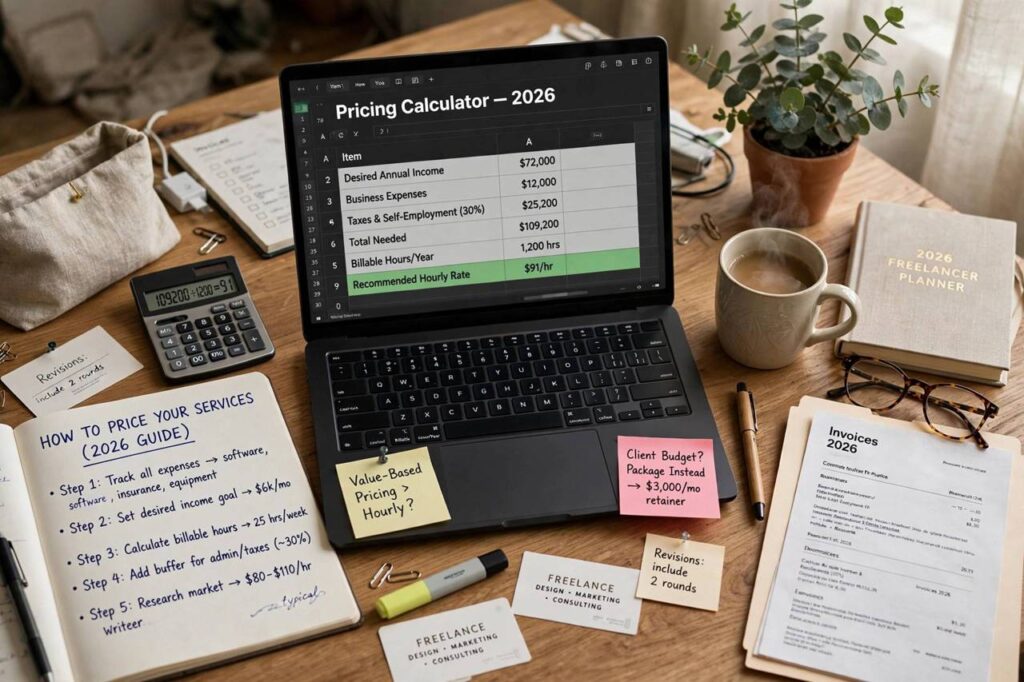
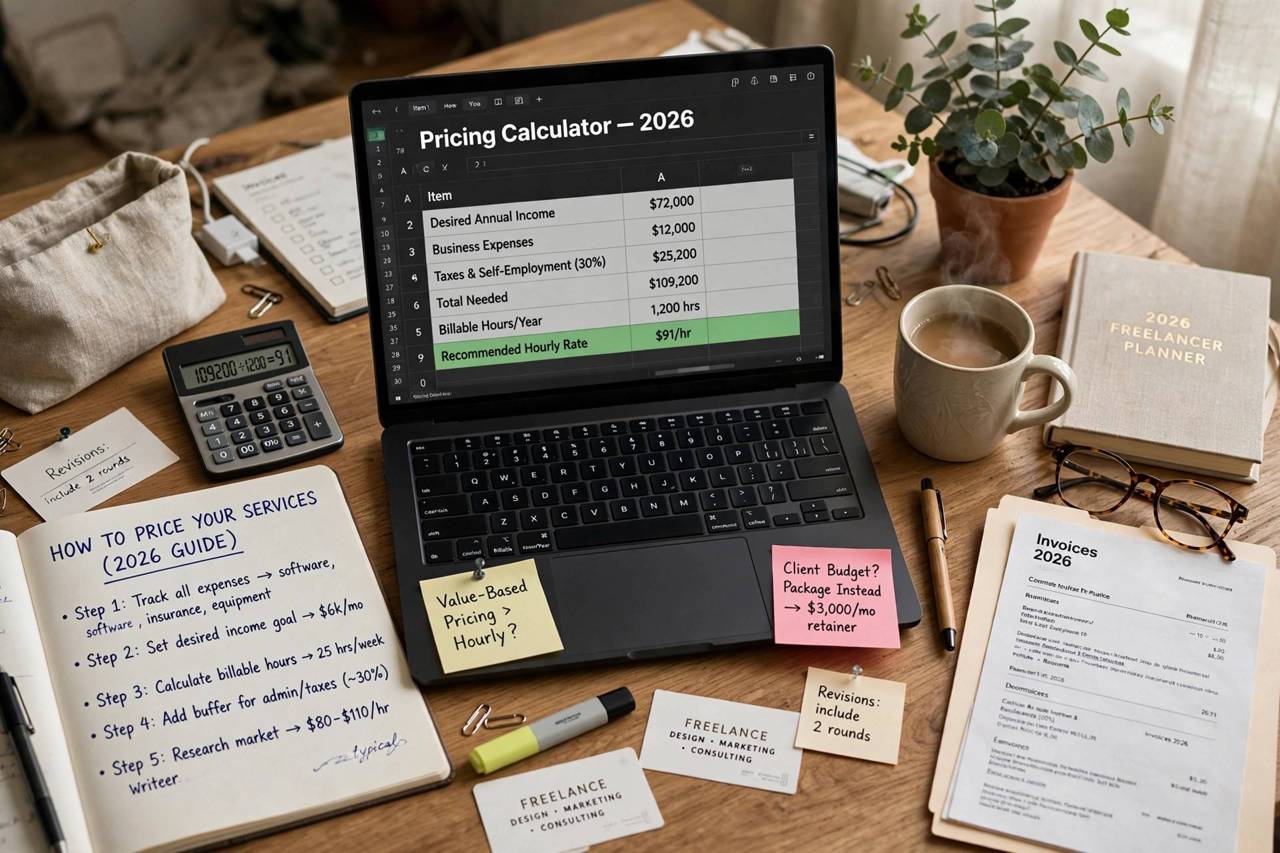
Before you think about what the market pays, work out what you need. Add up your annual living costs, business expenses, taxes, and a buffer for slow months and time off — most freelancers underestimate this by a wide margin. Divide that total by your realistic billable hours, not 2,080. A freelancer who works 40 hours a week might only bill 20, because the rest goes to marketing, admin, and learning. If you need $72,000 a year after tax and can bill 1,000 hours, your floor is $72 an hour before tax considerations push it higher. This number is non-negotiable. Any project priced below it is charity work, and you should only do charity deliberately, never by accident.
Hourly vs. Project Pricing: Choose Deliberately
Hourly pricing is simple and fair for open-ended work, but it punishes efficiency: the faster you get, the less you earn. Project pricing rewards expertise and lets clients budget with certainty, but it requires you to scope accurately or you will work for free. A practical rule: use hourly rates for maintenance, consulting, and undefined scopes; use project pricing for defined deliverables where you control the process. Many experienced freelancers use a hybrid — a project fee with an hourly rate for out-of-scope changes, stated in the contract. Whichever you choose, anchor it to your floor rate. A $2,000 project that takes 40 hours is a $50 hourly rate in disguise, so do that division before you quote.
Price the Outcome, Not Just the Hours
Clients do not buy your time; they buy what your time produces. A landing page that generates $200,000 in sales is not worth the same as a landing page nobody reads, even if both took you ten hours. Value-based pricing means tying your fee to the result: faster delivery, higher conversion, risk removed. You do not need a complex formula to start. Simply ask better discovery questions — what is this worth to the business, what happens if it fails, what does success look like in numbers — and let the answers inform your quote. Even moving from “my rate is $80 an hour” to “this project is $4,800 because it includes strategy, two revision rounds, and a 30-day support window” changes the conversation from cost to investment.
Research the Market Without Copying It
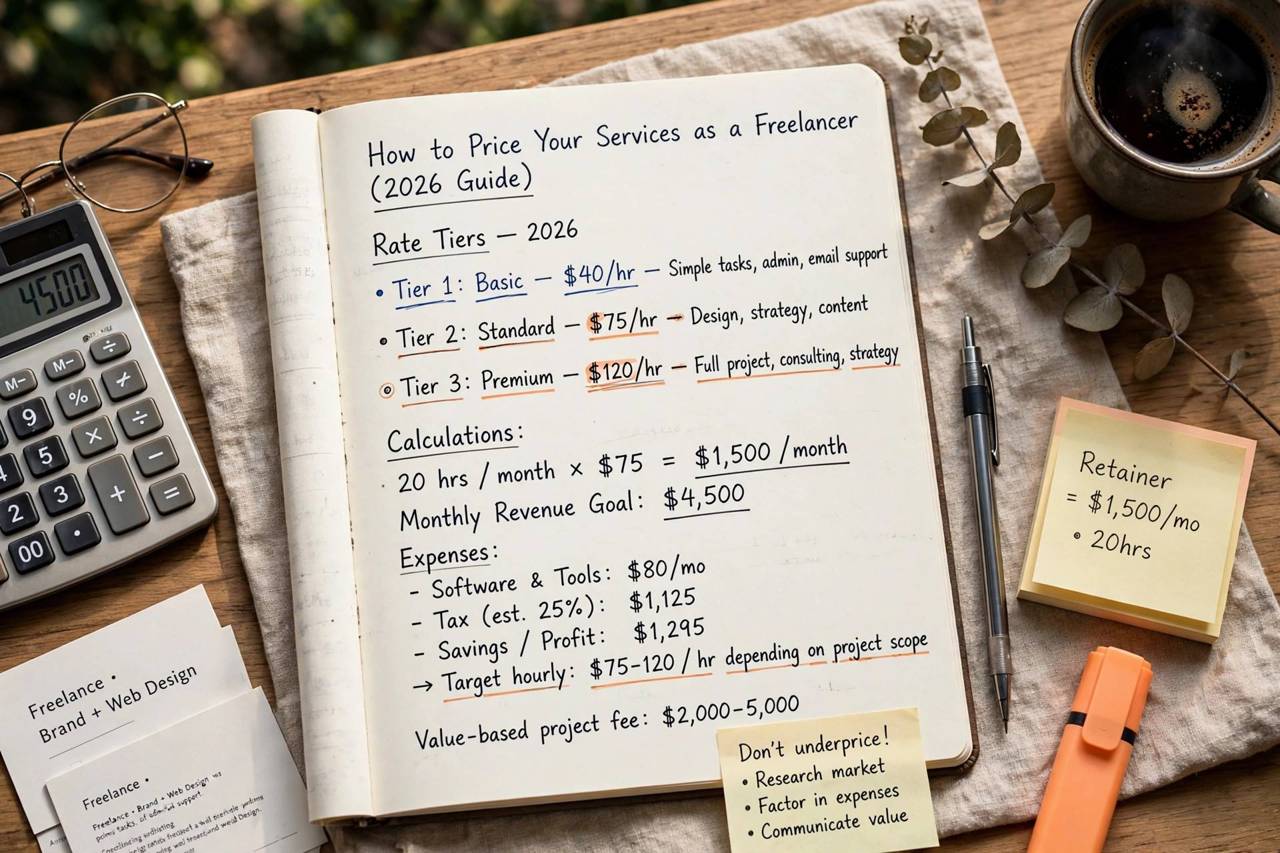
Market research prevents two mistakes: pricing so low you look inexperienced, and pricing so high you never get a reply. Look at rate surveys for your discipline, freelance platform data, and what agencies charge for comparable work — then position yourself deliberately. Beginners often anchor to the cheapest visible rates, which is exactly backwards: the cheapest segment has the most competition and the worst clients. A better approach is to price in the middle of the professional range and compete on reliability, communication, and niche expertise. Your rate is a positioning statement. Make sure it says what you intend.
Build Packages That Sell Themselves
Packaging turns a vague service into a buyable product. Instead of “copywriting services,” offer a Website Copy Package: homepage, about page, and services page, delivered in three weeks, two revision rounds, $3,500. Packages reduce back-and-forth, justify higher prices through defined scope, and make it easy for clients to say yes. Create two or three tiers — a focused starter option, a comprehensive middle option most clients choose, and a premium option with extras like priority turnaround. The middle tier should be your sweet spot: profitable, repeatable, and clearly the best value. Update your packages yearly as your speed and reputation grow.
How to Raise Your Rates Without Fear
Raising rates feels risky, but the freelancers who never raise them are the ones who burn out. The cleanest method: raise rates for new clients first, then roll existing clients up gradually with 60 days’ notice and a clear explanation tied to demand and results. A short script works: “My rate for new projects is now X, reflecting current demand and the results we’ve achieved together. For you, the new rate takes effect on [date].” Expect to lose a few price-sensitive clients — that is the point. They are replaced by better ones, and you will do the same or better revenue in fewer hours. Review your rates at least twice a year; inflation alone justifies a regular adjustment.
Contracts and Deposits Protect Your Pricing
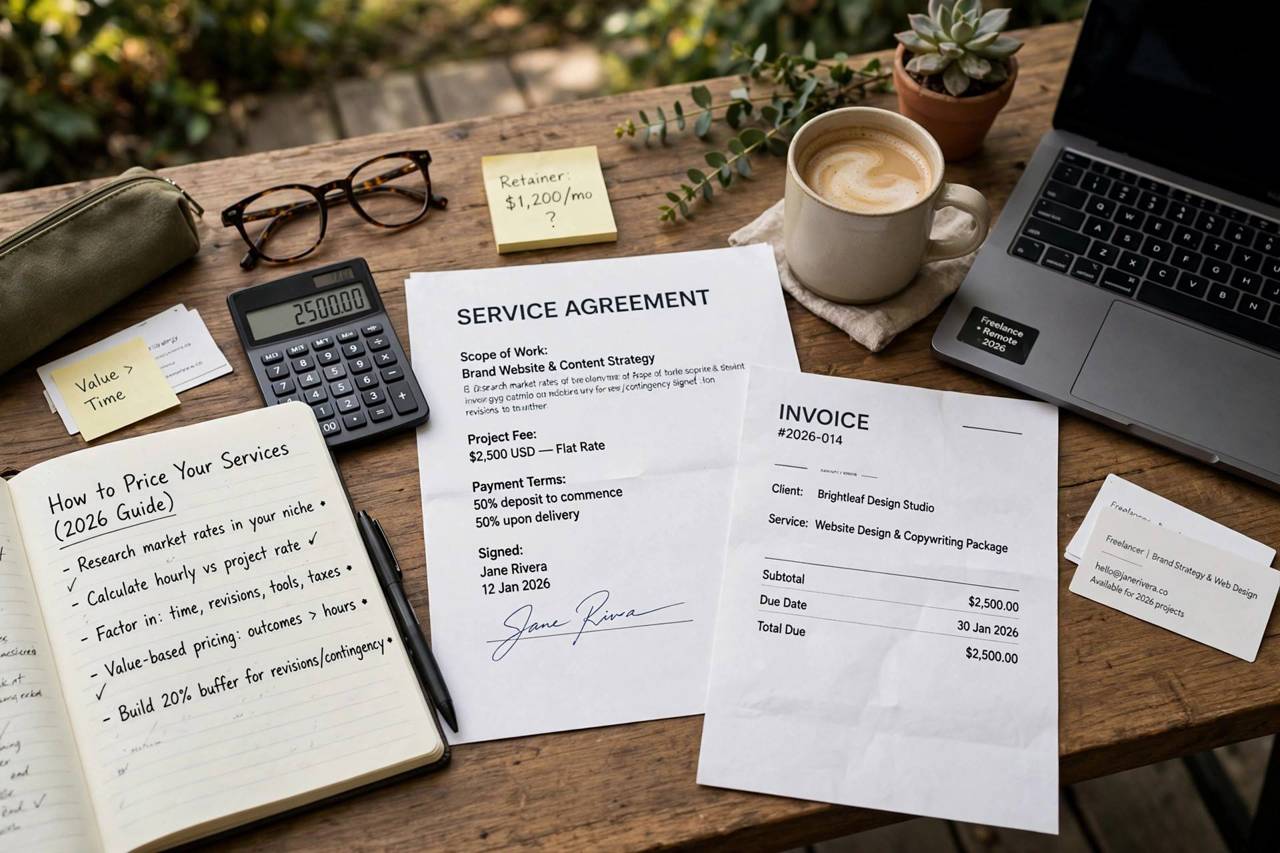
A price is only real if it is collected. Always get a signed agreement stating the fee, scope, revision limits, payment schedule, and what happens when scope changes. Take a deposit — 30 to 50 percent upfront is standard — before starting work. Deposits filter out unserious clients and protect you if a project stalls. State late-payment terms plainly; a modest late fee, enforced once, teaches clients to pay on time. And never let unpaid “quick tweaks” accumulate: track them, and when they cross the line you set in the contract, invoice them. Professionals respect boundaries. Clients who do not were never going to be good clients.
Common Pricing Mistakes to Avoid
The classic errors are predictable. Charging what you earned as an employee ignores that employers covered half your costs. Discounting to win work trains clients to expect discounts forever — offer a smaller scope instead of a lower price. Forgetting revision limits turns fixed projects into open-ended ones. Quoting before understanding the scope guarantees either an embarrassed follow-up or unpaid hours. And the biggest one: keeping the same rate for years while your skills compound. Your price should rise with your capability. Set a calendar reminder every six months to review it, and treat the review as a business appointment you cannot skip.
Putting It Together: A Pricing Workflow
Here is the workflow in order. First, calculate your floor rate from real costs and realistic billable hours. Second, research your market position and set a target rate above your floor. Third, decide hourly versus project pricing per offer, and build two or three packages around your most repeatable work. Fourth, write discovery questions that uncover the value of the outcome, and quote against that value. Fifth, protect every quote with a contract, deposit, and scope-change process. Finally, review and raise twice a year. That is how to price your services as a freelancer like a business instead of a hobby — methodically, profitably, and without apology. For product-style offers, the same thinking applies; see our guide on how to price products for a small business for the parallel framework.

How to Price Your Services as a Freelancer: Three Worked Examples
Theory is nice; numbers are better. Example one: a freelance web designer with $60,000 in annual costs and 1,000 billable hours has a $60/hour floor. She packages a standard five-page website at $4,500 — roughly 40 hours of work plus strategy and revisions — which beats her floor while giving the client price certainty. Example two: a freelance writer charges $0.50 per word for articles, but quotes a $2,000 monthly retainer for four posts to a regular client — the retainer trades a small discount for predictable income. Example three: a freelance developer quotes $9,000 for a project he can finish in 60 hours ($150/hour effective) because the client’s alternative — hiring an agency — costs twice as much and takes twice as long. In each case the freelancer started from the floor, researched the market, and priced the value, not just the hours. Run your own numbers through the same three steps before your next quote.
When to Walk Away Over Price
Not every negotiation deserves a yes. Walk away when a client demands your premium work at a beginner’s rate and will not budge — they will also be the client who pays late and requests endless revisions. Walk away when the scope keeps growing but the budget does not; that is a project designed to lose money. Walk away when a prospect’s entire pitch is about how cheap you are compared to the last freelancer — you are being hired as a discount, not a professional. Saying no to bad-fit work is what keeps your schedule open for good-fit work. A polite decline — “I don’t think I’m the right fit at that budget, but I can recommend someone earlier in their career” — costs you nothing and protects your positioning.
Frequently Asked Questions
How much should I charge as a beginner freelancer?
Start from your floor rate — your costs divided by realistic billable hours — then position yourself in the lower-middle of professional rates for your field, not at the cheapest visible price. Raise rates as your portfolio and demand grow, ideally reviewing twice a year.
Should freelancers charge hourly or per project?
Use hourly for open-ended or maintenance work, and project pricing for defined deliverables. Many freelancers use both: a project fee for the core deliverable plus an hourly rate for out-of-scope changes.
How do I justify higher freelance rates to clients?
Tie your fee to outcomes: faster delivery, revenue impact, or risk removed. Packages with defined scope and revision limits also justify higher prices because clients can see exactly what they are buying.
When should I raise my freelance rates?
Review at least twice a year. Raise for new clients first, then move existing clients with 60 days’ notice. Losing a few price-sensitive clients is normal and usually improves your overall client mix.
What deposit should a freelancer ask for?
Thirty to fifty percent upfront is standard. Always pair it with a signed agreement covering scope, revisions, payment schedule, and late-payment terms.