


I get asked this constantly: “Ethan, where do I even start with AI?” Usually by smart people who opened a machine learning textbook, hit page three, and quietly closed it forever.
Here’s the truth from someone who’s been through it: learning artificial intelligence is absolutely doable, but most roadmaps are either too academic (start with linear algebra proofs!) or too shallow (just prompt ChatGPT lol). The real path is in the middle. Let me lay it out the way I wish someone had laid it out for me.
Contents
- Before You Start: What “Learning AI” Actually Means
- Step 1: Python (Your Foundation)
- Step 2: Just Enough Math
- Step 3: Machine Learning Basics
- Step 4: Deep Learning
- Step 5: Build Real Projects
- Step 6: Specialize
- Mistakes That Waste Months
- How Long Does It Take?
Before You Start: What “Learning AI” Actually Means
“AI” is a huge umbrella. When people say they want to learn AI, they usually mean one of three things:
- Using AI tools — getting good with ChatGPT, image generators, coding assistants. (Weeks, not months.)
- Building with AI — using APIs and frameworks to put AI in applications. (A few months.)
- Understanding AI deeply — the math, the architectures, training models yourself. (6–18 months.)
All three are valid. But they need completely different roadmaps, and most beginners burn out because they accidentally start on path 3 when they wanted path 1. Be honest about which one you want. This guide covers the full journey, but I’ll flag where you can stop.
Step 1: Python (Your Foundation)
Everything in AI runs on Python. Not Java, not C++ — Python. The entire ecosystem (PyTorch, TensorFlow, scikit-learn, Hugging Face) lives there.
You don’t need to be a software engineer. You need:
– Variables, loops, functions, conditionals
– Lists, dictionaries, and how to slice data
– NumPy basics (arrays and math operations)
– Pandas basics (loading and exploring datasets)
– How to read documentation and debug errors
How to learn it: pick one interactive course and finish it. Don’t collect five courses. I recommend working through problems daily for 3–4 weeks rather than binge-watching tutorials — the people who type the code themselves learn ten times faster than the people who watch someone else type it.
Time estimate: 3–6 weeks at an hour a day. If you already program, one week.
Step 2: Just Enough Math
This is where most people quit, and it’s a shame, because you need far less math than the textbooks imply.
The honest minimum:
– Linear algebra basics — vectors, matrices, what multiplication means geometrically. You need intuition, not proofs.
– Calculus basics — what a derivative is and why gradient descent uses it. One solid explainer video can cover this.
– Probability basics — distributions, Bayes’ rule at an intuitive level.
Here’s my rule: learn math just in time, not just in case. When a machine learning concept confuses you, learn the specific math behind that concept. Trying to master all the math upfront is how people spend six months on textbooks and never touch a model.
Time estimate: 2–4 weeks, interleaved with Step 3. Don’t do this as a separate phase.
Step 3: Machine Learning Basics
Now the fun starts. Classical machine learning — regression, classification, clustering, decision trees — is where you learn how machines actually “learn” from data.
Work through scikit-learn with real datasets. The classic progression:
1. Linear regression on housing prices (learn: features, labels, training vs. testing)
2. Classification on the iris or Titanic dataset (learn: accuracy, overfitting)
3. A Kaggle competition (learn: that real data is messy and humbling)
The concept that matters most here is the train/test split and overfitting — the idea that a model can memorize instead of learning. I test every tool I write about against this, and you should too: if your model is perfect on training data and garbage on new data, it learned nothing.
Time estimate: 4–8 weeks.
Step 4: Deep Learning
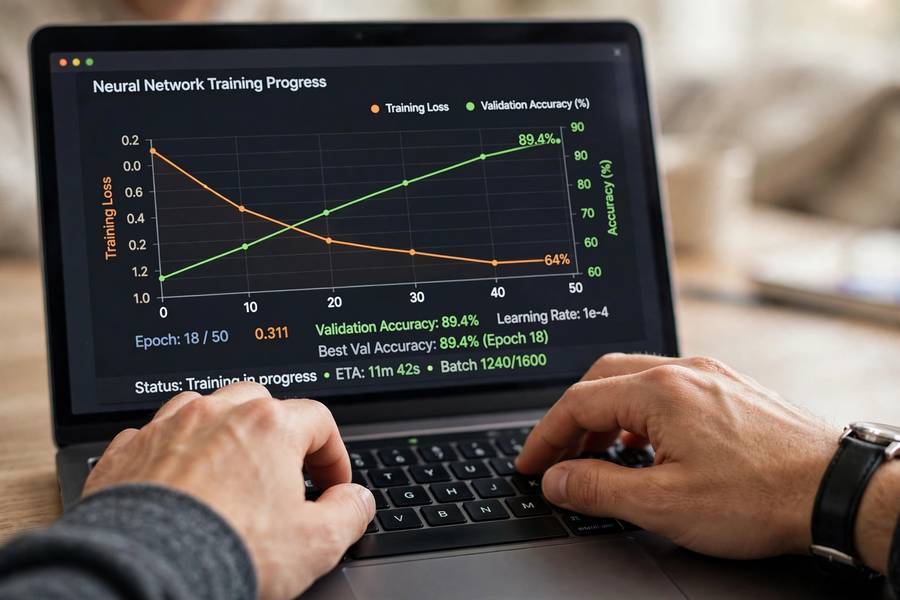
Deep learning is what powers the modern AI boom — the neural networks behind ChatGPT, image generators, and voice assistants. Start with PyTorch (it’s what most practitioners and researchers actually use now).
Learn in this order:
1. What a neural network is (layers of simple units, trained by gradient descent)
2. Train a simple image classifier
3. Convolutional networks for images
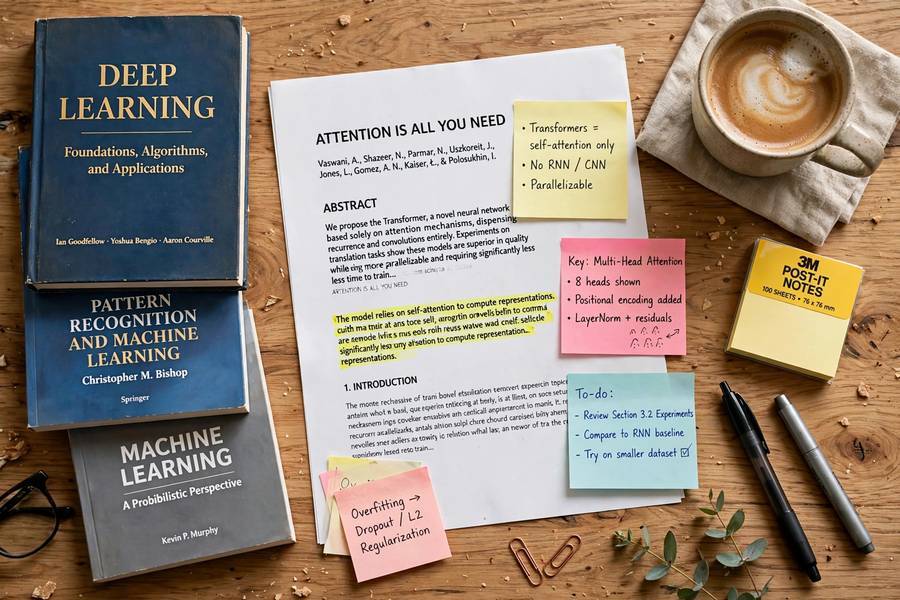
4. Transformers for text (the architecture behind modern language models)
You do not need a supercomputer. A free cloud GPU (Google Colab gives you one) handles everything at the beginner level. I trained my first real models on borrowed cloud GPUs, and so can you.
Time estimate: 6–10 weeks.
Step 5: Build Real Projects
This is the step everyone skips and the step that matters most. Tutorials teach you to follow; projects teach you to think.
Project ideas that actually teach:
– A sentiment classifier on real reviews (you’ll learn data cleaning the hard way)
– A chatbot on your own documents using a language model API
– An image classifier for something you care about (plant diseases, bird species, your cat vs. other cats)
– Reproduce a small research result from a paper
Put them on GitHub with clear READMEs. When I evaluate someone’s AI skills, I look at what they’ve built, not what courses they’ve finished. Employers do the same.
Step 6: Specialize
Once you have the fundamentals, pick a lane:
– NLP / language models — the hottest area, centered on transformers
– Computer vision — images and video
– Reinforcement learning — games, robotics, control
– MLOps — deploying and maintaining models in production (hugely employable, chronically unsexy)
– AI safety / alignment — making sure advanced systems behave
Depth beats breadth from here on. One specialty, done well, is worth more than surface knowledge of five.
Mistakes That Waste Months
I’ve watched a lot of people fail at this. The patterns:
Tutorial hell. Watching 40 hours of video without writing original code. If you’re not stuck regularly, you’re not learning.
Math-first paralysis. Spending half a year on textbooks before touching a dataset. Learn math alongside building, not before.
Framework hopping. PyTorch vs. TensorFlow doesn’t matter at your stage. Pick PyTorch and commit.
Chasing every new model. The field moves fast. Fundamentals move slow. A solid grasp of transformers from 2017 serves you better than shallow knowledge of this month’s releases.
No portfolio. “I understand AI” is worthless without proof. Build things people can see.
Free vs Paid: Where to Actually Spend Money
People ask me what to pay for, so here’s my honest breakdown. The good news: you can learn AI almost entirely for free. The best free resources (Fast.ai, Hugging Face courses, Stanford lectures on YouTube, 3Blue1Brown) are genuinely world-class — I recommend them without reservation.
So what does paying buy you? Three things: structure (a curated path instead of self-assembling one), pacing (deadlines and cohorts that keep you moving), and credentials (certificates that matter somewhat for job applications, though far less than a portfolio). A Coursera or Udacity subscription buys all three for roughly $40–80/month.
My recommendation: start free. Work through Fast.ai or the Hugging Face NLP course and build one real project. If you’re progressing well solo, you may never need to pay. Consider paying when you hit one of two walls: you need external structure to stay consistent (common and nothing to be ashamed of), or you’re job-hunting and want the credential plus career services.
What I’d never pay for: any course that won’t show you its full syllabus before purchase, anything promising employment outcomes without naming hiring partners, and anything costing thousands that covers what the free resources teach. The most expensive course I ever took taught me less than a free YouTube series. Price and quality are uncorrelated in this market — evaluate the curriculum and the projects, not the price tag.
How Long Does It Take?
Honest numbers, at roughly an hour a day:
– Using AI tools well: 2–4 weeks
– Building AI-powered apps: 3–6 months
– Working as an ML practitioner: 9–18 months
– Research-level understanding: 2+ years
These aren’t motivational numbers; they’re what I’ve observed. The good news: every step of the way, what you learn is immediately useful. You don’t wait 18 months for a payoff — after two months you can already build things most people can’t.
Start today, build constantly, and don’t let the perfect roadmap become the enemy of the first step. The field rewards people who ship.
As you learn, keep these companions handy: what AI tools can actually do today (so you build on real capabilities, not hype), how AI models are trained (the foundation everything else rests on), and how search engines work — the older sibling of modern AI retrieval.

Frequently Asked Questions
No. You need basic linear algebra, calculus, and probability intuition — not proofs or a degree. Learn math just-in-time alongside building projects rather than studying it all upfront.
Python, without question. The entire AI ecosystem — PyTorch, TensorFlow, scikit-learn, Hugging Face — is built on Python. Learn its basics plus NumPy and Pandas before moving to machine learning.
Using AI tools takes weeks; building AI-powered applications takes 3–6 months; working as a machine learning practitioner typically takes 9–18 months of consistent study at about an hour a day.
Yes. Free cloud GPUs through Google Colab handle everything at the beginner and intermediate level. You don’t need to buy expensive hardware to learn deep learning.
PyTorch. It’s what most practitioners and researchers use today, it has the best community resources for learners, and the choice genuinely doesn’t matter much at the beginner stage — so just pick one and commit.