

Nobody loves burpees. I’ve never met a single person — not beginners, not athletes, not even the sadists who program them — who said “oh good, burpees today” and meant it. But here’s why they keep showing up in every serious training program on earth: there is no other bodyweight exercise that does as much in as little time.
One proper burpee chains together a squat, a plank, a push-up, another squat, and an explosive jump. That’s legs, chest, shoulders, core, and cardio in about five seconds. Done in sets, they’re a full-body workout that fits in a phone booth. Done badly, they’re a floppy mess that wrecks your lower back and teaches you nothing.
The difference between a good burpee and a bad one isn’t fitness — it’s form. I’ve seen out-of-shape beginners do beautiful, controlled burpees and fit people do terrible ones. This guide will make sure you’re in the first group.
Table of Contents
- What Is a Burpee, Really?
- Muscles Worked and Benefits
- Step-by-Step: The Standard Burpee
- The Push-Up Question: With or Without?
- Beginner Modifications
- Common Form Mistakes
- Advanced Burpee Variations
- Burpee Workouts to Try
- Frequently Asked Questions
What Is a Burpee, Really?
The burpee was invented in the 1930s by physiologist Royal Burpee as a simple fitness test — the original version didn’t even include the push-up or jump. Just: squat down, kick back to plank, return, stand up.
The modern version most programs use has six phases:
- Squat down — feet flat, hands on the floor
- Kick back — jump or step feet back into a plank
- Push-up (optional but standard) — chest to floor
- Return — jump or step feet back to the squat
- Stand/jump — explode upward
- Land soft — reset and repeat
Five exercises welded into one flowing movement. Each phase has its own form requirements — one sloppy phase infects the rest, which is why burpees fall apart when people rush.
Muscles Worked and Benefits
A single burpee hits:
- Legs: Quads, glutes, hamstrings, calves — through the squat, kick-back, and jump
- Chest, shoulders, triceps: Through the push-up and plank hold
- Core: Stabilizes every transition, constantly
- Cardiovascular system: Spikes heart rate faster than almost any bodyweight exercise
Why they work:
- Zero equipment, anywhere. Hotel room, park — if you have floor space, you have a workout.
- Time efficiency. A 10-minute burpee workout humbles people who train for an hour.
- Full-body conditioning. Strength, power, endurance, coordination — one movement, all of them.
- Scalability. From walk-out beginner versions to box-jump burpees, it scales to any level.
If you’re building a home routine, burpees pair perfectly with the movements in my bodyweight exercises you can do anywhere guide.
Step-by-Step: The Standard Burpee
Slow it down. Learn each phase cleanly before you try to go fast.
Phase 1 — The squat down. Bend your knees, hands flat on the floor just outside your feet. Back flat, weight balanced — not pitched forward onto your hands.
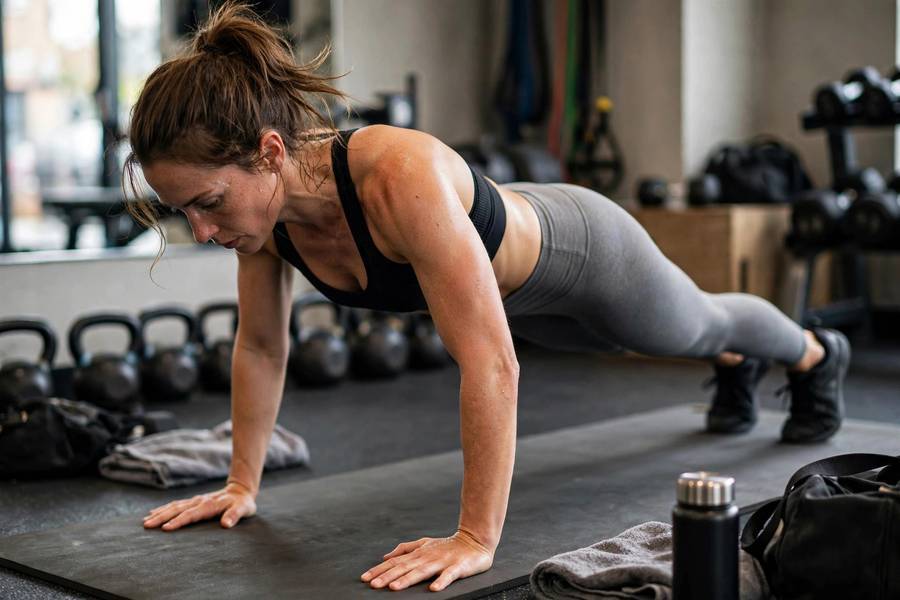
Phase 2 — The kick back. Jump both feet back into a strong plank: body straight head to heels, core braced, hands under shoulders. Most people get sloppy here and land with sagging hips. If you need a refresher, my guide on how to do a plank correctly covers it.
Phase 3 — The push-up. Lower with control, elbows at roughly 45 degrees — not flared wide, not pinned tight. Full range: chest touches the floor, arms fully extend at the top.
Phase 4 — The return. Jump feet forward to the squat, feet flat outside your hands. Keep your back flat — this is where lower backs get cranky.
Phase 5 — The jump. Explode upward, hips fully extended, arms overhead. Commit to real height — a lazy half-hop isn’t a jump.
Phase 6 — The landing. Land softly on the balls of your feet, knees bent, and flow into the next rep. Loud landings mean stiff legs and stressed joints.
Breathing: Exhale on the push-up press and the jump. Inhale during transitions. Don’t hold your breath — you’ll gas out by rep six.
Practice slowly first. Speed is earned. Ten slow, perfect burpees beat twenty sloppy ones.
The Push-Up Question: With or Without?
Purists say a “real” burpee includes the push-up. The original inventor would disagree. My take:
Include it if you can do clean push-ups. It makes the burpee a genuine upper-body exercise.
Skip it if your push-up form breaks down, you’re doing high-rep conditioning, or you’re still building the base. A burpee without the push-up is still excellent — zero shame in it.
Middle ground: include it early in the workout, drop it when fatigue sets in. Smart scaling beats stubborn grinding.
If push-ups are the weak link, work on them separately — how to do push-ups with perfect form will get you there.
Beginner Modifications
Burpees are for everyone, but not everyone should start with the full version. Here’s the honest progression:
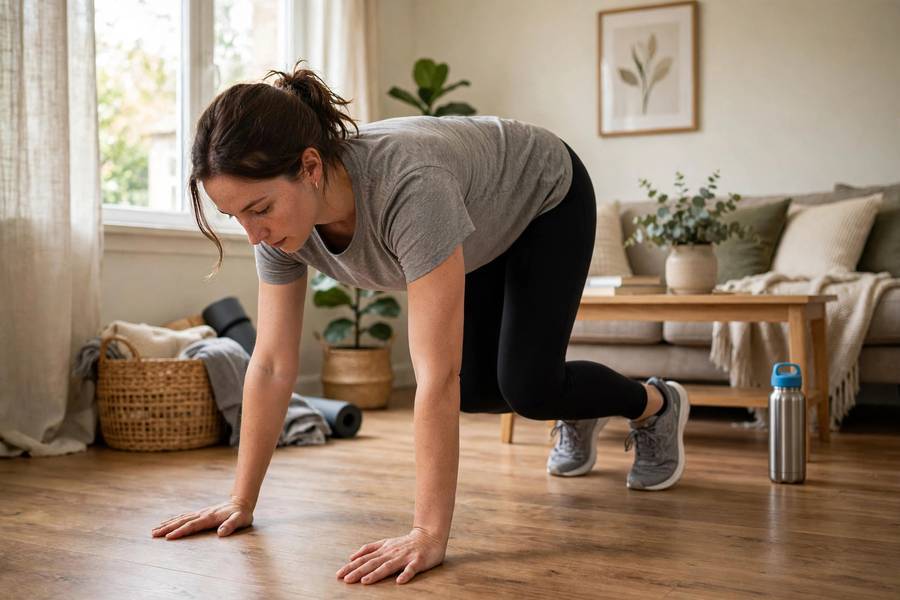
Level 1: The walk-out (no jump, no push-up). Squat down, walk your feet back to plank one at a time, walk them back in, stand up. No jumping, no push-up, no impact. Master this for 2-3 weeks.
Level 2: The step-back burpee. Same as Level 1, but add the jump at the top. You’re building the explosive finish without the high-impact transitions.
Level 3: The jump-back burpee (no push-up). Now jump the feet back and forward instead of stepping. Still no push-up. This is where most beginners should live for a while — it’s already a serious workout.
Level 4: The full burpee. Add the push-up. Welcome to the real thing.
Level 5: Speed and volume. Now — and only now — start pushing the pace and rep counts.
Spend at least 1-2 weeks at each level. I know it’s tempting to jump ahead. The people who rush the progression are the same people who do burpees with sagging backs and wonder why their lower back hurts. Build the movement right and you’ll be doing full burpees for years without issues.
Common Form Mistakes
I’ve coached thousands of burpee reps. These are the errors I correct on repeat:
1. The worm. Instead of a controlled push-up, people flop their whole body to the floor and wriggle back up. If you can’t do a real push-up in the sequence, drop the push-up — don’t worm. The worm teaches your body that collapsing is acceptable. It isn’t.
2. Sagging hips in the plank. Every transition lands in a plank, and fatigued people land with their hips dragging on the floor. This dumps stress straight into the lower back. Brace your core on every single landing like it’s the first rep.
3. Rounding the back on the return. Jumping the feet forward with a rounded spine, especially under fatigue. Think “flat back” as the feet come through. If you can’t keep it flat, step the feet in instead of jumping until you can.
4. Skipping the jump. Doing everything except the explosive finish turns the burpee into a different, lesser exercise. The jump is where the power and the calorie burn live. Even a small jump counts — but jump.
5. Stomping landings. Landing flat-footed with straight legs sends impact straight up the joints. Land soft, knees bent, quiet as a cat. If your neighbors can hear your burpees through the floor, you’re landing wrong.
6. Rushing before you’re ready. Speed without form is just fast bad reps. The CrossFit-style “as many as possible” approach has its place, but not until your form is automatic. Slow perfect reps first. Always.
Advanced Burpee Variations
Full burpees feeling routine? Rotate one of these in:
Burpee box jump. Jump onto a sturdy box instead of jumping in place. Serious power demand — make sure the box is stable.
Burpee pull-up. Do the burpee under a pull-up bar, finish each rep with a pull-up instead of the jump.
Devil press. Hold light dumbbells through the whole burpee, push-up on the dumbbells, swing them overhead at the top. The advanced hybrid from serious conditioning programs.
8-count bodybuilder. The military classic: each phase is a distinct, paused count. No momentum allowed. Brutal in a way fast burpees aren’t.
Add one variation at a time and give it 3-4 weeks before rotating. Depth over novelty.
Burpee Workouts to Try
Plug-and-play workouts for different goals. Adjust the levels to wherever you are.
The 10-Minute EMOM (conditioning). Every minute on the minute, 8-10 burpees, rest the remainder. 10 rounds. Simple, devastating, effective.
Burpee ladder (mental toughness). 1 burpee, rest 10 seconds, 2 burpees, rest 10 seconds… climb to 10, then back down. 100 total. Pace yourself.
The 5-minute finisher. After your regular workout: 30 seconds burpees, 30 seconds rest, repeat 5 times. Short, sharp, done.
Burpee + mountain climber circuit. 30 seconds burpees, 30 seconds mountain climbers, 30 seconds rest — 4-6 rounds. No equipment, full body.
Start with the finisher or the EMOM at your current level. The goal is to finish with form intact, not to collapse halfway through.
One more variable worth optimizing: timing. The research on the best time to exercise is more nuanced than “morning is best” — consistency beats the clock, but there are real differences worth knowing.

Frequently Asked Questions
Start with 3 sets of 5-8 reps at whatever modification level matches your fitness — walk-out burpees if needed. Focus entirely on clean form. Add 1-2 reps per set each week. Jumping straight to 50 burpees is how beginners get injured and quit; patient progression is how they become people who do burpees regularly.
Burpees done with good form are not bad for your back. Back pain from burpees almost always comes from two mistakes: sagging hips in the plank phases and rounding the lower back when jumping the feet forward. Fix those — brace the core on every landing, keep a flat back on the return — and the back pain disappears. If sharp pain persists despite good form, stop and get assessed.
Both, within limits. Burpees build muscular endurance and some muscle, especially in beginners — the push-up phase works the chest, shoulders, and triceps, while the squat and jump work the legs. But they’re primarily a conditioning exercise, not a muscle-building one. For significant muscle growth you need progressive resistance training; burpees are the conditioning complement to that work, not a replacement for it.
Include the push-up if you can do it with good form — it makes the burpee a true full-body exercise. Skip it if your push-up form breaks down or you’re a beginner still building base strength; the burpee is still excellent without it. You can also mix: include push-ups on early sets and drop them as fatigue sets in. Smart scaling beats grinding through ugly reps.
Burpees burn roughly 10-15 calories per minute for an average-sized adult doing them at a solid pace — among the highest rates of any bodyweight exercise. A 10-minute burpee workout can burn 100-150 calories while also building strength and conditioning. But don’t major in the minors: the real value of burpees is the fitness they build, not the calories on any single day’s tracker.
You can do a small number of burpees daily, but high-volume burpees every day is a fast track to overuse issues in the wrists, shoulders, and lower back. Treat intense burpee sessions like any hard workout: 3-4 times per week with rest or lighter days between. Daily movement is great — daily punishment is not. Listen to your joints; they’re keeping score even when you aren’t.