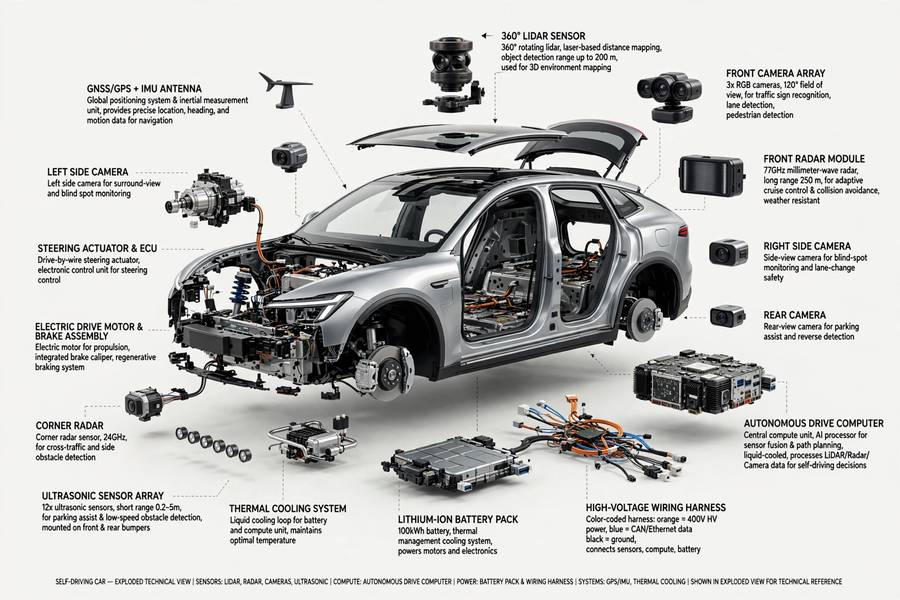
Pop the hood of a self-driving car — metaphorically, since there is no engine to see — and you find three technology families working together: hardware that perceives the world, maps that describe it in advance, and software that decides what to do. Each family is a deep engineering discipline on its own. Together, they form the most complex consumer machine ever built.
I am going to walk through the full stack the way an engineer would explain it to a smart friend: what each piece does, why it exists, where it fails, and how the pieces fit. For the conceptual overview, my guide to how self-driving cars work covers the big picture; this article is about the machinery.
Table of Contents
- Layer 1: Perception Hardware
- Cameras: The Primary Eyes
- Radar: Seeing Through Weather
- LiDAR: The Precision Instrument
- Ultrasonic and the Rest
- Layer 2: Maps and Localization
- Layer 3: Compute Hardware
- Layer 4: The Software Stack
- Perception Software
- Prediction and Planning
- Control Systems
- Connectivity and Fleet Infrastructure
- Frequently Asked Questions
Layer 1: Perception Hardware
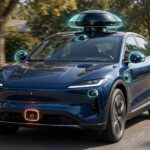
Everything starts with sensing. A self-driving car carries a sensor suite that would make a military drone jealous, and each sensor type exists because the others have blind spots.
Cameras: The Primary Eyes
Cameras are the workhorse — cheap, high-resolution, information-dense. A typical autonomous vehicle carries eight or more, covering every direction. They read traffic lights, stop signs, lane markings, brake lights, turn signals, and the body language of pedestrians. No other sensor can do all of this; a camera is the only sensor that sees the world the way the driving task was designed to be seen (by humans, with eyes).
The technology keeps improving: high dynamic range for driving out of tunnels into sunlight, thermal cameras for detecting pedestrians at night, ever-higher resolutions. But the fundamental weakness never goes away — cameras need light. Darkness, glare, fog, heavy rain, and snow all degrade them. Every camera-only driving system is betting that software can compensate for physics. Sometimes it can. Sometimes a white truck against a bright sky is just invisible.
Radar: Seeing Through Weather
Radar bounces radio waves off objects and measures the reflections. It tells the car how far away things are and how fast they are moving — directly, by Doppler shift, with no computation required. Its superpower is weather immunity: rain, fog, snow, and darkness barely affect it. When cameras go blind, radar keeps working.
The tradeoff is resolution. Automotive radar knows something is ahead and how fast it is closing; it struggles to say what that something is. Is it a stopped car, a metal sign, or an overhead bridge? Radar famously struggles with stationary objects — the classic failure mode is a radar system ignoring a stopped fire truck because it filtered it as clutter. Modern imaging radar is closing the resolution gap, but radar remains a supporting sensor: superb at “how far, how fast,” poor at “what.”
LiDAR: The Precision Instrument
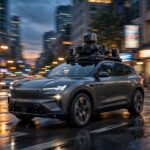
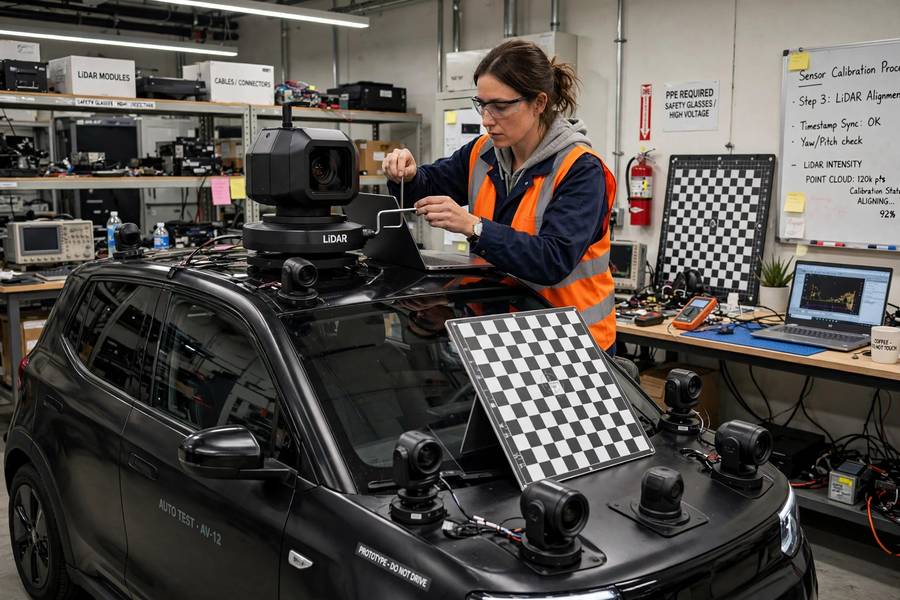
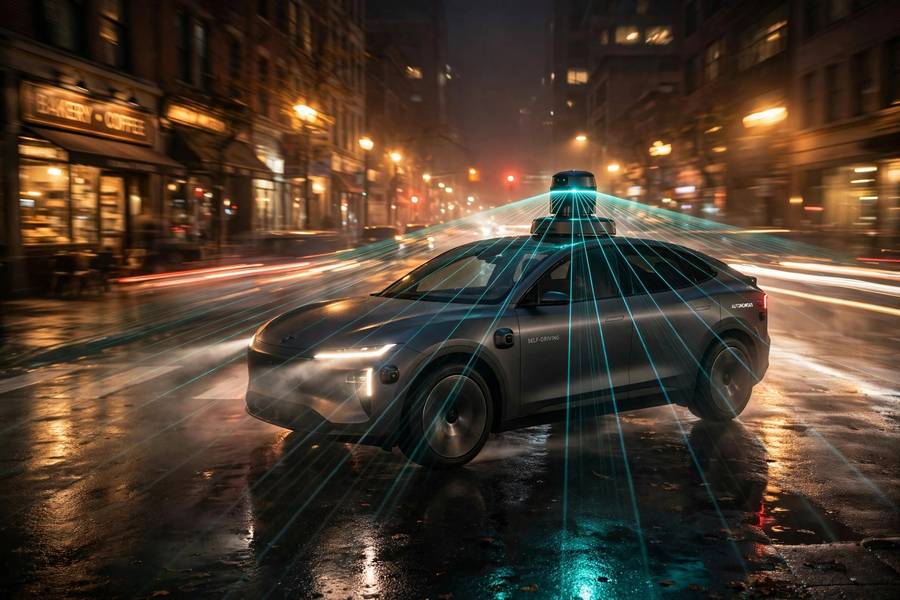
LiDAR fires laser pulses in a sweeping pattern and times their return, building a three-dimensional point cloud of the surroundings — millions of points per second, accurate to centimeters. It is how the car knows the exact shape of the truck ahead, the precise location of the curb, the height of the overpass. Nothing else gives geometry this good.
LiDAR’s enemies are cost and weather. Early units cost tens of thousands of dollars; solid-state designs have brought that down dramatically, but it remains the most expensive sensor on the car. Heavy rain and snow scatter the laser pulses, degrading the point cloud exactly when driving gets hardest. And LiDAR cannot read a traffic light’s color or a sign’s text — geometry without semantics.
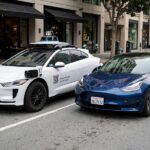
The industry split over LiDAR is the technology’s defining debate. Waymo, Cruise, and most others consider it essential. Tesla insists cameras plus AI are sufficient, arguing that humans drive with vision alone. My read: LiDAR makes the perception problem dramatically easier, at a cost in money and complexity. Whether cameras alone can match it is the multi-billion-dollar question.
Ultrasonic and the Rest
Short-range ultrasonic sensors — the same technology as parking sensors — handle the immediate surroundings: the car in the next parking spot, the bollard behind you. Cheap, reliable, limited to a few meters. Microphones are emerging too, letting cars hear sirens before they see the emergency vehicle. And inertial measurement units (accelerometers and gyroscopes) track the car’s own motion precisely, which matters for both control and localization.
Layer 2: Maps and Localization
Here is the technology layer most people underestimate: the map.
HD maps are not Google Maps. They are centimeter-accurate 3D models of the driving environment: every lane marking, curb, crosswalk, traffic light position, sign, and road edge, surveyed by mapping vehicles with their own LiDAR rigs. Building them is enormously expensive — fleets of mapping cars driving every street, repeatedly, because the world changes: construction zones appear, markings fade, signs move.
Why they matter: the map lets the car know what should be there, so perception only has to detect what changed — the pedestrian, the double-parked truck, the fallen branch. This division of labor is load-bearing: it is far easier to spot deviations from a known map than to understand a street from scratch at 60 km/h.
Localization is the companion technology: figuring out exactly where the car is within the map. GPS gives meters; driving needs centimeters. The car matches live LiDAR and camera data against the HD map — “I see this curb shape and that sign pole, so I must be here” — continuously refining its position. When GPS drops in tunnels or downtown canyons, inertial sensors bridge the gap by dead reckoning.
The strategic implication is huge: today’s leading autonomous systems only work where they have mapped. The map is not an accessory to the technology; it is the technology, half of it. Expanding the mapped territory is the business model disguised as an engineering task.
Layer 3: Compute Hardware
All that sensor data — gigabytes per second — has to be processed in real time, in a car, on automotive power budgets, without melting. This is a serious computing problem.
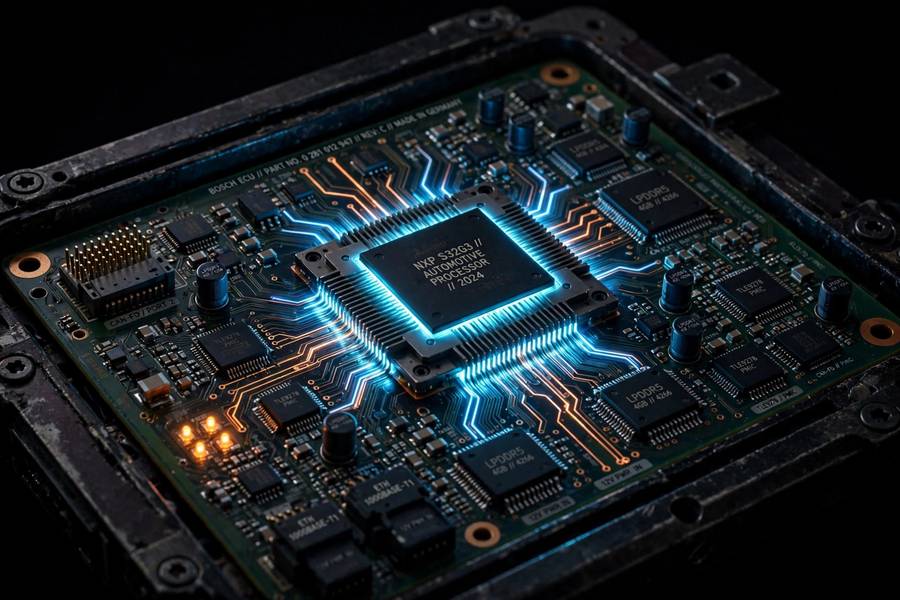
Early autonomous vehicles carried trunks full of server racks. Modern systems use specialized automotive AI chips: NVIDIA’s Drive platform, Tesla’s custom FSD computer, Mobileye’s EyeQ, Qualcomm’s Snapdragon Ride. These chips run neural networks with tera-operations per second of throughput while sipping tens of watts — an efficiency achievement that gets too little credit.
The architecture matters: perception neural networks run on dedicated accelerators, safety-critical control runs on separate redundant processors (so an AI crash cannot take down the brakes), and everything is duplicated. Redundancy is not optional — aviation-grade thinking applied to automobiles. If the main computer fails, a backup must bring the car to a safe stop. There is no “reboot while driving” option.
Over-the-air updates close the loop: the fleet’s software improves continuously, and every car gets better overnight. This is also a risk vector — a bad update can brick a fleet — which is why updates roll out in stages with rollback capability.
Layer 4: The Software Stack
Hardware perceives; software decides. The stack has three main layers, each an AI discipline unto itself.
Perception Software
Raw sensor data becomes understanding. Neural networks perform object detection (bounding boxes around cars, pedestrians, cyclists), semantic segmentation (every pixel labeled: road, sidewalk, vehicle, sky), depth estimation, and tracking (that pedestrian from three frames ago is this pedestrian now, moving left at 1.2 m/s).
Sensor fusion combines the modalities: the camera says “red light,” the LiDAR says “object 40 meters ahead,” the radar says “closing at 15 m/s” — fused into a single coherent world model. Fusion is where redundancy pays off: when the camera is blinded by sun glare, LiDAR and radar keep the world model alive.
Training this software consumes the industry’s scarcest resource: labeled driving data. Millions of miles of sensor recordings, annotated by humans and by automated labeling pipelines, teaching networks what the world looks like. The AI behind it all is deep learning at its most applied — and the data flywheel (more miles, better models, more deployment, more miles) is the core competitive moat.
Prediction and Planning
Modern prediction uses learned models of human behavior — essentially, AI trained on how traffic participants actually move.
Planning then chooses the car’s own trajectory: safe, legal, comfortable, and making progress toward the destination. It must handle negotiation — the four-way stop, the merge, the unprotected left turn — where the right move depends on predicting what others will do in response to what you do. Game theory meets robotics.
The frontier here is end-to-end learning: single neural networks that map sensor input directly to driving output, trained on expert human driving. It is impressively capable and uncomfortably opaque — AI agents that make their own driving decisions raise exactly the explainability questions regulators are starting to ask.
Control Systems
The planned trajectory becomes physical action: steering angle, throttle, brake pressure, updated hundreds of times per second. Control theory — the old, rigorous mathematics of keeping systems stable — handles this layer, and it is the most mature part of the stack. Your current car’s anti-lock brakes and stability control are control systems; autonomy just gives them a smarter boss.
The subtle art is in the tuning: a trajectory that is mathematically safe but jerky will terrify passengers and erode trust. Comfort is a control problem — smooth acceleration profiles, gentle braking, natural-feeling lane positioning. The best autonomous rides feel boring. Boring is the goal.
Connectivity and Fleet Infrastructure
The car does not operate alone. Behind every autonomous vehicle is infrastructure:
- Fleet management systems dispatch vehicles, route them, and monitor their health remotely.
- Remote assistance centers where humans can help stuck vehicles — not by driving them remotely (the latency makes that unsafe), but by confirming “yes, go around that obstacle.”
- Map update pipelines that push road changes to the fleet.
- Data pipelines that upload interesting driving moments (disengagements, near-misses, novel scenarios) to improve the next software version.
This infrastructure is the unglamorous half of the technology — and the half that determines whether a demo becomes a business.
Frequently Asked Questions
Four layers: perception hardware (cameras, radar, LiDAR, ultrasonic sensors), HD maps for centimeter-accurate localization, specialized AI compute chips, and a software stack (perception, prediction, planning, control) — plus fleet infrastructure for dispatch, remote assistance, and updates.
Most companies say yes — LiDAR provides centimeter-accurate 3D geometry that makes perception dramatically easier. Tesla argues cameras plus AI are sufficient since humans drive with vision alone. It is the industry’s biggest technical debate, worth billions either way.
HD maps are centimeter-accurate 3D models of roads — every marking, curb, sign, and light. The car matches live sensor data against the map to pinpoint its position and only needs to detect what changed. This is why robotaxis work in mapped zones but not elsewhere.
Enormous by automotive standards: specialized AI chips delivering tera-operations per second to process gigabytes of sensor data in real time. Safety-critical control runs on separate redundant processors so an AI failure cannot disable the brakes.
The system is designed for graceful degradation: overlapping sensors compensate for each other, and the car slows down and drives more cautiously when uncertain. If the main computer fails, redundant backup systems bring the car to a safe stop.