How to Do Mountain Climbers Correctly: Form Guide

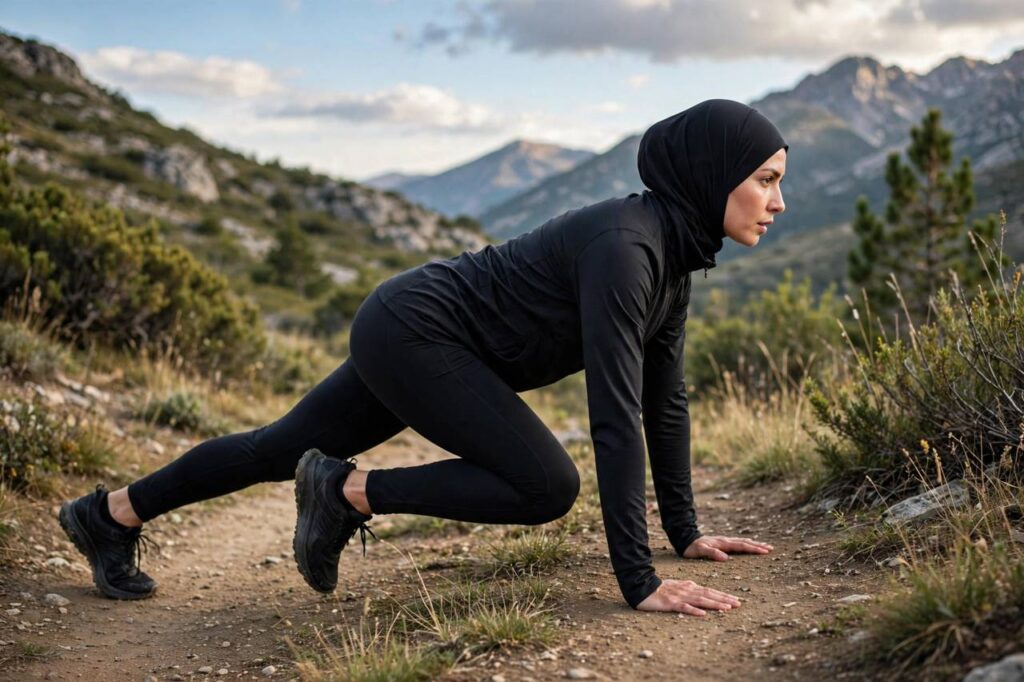
Mountain climbers are the exercise everyone does fast and almost nobody does well. Watch a typical gym: hips bouncing up and down like a pogo stick, backs sagging, knees barely coming forward. It’s cardio theater — lots of motion, minimal training effect. If you want to know how to do mountain climbers correctly, forget speed entirely. The exercise is a moving plank, and the plank part matters more than the moving part.
I’m Jake. I use mountain climbers as a conditioning finisher and a core-builder, but only after clients can hold a solid plank. Here’s the form breakdown, the mistakes that ruin the movement, and the progressions that actually make it useful.
How to Do Mountain Climbers Correctly: The Setup
Start where the exercise starts — with the plank:
- Hands under shoulders. Get into a high plank: hands directly below shoulders, arms straight but not locked.
- Body in one line. Head, hips, and heels form a straight line. Squeeze your glutes and brace your abs like someone’s about to poke your stomach.
- Drive one knee forward. Bring your right knee toward your chest — aim it at your right elbow, keeping the hips level. The foot doesn’t need to touch the floor.
- Switch with control. Extend the right leg back as the left knee drives forward. It’s a smooth exchange, not a jump.
- Keep the hips still. This is the whole exercise. Your hips should barely move. If they’re bouncing, you’re going too fast.
Pace: start at a controlled tempo — about one knee-drive per second. Speed is a progression you earn, not a starting point. If you’re building the base plank strength this movement demands, how to do a plank correctly is the place to start — you shouldn’t be doing mountain climbers until you can hold a clean plank for 45 seconds.
The Hip Problem: Sagging, Piking, and Bouncing
Three hip errors destroy this exercise, and nearly everyone commits at least one:
Sagging. The lower back drops toward the floor, usually from fatigue or weak core bracing. This dumps load into the lumbar spine. Fix: shorten the set, brace harder, and stop the set when the sag starts — grinding through a saggy plank trains nothing but bad patterns.
Piking. The hips shoot up into the air, turning the movement into a weird downward-dog march. Usually a sign the core has checked out and the shoulders are doing everything. Fix: think “long body,” and keep the gaze slightly forward rather than at your feet.
Bouncing. Hips bobbing up and down with each knee drive — the classic speed-demon error. Every bounce is momentum replacing muscle work. Fix: slow down by half. Then slow down again. Film yourself from the side; the video doesn’t lie.
Beginner Modifications That Actually Work
If the full version falls apart after ten seconds, regress instead of suffering through ugly reps:
- Incline mountain climbers: Hands on a bench, box, or sturdy chair. The elevated angle unloads the core and shoulders dramatically while keeping the movement pattern. This is the best starting point for most beginners.
- Slow march: From the plank, drive one knee forward, pause one full second, return, then switch. No rhythm, no momentum — pure control.
- Short sets: Five perfect reps beat twenty sloppy ones. Do multiple short sets with full rest.
Progress by lowering the incline over weeks, then adding speed only when the hips stay dead still at the slower tempo.
Programming: Where Mountain Climbers Belong
Mountain climbers are a hybrid — part core exercise, part conditioning. Program them accordingly:
- Core finisher: 3 sets of 20–30 seconds, slow and controlled, at the end of a workout.
- Conditioning intervals: 30 seconds on, 30 seconds off, 6–8 rounds. Keep form strict even as fatigue builds — the moment hips start bouncing, the interval is over.
- Circuit station: Pair with squats, push-ups, and rows from the bodyweight exercises library for a full no-equipment circuit.
What they aren’t: a primary ab-builder (planks and dead bugs do that better) or a fat-loss magic trick (no single exercise is). They’re a solid supporting player — treat them like one.
Mountain Climbers vs. Other Core Exercises
Where do mountain climbers sit in the core-exercise hierarchy? Honestly assessed:
vs. planks: The plank builds static endurance better — it’s the foundation. Mountain climbers add a dynamic element that trains the core to stabilize while the limbs move, which transfers better to sports. Do planks to build the base, climbers to make it athletic.
vs. dead bugs: Dead bugs train anti-extension (resisting arching) superbly and are gentler on the wrists and shoulders. They’re the better choice for beginners and anyone with upper-body limitations. Mountain climbers are the progression once dead bugs feel easy.
vs. hanging knee raises: Hanging work loads the abs harder through spinal flexion, but requires equipment and grip strength. Mountain climbers win on accessibility — floor space is all you need.
The honest ranking for most people: dead bugs and planks first, mountain climbers second, advanced variations third. Skip the foundation and everything built on it wobbles — literally.
The 4-Week Mountain Climber Progression
Week 1 — Incline slow march: Hands on a bench. Drive one knee forward, pause one second, return, switch. 3 sets of 8 per leg. The only goal is perfect stillness in the hips.
Week 2 — Floor slow march: Same pattern on the floor. 3 sets of 8 per leg. If the hips sag, go back to the incline — there’s no shame in it, and there is injury risk in pushing through.
Week 3 — Controlled tempo: Floor position, smooth continuous motion at about one knee-drive per second. 3 sets of 20 seconds. Film yourself from the side once — what you feel and what’s happening are often different.
Week 4 — Working sets: 3 sets of 30 seconds at a challenging-but-controlled pace. From here, progress by adding 5 seconds per set weekly, or move to the variations below.
This progression looks slow. It’s supposed to be. Four weeks of patient form work builds a movement you’ll use safely for years; four weeks of sloppy speed builds nothing but bad habits.
Mountain Climber Variations, Ranked by Usefulness
- Cross-body mountain climbers: Drive the knee toward the opposite elbow. Adds oblique engagement. Genuinely useful — my first recommended variation.
- Wide mountain climbers: Feet land wide outside the hands. Opens the hips and adds a groin stretch component. Good for field-sport athletes.
- Spiderman climbers: Slow, deliberate, knee to outside of elbow with a pause. More mobility than conditioning — excellent as a warm-up.
- Elevated-feet climbers: Feet on a bench, hands on floor. Dramatically harder on the shoulders and core. Advanced only.
- Weighted vest climbers: The straightforward overload option once bodyweight sets exceed 45 seconds with perfect form.
Skip the circus variations (climbers on medicine balls, etc.) until the basics are bulletproof. Fancy instability plus fatigue is how wrists get hurt.
Programming Mistakes That Waste the Exercise
Using climbers as a heavy warm-up. A few slow, controlled reps are a fine warm-up. But blasting 60 seconds of sloppy climbers before lifting just fatigues the core you need for your main lifts. Warm up with the slow-march version; save the hard sets for the end.
Chasing the clock instead of the form. Timed sets are fine, but the moment your hips start bouncing, the set’s training value drops to near zero while injury risk climbs. End the set when form breaks — that’s the discipline the exercise is secretly teaching.
Doing them daily at max effort. The shoulders and wrists accumulate stress from daily high-volume climbers. Two to three quality sessions per week is plenty; daily light technique practice is fine, daily burnouts are not.
Neglecting the rest of the core. Mountain climbers are one tool. A complete core program also needs anti-rotation work, loaded carries, and direct trunk work. One exercise is never the whole program.
Wrist and Shoulder Considerations
Mountain climbers load the wrists and shoulders isometrically while the legs move — a combination that bothers some people. If your wrists ache: warm them up properly (wrist circles, gentle stretches), consider parallettes or dumbbell handles to keep them neutral, and keep sets short. Persistent wrist pain is a sign to switch to forearm-based core work instead.
For shoulders: actively push the floor away (protract the shoulder blades slightly) rather than hanging on the joints. If you feel pinching in the front of the shoulder, stop — that’s impingement territory, and no conditioning exercise is worth it. The incline regression unloads both wrists and shoulders significantly, which is another reason it’s the right starting point.

FAQ
What muscles do mountain climbers work?
The core (rectus abdominis, obliques, transverse abdominis) as the primary stabilizer, plus the hip flexors driving the knees, and the shoulders, chest, and quads supporting the plank position. It’s a full-body movement anchored by the midsection.
Are mountain climbers bad for your back?
They can be if your hips sag — that position loads the lumbar spine. With a braced, neutral spine and level hips, they’re safe for most people. Stop if you feel sharp lower-back pain.
How fast should mountain climbers be?
As fast as you can go while keeping your hips perfectly still. For most people learning the movement, that’s much slower than they expect — about one knee drive per second to start.
Can beginners do mountain climbers?
Yes, with regressions: incline versions with hands on a bench, slow-march tempo, and short sets. Master the plank first — it’s the prerequisite for everything in this movement.
Do mountain climbers burn belly fat?
No exercise targets fat in a specific area — that’s the spot-reduction myth. Mountain climbers burn calories and build core strength; overall fat loss comes from sustained calorie balance and consistent training.
How many mountain climbers should I do?
Start with 3 sets of 20–30 seconds at a controlled pace. As form solidifies, extend to 45-second sets or add rounds. Quality reps with still hips always beat higher counts with bouncing hips.
Slow them down, freeze the hips, and earn your speed. Done right, the mountain climber stops being cardio theater and becomes one of the most honest core exercises you can do anywhere, no equipment needed.