World Cup Format Explained: The Complete Tournament Guide

When I explain the World Cup format to someone new, I start with this: 48 teams, one month, one trophy, and a format designed so that every single match matters. Then they ask about the groups, the third-placed teams, and what happens in ties, and that is where this guide comes in.
This is the complete format breakdown for the modern 48-team World Cup: the group stage, how teams advance, the knockout bracket, and every rule that decides who goes home. It pairs perfectly with our in-depth guide to how the World Cup works.
The Big Picture: 48 Teams, 104 Matches, One Month
The expanded World Cup features 48 teams playing 104 matches over roughly five to six weeks. Twelve groups of four teams each play a round-robin group stage, then 32 teams advance to a single-elimination knockout bracket that ends with the final.
Compare that to the old 32-team format with 64 matches, and you see the scale of the change. More teams means more nations at the party, more matches for fans, and a longer, more grueling test for the players. As a coach, I respect the expansion but I never underestimate what those extra games do to tired legs.
The Group Stage: Points and Tables
Each group has four teams, and every team plays the other three once. A win earns three points, a draw earns one, and a loss earns zero. After three rounds of matches, the group table decides who advances: the top two in each group go through automatically.
The points system rewards attacking football because wins are worth three times a draw. I drill this into players: in a short group stage, one win can carry you. Teams that play for draws usually regret it. Three points for a win is the engine that keeps group-stage football aggressive.
The Best Third-Placed Teams: The Format’s Twist
Here is the part that confuses newcomers. Beyond the 24 automatic qualifiers (top two from each of 12 groups), the eight best third-placed teams also advance, making 32 knockout teams. Third-place finishers are ranked across groups by points, then goal difference, then goals scored.
This rule keeps the final group games alive. A team sitting third with four points is still dreaming, and their fans are calculating scenarios. I actually like it: it means fewer dead matches and more drama on the last matchday. But it also means goal difference matters enormously, so running up the score is never just showboating.
Tiebreakers: Separating Teams Level on Points
When teams finish level on points, FIFA applies tiebreakers in order: goal difference across all group matches, then goals scored, then fair play points based on yellow and red cards, and finally drawing of lots if everything is still equal. Head-to-head is not the first tiebreaker in the group stage.
Fair play points are the sneaky one: yellow cards cost points, reds cost more. I have seen teams advance on fair play, and I use it as a coaching lesson every cycle. Discipline is not just about avoiding suspensions; in a tight group, your card count can literally be the difference between the knockouts and the airport.
The Knockout Bracket: Win or Go Home
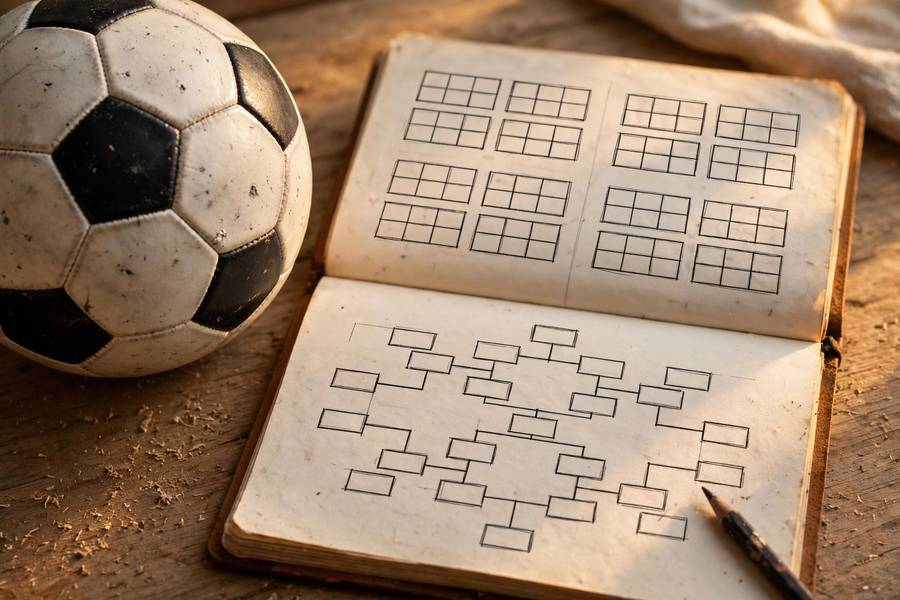
Thirty-two teams enter a fixed single-elimination bracket: round of 32, round of 16, quarterfinals, semifinals, and the final, plus a third-place playoff. The bracket is set before the tournament, so teams can trace their potential path from the draw onward.
Knockout matches cannot end in draws. Level after 90 minutes means 30 minutes of extra time, then penalties. Teams get a sixth substitution in extra time. The football changes here: caution rises, set pieces decide games, and the fittest squads prevail. Tournament conditioning, built on months of strength training and core work, is what separates survivors from casualties.
Scheduling: How the Month Is Organized
The tournament runs in phases. The group stage takes about two weeks with multiple matches per day. Then a short breather before the round of 32, and the knockouts play out over roughly two more weeks, with rest days built in. The final is the last act, preceded by the third-place playoff.
Rest days between rounds are not equal, and coaches track them obsessively. A team that plays extra time and penalties gets fewer recovery hours before its next match. I plan tournament squads around this reality: depth is not a luxury in a month-long tournament, it is survival gear.
How the Format Changed Over Time
The format has grown with the tournament. It started with 13 teams in 1930, settled at 16, then 24 in 1982, then 32 from 1998 to 2022, and now 48. Each expansion changed the tactics: more groups, new advancement rules, and longer tournaments.
The 48-team era is still young, and coaches are still learning it. The round of 32 is new territory, and the eight best third-placed teams create scenarios the old format never had. I find this exciting: the strategy books are being rewritten in real time, and every tournament teaches us something new about the format.
Format Cheat Sheet: The Numbers to Remember
Let me give you the pocket version I hand to new fans. 48 teams. 12 groups of 4. 3 points for a win. Top 2 advance plus 8 best thirds. 32-team knockout bracket. No draws in knockouts: extra time then penalties. 5 subs, plus a 6th in extra time. One trophy.
Memorize those numbers and you will follow any World Cup like a seasoned fan. And when someone at the watch party asks a tricky question about tiebreakers or third-placed teams, you will have the answer before the commentators finish the sentence. For the deeper story behind these rules, our complete guide to how the World Cup works has you covered.
Format Comparisons: World Cup vs Euros vs Copa America
The World Cup’s 48-team format is the biggest, but the continental championships do things differently. The Euros run 24 teams in six groups with a round of 16, a format many fans consider the sweet spot: big enough for romance, tight enough that every group game matters. The Copa America has experimented with various sizes around 16 teams, often inviting guests.
The key difference is depth versus intensity. The World Cup’s scale means more mismatches in the group stage but unmatched global drama. The Euros’ smaller field means a higher average quality per match. I enjoy both, but I tell new fans the Euros are the connoisseur’s tournament while the World Cup is the people’s festival.
Qualifying reflects the same contrast. European qualifying is a brutal group grind among near-equals; South America’s is a marathon league; other regions mix formats. The World Cup format has to accommodate all these paths fairly, which is why its structure looks complex. It is the only tournament that must be fair to the entire planet at once.
Criticisms of the 48-Team Format
The expansion was not universally loved, and the criticisms deserve a fair hearing. More teams means more group-stage mismatches, and purists argue the old 32-team format had a higher average quality. There is also the calendar cost: 104 matches demand more stadiums, more travel, and more days from players’ summers.
The third-place advancement rule draws particular fire. Critics say it lets mediocre teams through and cheapens the group stage. I understand the argument, but I have also watched the drama it creates on final matchdays, and I think the trade is worth it. More teams alive longer means more meaningful football, not less.
My own view as a coach: the expansion is good for the sport’s global growth, and the format problems are solvable. The round of 32 adds a genuinely exciting knockout round, and the best teams still rise. Formats are frameworks; greatness fills whatever frame you give it. The 48-team era will produce its own classics, just as every era has.
48 teams compete in the expanded format, organized into 12 groups of four. 104 matches are played across the tournament.
The top two teams in each group advance automatically, plus the eight best third-placed teams across all groups, making 32 knockout teams.
Tiebreakers apply in order: goal difference, goals scored, fair play points from cards, and finally drawing of lots.
No. Tied knockout matches go to 30 minutes of extra time, then a penalty shootout. Teams get an extra sixth substitution in extra time.
104 matches in the 48-team format: 72 group-stage games plus 32 knockout ties including the final and third-place playoff.