How to Write Stand-Up Comedy: The Complete Pipeline


Writing stand-up is two crafts disguised as one: writing jokes that work on paper, and writing jokes that work in a room, at 11pm, for strangers who have been drinking. I learned the difference during my first year, when material that killed among friends died horribly on stage, and I could not figure out why. The answer is that stand-up is not written, it is rewritten, in front of audiences, dozens of times, until the words disappear and only the laughs remain. This guide covers the complete pipeline: generating raw material, structuring a tight five minutes, finding your stage persona, the stagecraft that separates pros from open-micers, and how to actually get the stage time that makes it all work. The joke mechanics underneath it all are covered in how comedians write jokes, and my setup-punchline deep dive pairs directly with this guide.
The Stand-Up Skill Stack
Stand-up demands five skills, and weaknesses in any one cap the others. Writing: generating premises and structuring jokes. Editing: cutting ruthlessly, which most beginners never learn. Performing: voice, timing, physicality, the delivery system for the writing. Persona: a consistent stage identity the audience can bond with. Resilience: bombing without quitting, the skill nobody lists but everybody needs. Beginners obsess over writing and ignore the rest; professionals will tell you performing and persona matter at least as much. A mediocre joke delivered with perfect timing by a compelling persona beats a brilliant joke mumbled by a stranger. Assess yourself honestly across all five, train the weakest first, and retest quarterly. The stack is the career.
Generating Material: Volume Before Quality
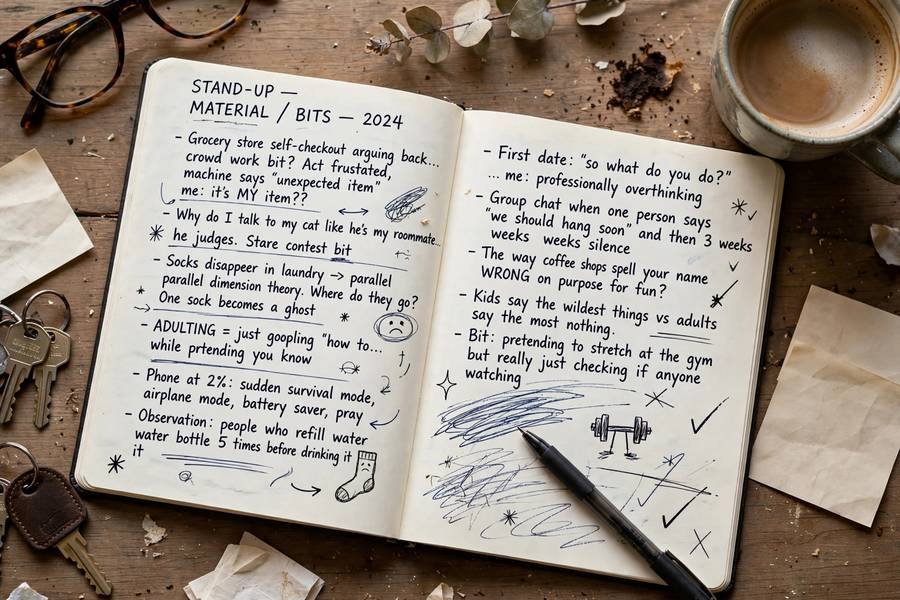
Write every day, and separate generation from judgment. The practice: 30 minutes daily, notebook or doc, premises only, no editing allowed. Aim for 10 premises a day; 9 will be garbage, and that is the correct ratio. Professionals write hundreds of premises to find dozens of jokes to keep a handful of bits. The math is unforgiving and wonderful: volume is the only reliable path to quality, because you cannot think your way to funny, you can only write your way there. Keep an “everything” file and never throw anything away; premises that seem dead often resurrect months later when your skills catch up to the idea. And steal like an artist from life, not from comics: your diary is the only truly original source material in existence.
Structuring a 5-Minute Set
A five-minute set is roughly 600-750 spoken words, which surprises everyone; it is shorter than you think, which is why tightness matters. Structure it: opener, your second-strongest joke, to grab the room fast. Middle: two to three medium bits, arranged so energy rises. Closer: your absolute strongest joke, the one that would work on strangers at midnight. Never open with crowd work or long stories; the audience decides in 30 seconds whether you are worth their attention, and you earn it with a laugh, not with charm. Transitions between bits should be invisible or funny; “speaking of which” is the mark of an amateur. Time every set with a stopwatch in practice; going over your time at open mics is the fastest way to stop getting booked.

Your Persona: Who Are You on Stage?
Your persona is the audience’s answer to “who is this person and why should I listen?” It is a heightened version of you, not a character, with one or two traits turned up: the neurotic overthinker, the cheerful cynic, the bewildered everyman. Find it by noticing what audiences already respond to; the laughs cluster around a version of you, and that cluster is your persona emerging. Then write to it deliberately: every joke should sound like it could only come from your stage self. The classic beginner error is doing impressions of favorite comics instead of developing a self; audiences smell imitation instantly. Record yourself and ask: would a stranger describe me in three words? If yes, you have a persona. If no, keep performing until one crystallizes, because it always does with stage time.
Stagecraft: The Half of Stand-Up Nobody Teaches
Stagecraft is the invisible half. Microphone technique: keep it a fist from your chin, never wander it around; every inch of drift costs the back row words. Stance: planted, still, owning the space; pacing reads as nervousness. Eye contact: pick three audience zones and rotate slowly; never stare at the floor or the back wall. Pauses: the professional’s secret weapon, a full two-second pause before a punchline feels eternal on stage and perfect in the room. Tagging: after a big laugh, add one more quick line on the same premise while the goodwill lasts; tags are free laughs. Handling silence: when a joke dies, do not apologize or explain; move to the next joke with total confidence, because the audience takes its cues from your reaction, not from the joke. These mechanics are learnable, practicable, and they multiply the value of every word you write. best comedy movies
Getting Stage Time and Improving
Stage time is the only real teacher, so get it relentlessly. Open mics: sign up weekly, treat them as laboratories, bring maximum three new bits per set. Bringer shows: do them sparingly early on, they are pay-to-play and the audiences are friends of comics, not real crowds. After a year of consistent mics and a solid 10 minutes, start asking for guest spots; after a solid 20, you can headline small rooms. Record every set, review within 48 hours, and keep a spreadsheet: joke, date, laugh rating 1-5. Promote jokes that average 4+ over five performances; rewrite 3s; retire 1s and 2s after honest rewrites fail. The spreadsheet feels unromantic until you realize it is the difference between comics who improve and comics who do the same set for five years. Do the work, track the work, and the career compounds.
Write daily, structure tightly, find your persona, master the stage, and chase stage time like rent is due. That is stand-up, and there are no shortcuts, only reps.
Writing for Your First Year vs Your Fifth
Year one writing is about volume and stage time: generate constantly, test everything, and do not get attached to any bit. Your taste exceeds your skill, which is painful but normal; the only cure is reps. Year two to three is about editing: you have material that works, now tighten it ruthlessly, cutting 30 percent of words while keeping the laughs. Year four to five is about voice: the jokes start sounding like you instead of like jokes, and you begin writing longer bits with callbacks and themes. Each phase has its trap: year one hoards untested material, year three over-edits until bits feel mechanical, year five coasts on persona instead of writing. Know your phase, do its work, and trust that the next phase’s problems are better problems.
The Business Side Nobody Warns You About
Comedy has a business whether you like it or not. Early on: never pay to perform beyond reasonable bringer-show limits, always confirm details in writing, and treat every booker like a future employer, because they are. Record clean 5-minute and 20-minute sets early; you will need them for submissions forever. Social media clips are the modern audition tape: post your best 60 seconds regularly, and one viral clip can do more for your career than a year of mics. But never let content creation replace stage time; the algorithm rewards consistency, the craft rewards reps, and only one of them makes you funny. Protect your material legally by documenting creation dates, though in practice the community polices theft socially. The business rewards professionals: show up on time, do your time exactly, do not trash other comics publicly. Reputation compounds like interest. what is improv comedy

Write 30 minutes daily, premises only, no editing: aim for 10 premises a day and accept that 9 will be garbage. Volume is the only reliable path to quality. Keep an ‘everything’ file and mine your own life, the only truly original source.
Opener (second-strongest joke) to grab the room, two to three medium bits with rising energy in the middle, closer (strongest joke) to finish. Never open with crowd work; the audience judges you in 30 seconds.
A heightened version of yourself with one or two traits turned up, that the audience can bond with. Find it by noticing which version of you gets laughs, then write deliberately to it. Never imitate favorite comics.
Enormous: mic technique, stillness, eye contact, pauses before punchlines, tagging big laughs, and never apologizing for dead jokes multiply the value of every written word. It is learnable and practicable.
Weekly open mics as laboratories, then guest spots after a solid 10 minutes (about a year), headlining small rooms after a solid 20. Record every set and track joke performance in a spreadsheet to guide rewrites.
Most comics need 2-3 years of consistent stage time to develop a reliable 20 minutes, and 5+ for a real hour. There are no shortcuts, only reps; the spreadsheet-and-rewrite loop is what separates improvers from stagnators.
Roughly 8-12 solid jokes, since a 5-minute set is only 600-750 spoken words. Beginners always overestimate; time yourself with a stopwatch, because going over your slot is the fastest way to stop getting booked.
Memorize structure and punchlines, not every word. Word-perfect memorization sounds robotic; knowing your beats cold while letting the connective tissue breathe sounds confident and alive. The audience should never see the writing.