7 Best Rear Delt Exercises for Posture, Width, and Healthy Shoulders


Rear delts are the most neglected muscle in the upper body, and it is not close. Walk into any commercial gym and count the people doing lateral raises versus the people doing rear-delt work. You will count for a while on the first one. The rear deltoid sits at the back of the shoulder, and when it is underdeveloped you get rounded shoulders, a flat look from behind, and an upper back that cannot hold position under heavy loads. I have fixed more “bad posture” with rear-delt training than with all the posture-corrector gadgets ever sold.
The good news: rear delts respond fast. They are a small muscle that most people have barely trained, so even modest, consistent work produces visible changes in eight to twelve weeks. Here are the best rear delt exercises I actually program for clients, with the form details that separate a real rear-delt rep from a back exercise in disguise.
In this guide:
- Why Rear Delts Get Ignored (And Why That Hurts)
- The 7 Best Rear Delt Exercises
- Programming: Sets, Reps, and Frequency
- Form Cues That Keep It on the Rear Delt
- Mistakes That Turn It Into a Back Exercise
- Frequently Asked Questions
Why Rear Delts Get Ignored (And Why That Hurts)
Three reasons rear delts get skipped. First, you cannot see them in the mirror, and most training decisions are made in the mirror. Second, they are small and unglamorous; nobody brags about their rear-delt fly numbers. Third, people assume rows cover them. Rows do involve the rear delts, but as assistants, not prime movers. The lats and mid-back dominate every rowing variation, and the rear delt gets leftovers.
The cost of skipping them shows up in three places. Aesthetically, your shoulders look narrow and incomplete from behind and from the side. Posturally, weak rear delts let the shoulders roll forward, especially if you press a lot. And for performance, the rear delt is a key stabilizer of the shoulder joint; underdeveloped rear delts are one reason pressing strength stalls and shoulders get cranky. If your bench has been stuck and your shoulders ache, the answer is rarely “press more.” It is usually “pull more, especially back here.”
For the complete shoulder picture, start with our best shoulder exercises overview to see how rear-delt work fits alongside pressing and side-delt training.
The 7 Best Rear Delt Exercises
1. Face Pull
The face pull is the king of rear-delt exercises and the one I program first for almost everyone. Set a cable at eye level or slightly above, grab the rope with a neutral grip, and pull the rope toward your forehead, splitting it apart so your knuckles finish beside your ears. Externally rotate at the end, like you are showing off your biceps. That rotation is what separates a face pull from a generic row and hammers the rear delts and external rotators together.
Use moderate weight for 12 to 15 reps. This is not a max-effort lift. If you are heaving the stack and leaning back, the rear delts checked out three reps ago. Light, controlled, and felt in the back of the shoulder: that is the standard.
2. Reverse Pec Deck (Machine Reverse Fly)
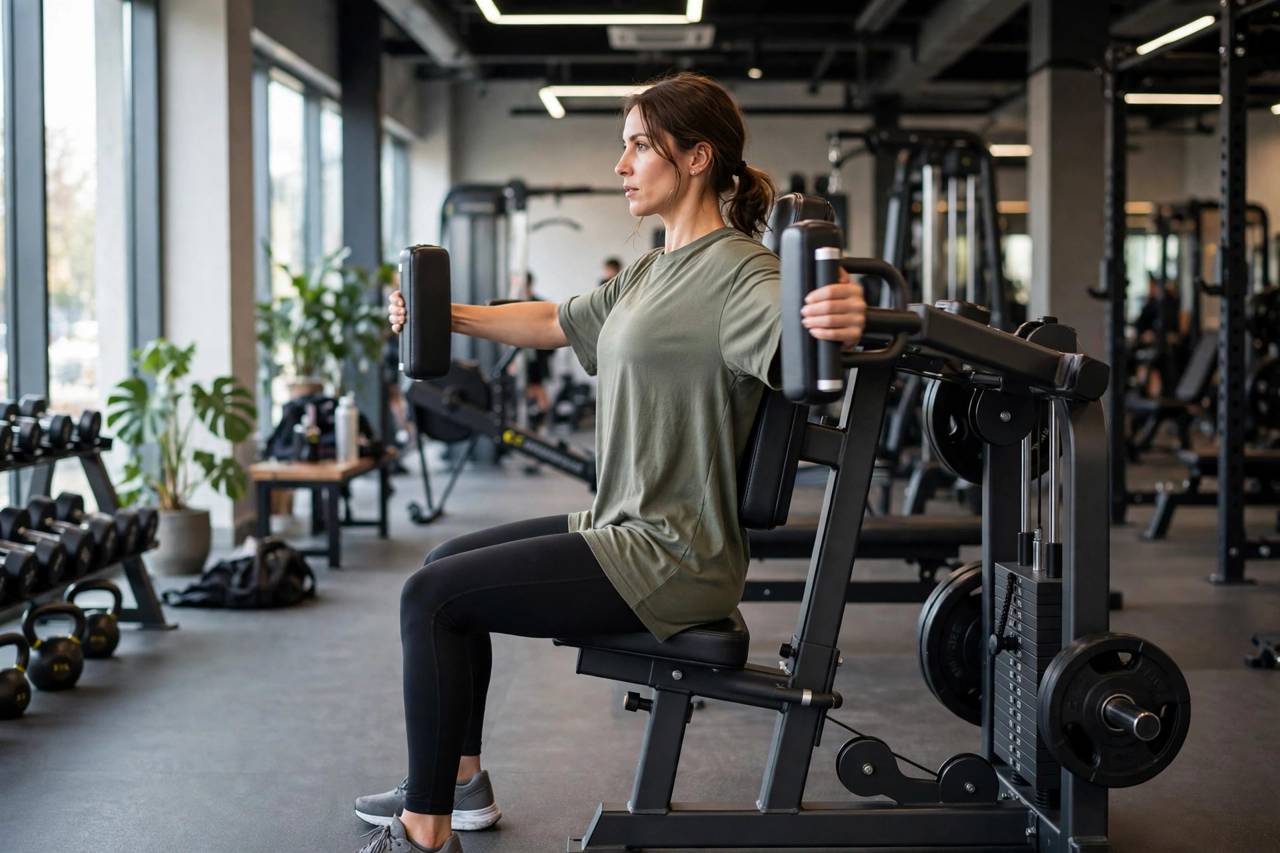
Sit facing the machine, grab the handles with arms nearly straight, and open your arms wide like you are hugging the room behind you. The machine gives you a fixed path, which is actually an advantage here: it stops your bigger back muscles from taking over. Keep the chest on the pad, stop when your arms are in line with your torso (not behind it), and squeeze for a beat. Three to four sets of 12 to 15 reps. This is the easiest rear-delt exercise to learn, which makes it perfect for beginners.
3. Bent-Over Dumbbell Reverse Fly
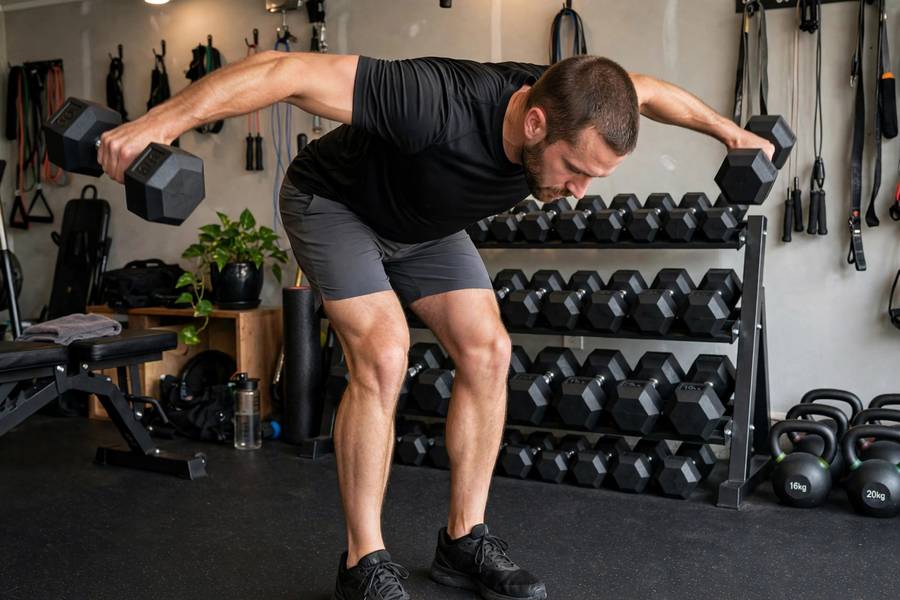
Hinge at the hips until your torso is near parallel to the floor, let dumbbells hang below your chest, and raise them out to the sides with a soft elbow bend. The cue that matters: lead with your elbows, not your hands. Think about pushing your elbows toward the ceiling behind you. Stop when your arms reach torso level. Going higher just recruits the traps.
The bent-over position is the weak point of this exercise. If your lower back is screaming, you are bent over too far or using too much weight. Chest-supported versions (lying face-down on an incline bench) fix this completely and let you focus on the delts.
4. Cable Rear-Delt Fly
Set two cables at shoulder height, cross them over (left hand grabs right cable), step back, and perform a wide fly motion. The cable keeps constant tension through the whole range, which dumbbells cannot do; dumbbells go nearly slack at the top of a reverse fly. That constant tension is why cables are arguably superior for rear delts. Keep the movement wide and controlled, 3 sets of 12 to 15 per side setup.
5. Rear-Delt Row (Wide-Grip, Elbows Out)
Take a wide grip on a barbell or dumbbells, row with your elbows flared out to about 70 to 90 degrees from your torso, and pull toward your lower chest. The flared elbow angle shifts emphasis from the lats to the rear delts and upper back. This is the heaviest rear-delt movement on this list, so it fits early in a session: 4 sets of 8 to 10. Keep the torso stable. If you are bouncing the weight up, drop it down.
6. Band Pull-Apart
Hold a resistance band at shoulder height with straight arms and pull it apart until the band touches your chest. Simple, brutal, effective. The band’s increasing resistance matches the rear delt’s strength curve beautifully: hardest where you are strongest. Do 3 sets of 20 to 25 as a warm-up, a finisher, or scattered through the day at your desk. I have clients do 100 pull-aparts a day spread across the workday, and their posture changes within a month.
7. Chest-Supported Rear-Delt Row
Lie face-down on an incline bench set to about 30 degrees, let dumbbells hang, and row with elbows flared wide. The bench removes momentum and lower-back involvement entirely, so the rear delts and upper back do all the work. This is the strictest option on the list and my favorite for lifters who cheat everything else. Three sets of 10 to 12, slow and deliberate.
Programming: Sets, Reps, and Frequency
Rear delts are small, recover quickly, and respond best to moderate weight and higher reps. Here is how I slot them in:
- Volume: 8 to 14 direct sets per week for most lifters. Because the muscle is small and usually undertrained, start at the low end.
- Reps: 12 to 20 for isolation moves (flys, pull-aparts), 8 to 12 for heavier rows.
- Frequency: 2 to 3 times per week. Rear delts handle frequency well since the loads are light.
- Placement: After main pressing or pulling work, or as part of a warm-up (band pull-aparts). Never before heavy pressing; fatigued stabilizers and heavy bench are a bad combination.
A simple weekly template: face pulls 3×15 on push day, chest-supported reverse flys 3×12 on pull day, and 100 band pull-aparts spread across the week. That is roughly 10 sets plus the daily volume, and it is enough to transform most people’s rear delts in two to three months.
Rear-delt work pairs naturally with a full back program. Our best back workouts guide shows where to place these movements in a pull day, and if you only own dumbbells, the best dumbbell exercises list covers rear-delt options that need nothing else.

Form Cues That Keep It on the Rear Delt
The rear delt is easy to lose to bigger muscles. Three cues keep the work where it belongs:
“Elbows wide, not tucked.” Tucked elbows make any row a lat exercise. Flare the elbows out to at least 45 degrees, ideally 70 to 90, and the rear delt becomes the prime mover.
“Stop at torso level.” On every fly variation, the effective range ends when your arms align with your torso. Going further back shifts the load to the traps and rhomboids and unloads the delt.
“Light enough to feel.” If you cannot feel the back of your shoulder working, the weight is too heavy and your traps are doing the job. Rear-delt training is one of the few places where checking your ego genuinely builds more muscle. Drop the weight, slow the rep, and chase the burn in the right spot.
Mistakes That Turn It Into a Back Exercise
Shrugging. If your shoulders are up by your ears during reverse flys, your upper traps have hijacked the movement. Depress the shoulder blades (pull them down toward your back pockets) before each set and keep them there.
Using the whole body. Bent-over reverse flys done with a standing hip thrust on every rep are not rear-delt training. They are a weird dance. Brace, stay still, and move only the arms.
Skipping them because “rows are enough.” Rows are great, and they do involve the rear delt. But involvement is not emphasis. If your rear delts are a weak point, they need direct work, the same way weak arms need curls even though rows involve the biceps. Our compound vs isolation exercises breakdown explains exactly when indirect work stops being enough.
Training them once a month. Rear delts need consistency more than intensity. Two light sessions a week beats one heroic session followed by three weeks of forgetting they exist.
The face pull. It directly targets the rear delts while also training external rotation, which improves shoulder health. Use moderate weight for 12 to 15 controlled reps, pulling the rope to your forehead and rotating your knuckles back. The reverse pec deck machine is the best beginner alternative.
Two to three times per week. Rear delts are small, recover fast, and respond well to frequency with light to moderate loads. Aim for 8 to 14 direct sets per week total, split across sessions, with reps mostly in the 12 to 20 range.
Not fully. Rows involve the rear delts as assistants, but the lats and mid-back do most of the work. If your rear delts are underdeveloped, you need direct work with flared elbows and a wide arm path, like face pulls, reverse flys, or rear-delt rows. Indirect work maintains; direct work builds.
Usually the weight is too heavy and the traps or lats are taking over. Drop the weight significantly, flare your elbows wide, stop the rep at torso level, and slow the tempo to 2 to 3 seconds per direction. You should feel the work in the back of the shoulder, not in the neck or upper back.
They help significantly. Rounded shoulders usually come from overdeveloped pressing muscles and weak rear delts and upper-back muscles. Consistent rear-delt training (face pulls, band pull-aparts) plus reducing excessive pressing volume pulls the shoulders back into better alignment over several weeks.