Selling a Business With a Broker vs Without: Honest Comparison


Should you pay a broker 10% to sell your business, or keep the commission and do it yourself? It’s one of the highest-stakes decisions in the sale process — a 10% commission on a $500K sale is $50,000. That’s real money. But the wrong choice can cost you far more than the commission saves.
I’ve seen both paths succeed and both fail. The answer isn’t ideological — it’s situational. Here’s the honest math, the real trade-offs, and a framework for deciding which path fits YOUR sale.
The Commission Math: What 10% Really Costs
Standard broker commissions: 8–12% for businesses under $1M, 5–8% for $1M–$5M. On a $400K sale at 10%, that’s $40,000. It feels enormous — until you compare it against the alternatives.
The broker’s value claim: they sell for 15–25% more than FSBO sellers (through competitive bidding, professional marketing, and negotiation experience) and close faster (6–9 months vs. 12–18 for DIY). If true, the math favors brokers: $400K × 1.2 = $480K minus $48K commission = $432K net, versus $400K FSBO. You net $32K MORE with the broker.
Is the premium real? Industry data suggests brokered sales do close higher — but the studies are broker-funded, so treat them skeptically. My observation: skilled brokers earn their fee on competitive dynamics alone (multiple bidders push prices up 10–20%), while weak brokers are an expensive listing service. The commission question is really a broker-quality question.
What Brokers Actually Do for the Fee
Beyond ‘finding buyers’: professional valuation and pricing strategy, confidential marketing (teasers, CIMs, listing platforms), buyer screening (separating qualified buyers from tourists — this alone saves months), managing showings and information flow, negotiating offers and terms, coordinating diligence, and pushing the deal to closing through the inevitable friction.
The invisible work: brokers manage the emotional rollercoaster. Sellers get offended by low offers, panic during diligence, and fatigue during month seven. A good broker absorbs this — keeping you rational, keeping buyers engaged, keeping the process moving. Owners selling FSBO underestimate how emotionally draining the process is.
What they DON’T do: guarantee a sale, create buyers from nothing (if your business isn’t sellable, no broker fixes that), or do your preparation (clean books, fixed operations — that’s on you, and it should be done before engaging anyone).
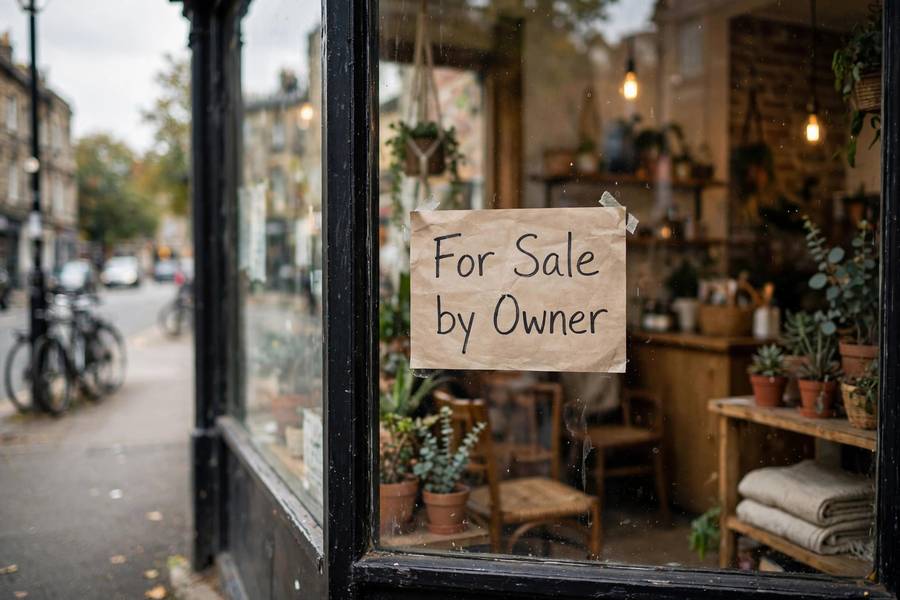
The FSBO Case: When DIY Makes Sense
FSBO (For Sale By Owner) works when: you have an identified buyer or strong buyer network (the hardest part is solved), your business is simple and clean (straightforward financials, no complications), you have transaction experience or excellent advisors, the deal is small (under $150K — commissions consume too much), or confidentiality demands minimal exposure.
The FSBO advantages are real: save $30K–$80K in commissions, control the timeline and messaging, move faster with a ready buyer (no broker onboarding, no marketing ramp), and keep the process personal (some buyers prefer dealing directly with owners).
But the costs are real too: your time (100–200 hours over 6–12 months — what’s your time worth?), pricing risk (no market test means you might leave 15% on the table), negotiation disadvantage (the buyer’s advisor negotiates deals daily; you do it once a decade), and process management (diligence coordination, document management, closing logistics — all on you).
For the DIY process done right, my selling guide walks through each phase you’d manage yourself.
Head-to-Head: The Real Comparison
Sale price: Brokered sales typically achieve 10–20% higher prices through competitive bidding — but only with good brokers. A bad broker who overprices and lets the listing go stale achieves worse than FSBO. Advantage: broker (if skilled).
Time to close: Brokers average 6–9 months; FSBO with an identified buyer can close in 2–4 months; FSBO searching for buyers often takes 12–24 months. Advantage: depends — broker for market sales, FSBO for identified-buyer sales.
Confidentiality: Brokers have systems (blind listings, staged disclosure); FSBO sellers often leak through informal outreach. Advantage: broker. Control: FSBO sellers decide everything; brokered sellers delegate. Advantage: FSBO (if you want control).
Net proceeds: the only comparison that matters. Model both: (Brokered price × 0.90) vs. (FSBO price). If you believe the broker adds 15% to price, brokered wins. If you have a buyer at fair price already, FSBO wins. Do YOUR math with YOUR situation — not industry averages.
The Hybrid Approach
You don’t have to choose purely. Hybrid options: Broker for marketing, you for closing — some brokers offer reduced commissions (4–6%) for listing and buyer-sourcing only, with you handling negotiation and closing. Attorney-led FSBO — hire a transaction attorney hourly ($5K–$15K total) for the legal mechanics while you manage buyer relationships. This captures most of the commission savings with professional legal protection.
Broker with carved-out buyers — list with a broker but exclude 2–3 specific buyers you’ve already identified (no commission if they buy). Get this in writing before signing. Limited-scope broker engagement — hire a broker for valuation and marketing materials only ($5K–$10K flat fee), then sell FSBO with professional presentation.
These hybrids often deliver the best of both: professional positioning and buyer reach, without the full commission. But they require you to be honest about what you can handle — the hybrid fails when sellers overestimate their capacity and underestimate the process.

Red Flags: When a Broker Isn’t Worth It
Don’t hire a broker who: demands large upfront fees on a small deal (they profit from listings, not closings), guarantees a sale price (impossible — it’s a market), has no recent closings in your industry/size range (you’re their learning curve), pressures you into 12+ month exclusive listings (6–9 months with performance clauses is standard), or overprices to win your listing (the flattering valuation that goes stale).
And don’t hire ANY broker when: you have a committed buyer at a fair price (paying 10% for an introduction you don’t need), the business isn’t sellable yet (fix it first — a broker can’t sell what buyers won’t buy), or you can’t afford to wait 6+ months (brokers need time; if you need speed, price aggressively FSBO or accept the discount).
The meta-rule: a broker is a force multiplier on a sellable business, not a miracle worker on an unsellable one. Get the business ready first — then decide if you need the multiplier. My broker guide details how to choose if you go that route.
Making the Decision: A Framework
Answer these five questions: 1. Do I have an identified, qualified buyer? Yes → lean FSBO. No → lean broker. 2. Is my business straightforward to diligence? Clean books, simple structure → FSBO viable. Complex → broker helps. 3. What’s my time worth? 150 hours × your hourly value vs. commission. Be honest.
4. How important is confidentiality? Critical (competitors, key staff) → broker’s systems help. Manageable → FSBO fine. 5. Have I done this before? First sale → broker’s experience is worth more. Experienced → FSBO more viable.
Score it: 4–5 toward broker → hire one (choose carefully). 4–5 toward FSBO → go DIY with an attorney. Split → consider the hybrid. And whatever you choose, get the business prepared BEFORE starting — preparation is the variable that matters more than the channel.
Key Takeaways
Broker vs. FSBO isn’t about saving 10% — it’s about net proceeds, timeline, and your capacity. Brokers earn their fee through competitive pricing and process management (when skilled); FSBO wins when you have an identified buyer and straightforward deal.
Do the math for YOUR situation, consider hybrid options, and choose the broker carefully if you go that route. The most expensive choice isn’t the commission — it’s the wrong channel for your sale.

Negotiating the Broker Agreement
Whether you hire a broker or go hybrid, the listing agreement terms matter enormously. Here’s what to negotiate before signing.
Commission structure: push for a sliding scale (10% on the first $500K, 8% above) rather than flat 10% — on a $800K sale, that saves you $6,000. For carved-out buyers (people you identified), insist on zero commission if they purchase — get the names listed in the agreement explicitly.
Listing duration: 6 months initial with your right to terminate on 30 days’ notice if performance milestones aren’t met (e.g., minimum buyer inquiries per month). Never sign 12+ month exclusive listings without performance outs — you’re hostage to someone with no incentive to hurry.
Tail provisions: brokers typically claim commission on buyers they introduced for 12–24 months after listing expiration. Negotiate this down to 6–12 months, and require a written list of introduced buyers within 14 days of expiration — otherwise the tail is unenforceable ambiguity that haunts your FSBO efforts later.
If you need buyer sourcing, confidentiality systems, and process management — yes, a skilled broker typically earns their 8–12% through higher prices and faster closes. If you have an identified buyer and simple deal, FSBO with an attorney saves the commission.
Attorney fees ($5K–$15K), valuation ($0–$5K), and your time (100–200 hours). Total cash outlay under $20K versus $40K–$80K in broker commissions — but factor in pricing risk without competitive bidding.
Skilled brokers often achieve 10–20% higher prices through competitive dynamics among multiple buyers. But broker quality varies enormously — a bad broker who overprices and goes stale does worse than FSBO.
Yes — especially on larger deals, carved-out buyers, or limited-scope engagements. Standard is 8–12% under $1M, but hybrids (4–6% for marketing only, flat fees for valuation) are increasingly available. Everything is negotiable before signing.