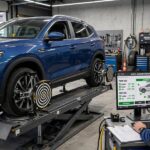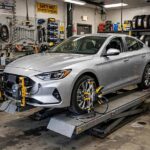
4 wheel vs 2 wheel alignment — when the shop offers you both, which do you pick? The price difference is usually $25–$50, and the cheaper option is tempting. But I’ve seen too many cars come back with the same pulling problem after a 2-wheel alignment because the real issue was in the rear.
Here’s the straight answer from the bay: for almost every modern car, 4-wheel alignment is the right choice. Let me explain why, when 2-wheel is acceptable, and how to tell which your car actually needs.
Contents
- What 2 Wheel Alignment Actually Covers
- What 4 Wheel Alignment Adds
- Thrust Angle: The Reason Rear Alignment Matters
- Which Cars Can Use 2 Wheel Alignment
- Which Cars Need 4 Wheel Alignment
- Price Difference: Is 4 Wheel Worth It
- Signs Your Rear Alignment Is the Real Problem
- What If the Shop Only Offers 2 Wheel
- My Recommendation
What 2 Wheel Alignment Actually Covers
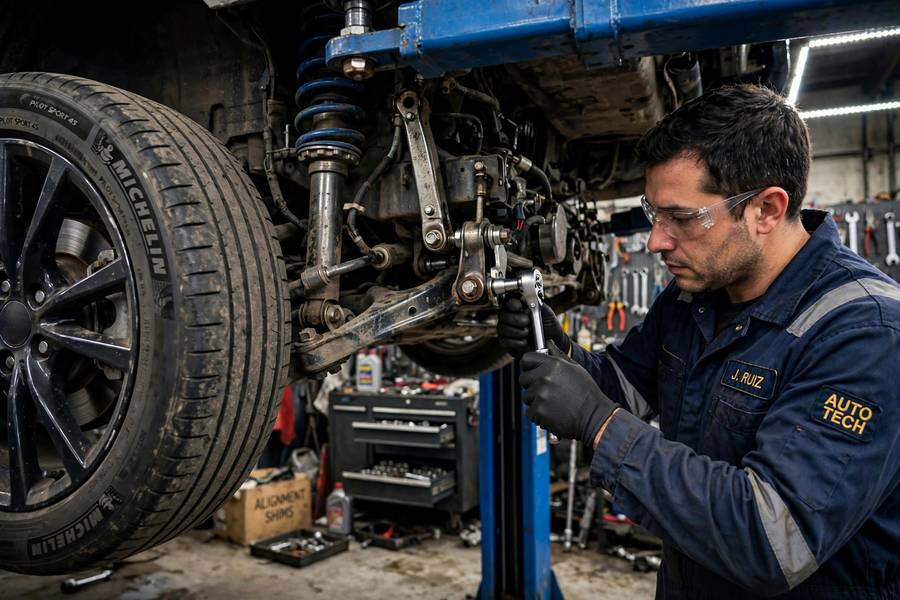
A 2-wheel (front-end) alignment measures and adjusts only the front axle: front camber, front caster, and front toe. The rear wheels get measured — a good tech checks them — but not adjusted. The underlying assumption: the rear is fine, or the rear isn’t adjustable anyway.
This made sense decades ago. Older cars, especially those with solid rear axles (think old pickups and American sedans), had rear geometry fixed at the factory. There was literally nothing to adjust back there, so a front-only alignment was the complete job.
On a modern car with independent rear suspension, that assumption falls apart. The rear has adjustable toe, often adjustable camber, and it absolutely goes out of spec — from potholes, worn bushings, and impacts just like the front.
What 4 Wheel Alignment Adds
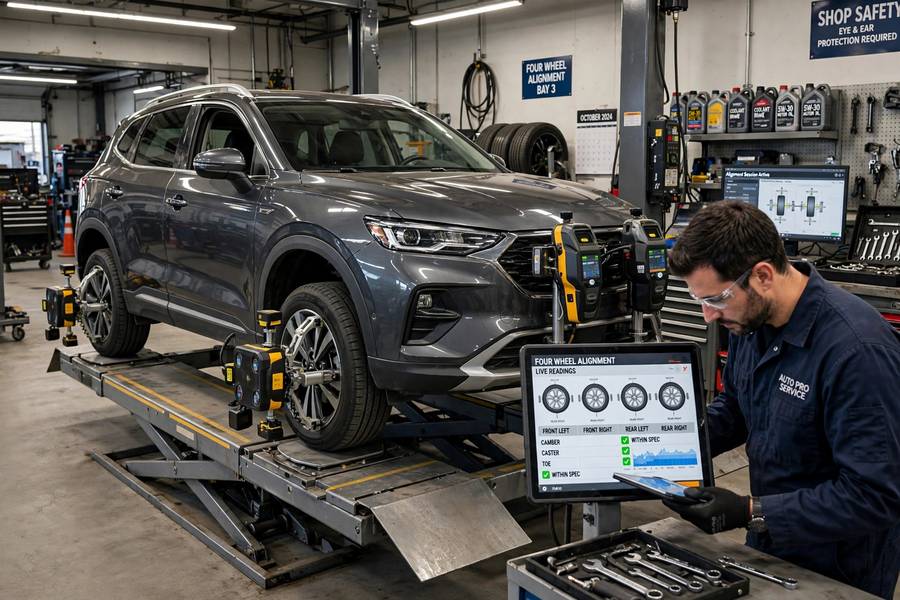
A 4-wheel alignment measures all four wheels and adjusts both axles. Critically, it establishes the geometric centerline of the car first — the true straight-ahead direction based on the rear wheels — and then aligns the front to match it.
This matters because of how cars actually steer. You think the front wheels determine direction, and they do — but the rear wheels determine the car’s reference direction. If the rear axle is pushing the car slightly sideways (bad rear toe), the front has to compensate by steering slightly off-center just to go straight. That’s why cars with rear alignment problems often have a crooked steering wheel that no front-only alignment can fix.
What gets adjusted in the rear varies by car: – Rear toe — adjustable on most modern cars via eccentric bolts or adjustable links – Rear camber — adjustable on many, fixed on some (may need aftermarket kits) – Thrust angle — not directly adjusted, but corrected by equalizing rear toe side to side
Thrust Angle: The Reason Rear Alignment Matters
Thrust angle deserves its own explanation because it’s the concept that makes 4-wheel alignment non-negotiable.
Imagine the rear axle as the engine’s push direction. In a perfect world, it pushes the car straight forward, dead in line with the chassis. The thrust angle is the difference between where the rear axle actually pushes and true straight-ahead. If rear toe is uneven side to side — say the left rear points slightly right — the rear of the car constantly pushes diagonally.
The result has a great name: dog-tracking. The car drives slightly sideways, like a dog running with its body angled. You compensate unconsciously by holding the steering wheel off-center. The car “goes straight” but everything’s crooked — steering wheel, tire wear patterns, handling in crosswinds.
A 2-wheel alignment cannot fix dog-tracking. It aligns the front wheels to each other, but to what reference? Without measuring the rear, the tech aligns the front to an assumed centerline that may not match reality. It’s like hanging a picture straight relative to a crooked wall.
Which Cars Can Use 2 Wheel Alignment
Honest answer: very few modern cars, but they exist.
- Older vehicles with solid rear axles and no rear adjustment — many older trucks and body-on-frame SUVs. If there’s nothing to adjust in the rear, a 4-wheel alignment is just a 2-wheel alignment with extra measuring.
- Cars where the rear is confirmed in spec — if a recent 4-wheel alignment showed the rear dead-on and nothing’s happened since, a front-only touch-up is reasonable.
- Budget emergencies — if money is truly tight and the front is the known problem, a 2-wheel alignment is better than nothing. Just understand its limits.
For everything else — which is nearly every car built in the last 20 years with independent rear suspension — 4-wheel is the correct service.
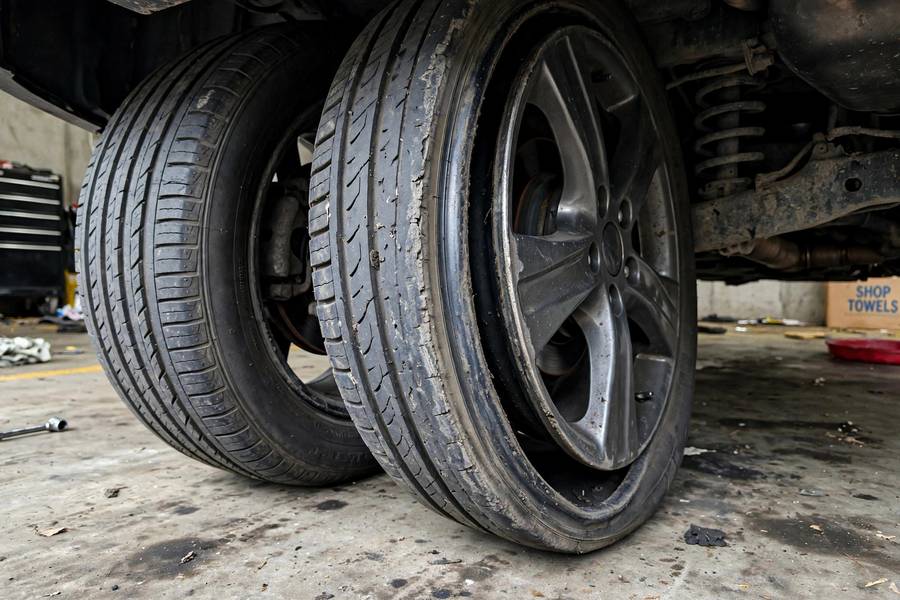
Which Cars Need 4 Wheel Alignment
- Any car with independent rear suspension — that’s most sedans, crossovers, and SUVs on the road today
- Cars with rear toe or camber wear — if your rear tires show uneven wear, the rear needs adjusting, not just the front
- Cars that dog-track — crooked steering wheel combined with the car feeling “sideways”
- AWD vehicles — all four wheels are driven, so all four wheels’ geometry affects handling and tire wear. Mismatched alignment on AWD also stresses the center differential. (More on drivetrains in my AWD vs 4WD explained guide.)
- Any car after a rear impact — even a parking-lot bump to the rear can shift rear toe
- Lowered or modified cars — suspension changes affect all four corners
When in doubt, ask the shop to show you the rear readings. If they’re out of spec and the shop only does 2-wheel alignments, you’re at the wrong shop.
Price Difference: Is 4 Wheel Worth It
Real-world pricing:
| 2-Wheel | 4-Wheel | |
|---|---|---|
| Tire chain | $50–$80 | $75–$120 |
| Independent shop | $60–$100 | $90–$150 |
| Dealership | $90–$130 | $120–$200 |
The difference is typically $25–$50. For that, you get the rear measured and adjusted, the thrust angle corrected, and the front aligned to a true centerline instead of an assumed one.
Think of it this way: a 2-wheel alignment that misses a rear problem costs you $50–$100 plus the tires it fails to save plus the 4-wheel alignment you’ll eventually need anyway. The “cheaper” option is only cheaper if the rear is actually fine — and you can’t know that without measuring it, which is half the 4-wheel job already.
Lifetime alignment packages (offered by many tire chains, ~$150–$250) are almost always 4-wheel. If you keep cars long-term or drive rough roads, they’re the best value in the shop.
Signs Your Rear Alignment Is the Real Problem
How do you know the rear is the culprit? Look for:
- Dog-tracking — the car feels like it drives slightly sideways; the steering wheel is off-center even after a front alignment
- Rear tire wear — inner or outer edge wear, or feathering on the rear tires specifically
- The car feels unstable in crosswinds — rear toe issues make the back end feel loose
- A front alignment didn’t fix the pull — the classic sign. If you paid for a 2-wheel alignment and the car still pulls, the rear is suspect #1
- Uneven rear tire wear after rotation — tires that were fine on the front start wearing funny after moving to the rear
I’ve lost count of the cars that came to me after a 2-wheel alignment “didn’t work.” The rear readings told the whole story every time.
What If the Shop Only Offers 2 Wheel
Some shops — usually older, smaller ones with older equipment — only do front-end alignments. Their rack might not have rear sensors, or the tech isn’t set up for it.
My advice: for a modern car, find a shop with 4-wheel capability. It’s not a specialty service anymore — any tire chain and most independents do it. A shop that can’t measure the rear can’t tell you whether the rear is the problem, which means they’re guessing. You don’t want guesses with your tires and safety.
The one exception: if you drive something with a solid rear axle and the shop knows it, 2-wheel is the honest correct service. A good shop will tell you this upfront rather than upselling you a 4-wheel alignment your car can’t use.
My Recommendation
For 95% of drivers with modern cars: get the 4-wheel alignment, every time. The extra $25–$50 buys you a complete job — measured rear, corrected thrust angle, front aligned to reality instead of assumption.
Get the 2-wheel only if your car genuinely has no rear adjustment (older solid-axle vehicles) or as a stopgap when money is tight. And always — always — get the before-and-after printout showing all four wheels. If the printout only shows the front, you didn’t get what you need.
One more thing: if you’ve been chasing a pull or a crooked wheel through multiple front alignments, stop and get the rear measured. The answer has been back there the whole time. For the fundamentals of what those angles mean, read what wheel alignment actually is, and if you’re trying to figure out what causes wheel misalignment in the first place, rear impacts and worn bushings are high on the list.
Frequently Asked Questions
A 2-wheel alignment adjusts only the front axle. A 4-wheel alignment measures and adjusts all four wheels, establishing the car’s true centerline from the rear and aligning the front to match it — including correcting thrust angle.
Yes, for almost all modern cars. The $25–$50 difference buys a complete job. A 2-wheel alignment can’t fix rear-caused pulling or dog-tracking, so the “cheaper” option often leads to paying twice.
If it has independent rear suspension — most cars built in the last 20 years — yes. Only older vehicles with non-adjustable solid rear axles are fine with 2-wheel alignments.
Only if the cause is in the front. If the pull comes from rear toe issues or thrust angle problems, a 2-wheel alignment won’t fix it — which is why pulls that survive a front alignment usually need the rear measured.
Thrust angle is the difference between the direction the rear axle pushes the car and the car’s true straight-ahead line. Uneven rear toe creates thrust angle error, causing dog-tracking — the car drives slightly sideways. Only a 4-wheel alignment corrects it.