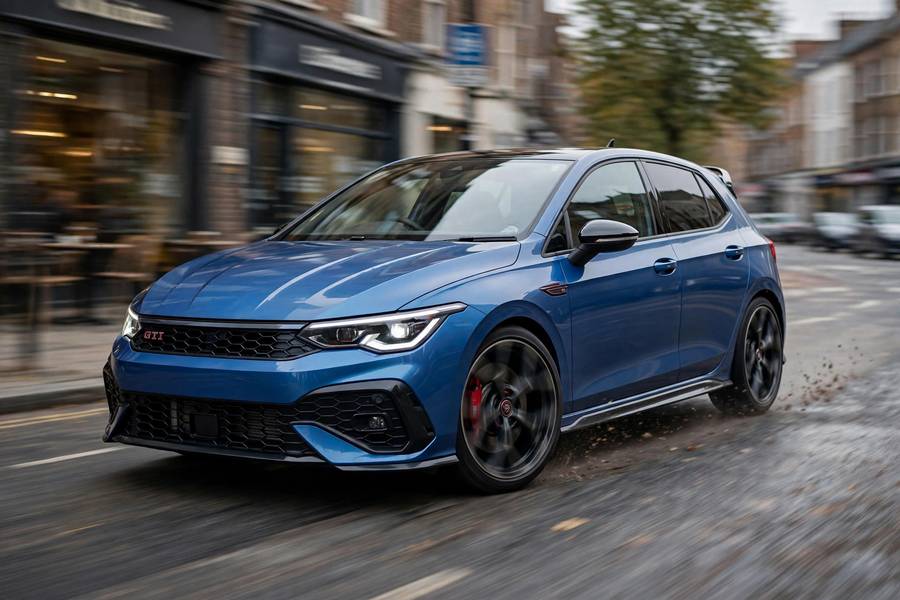
The first time it happened to me, I was test-driving a customer’s turbocharged hot hatch — floored it from a stoplight, and the steering wheel practically tried to rip itself out of my hands toward the right. I caught it, laughed, and thought: “So that’s what everyone complains about.” That violent tug under hard acceleration is torque steer, and if you’ve ever driven a powerful front-wheel-drive car, you’ve probably felt it.
Torque steer is the tendency of a front-wheel-drive car to pull to one side (or dart around) under hard acceleration. It’s not a malfunction — it’s physics, baked into the geometry of driving the front wheels. Some cars barely do it; some do it with enough enthusiasm to genuinely startle you. Here’s what’s actually going on and what engineers (and drivers) do about it.
Contents
- The Simple Explanation
- Cause #1: Unequal-Length Half-Shafts
- Cause #2: Steering Geometry and Scrub Radius
- Cause #3: Tires, Grip, and Road Surface
- Cause #4: Suspension Flex and Engine Movement
- How Engineers Fight It
- What You Can Do as a Driver
The Simple Explanation
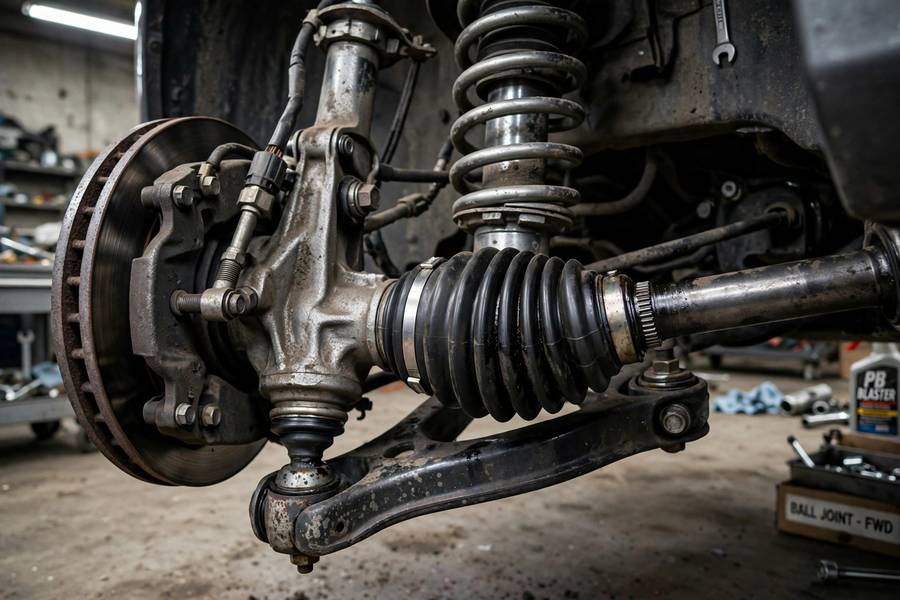
In a front-wheel-drive car, the same wheels that steer also receive the engine’s power. When you accelerate hard, two things happen at the front tires simultaneously: they’re being twisted by how torque works in cars, and they’re being asked to steer. The forces don’t distribute perfectly evenly between the left and right wheels, and the difference shows up as a pull on the steering wheel.
In a rear-wheel-drive car, the steering wheels (front) and the driven wheels (rear) are separate, so this particular fight doesn’t happen. That’s the fundamental reason torque steer is a FWD phenomenon — the front tires are doing two jobs at once, and under big power, the jobs conflict.
How much you feel it depends on power level. A 140-horsepower economy car? You’d need laboratory equipment to detect it. A 300-horsepower turbo FWD monster? It’ll remind you it’s there every time you floor it. The relationship is roughly: more torque through the front wheels equals more steering fight.
Cause #1: Unequal-Length Half-Shafts
This is the classic cause, and the one most articles lead with — with good reason.
In most transverse-engine FWD cars, the transmission sits off to one side of the engine bay (usually the left). That means the driveshaft (half-shaft) going to the left wheel is short, and the one going to the right wheel is long — sometimes dramatically longer. Under hard acceleration, the longer shaft twists slightly more than the short one (torsion flex), which means the left wheel momentarily receives more torque than the right. More torque on the left = the car pulls to the right.
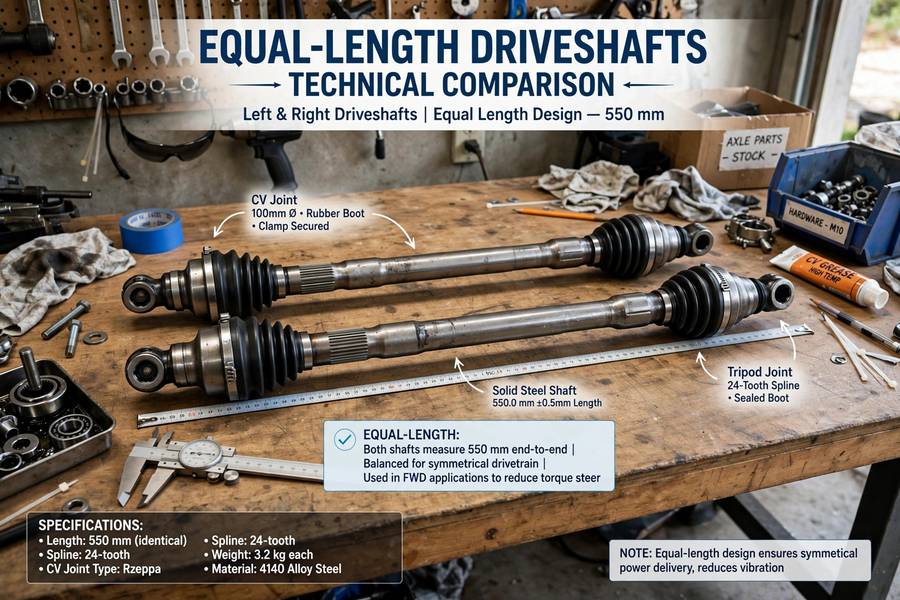
Engineers have known about this forever. The standard fix is an intermediate shaft (also called a jackshaft): instead of one long shaft on one side, the design uses a fixed intermediate shaft that makes both half-shafts effectively equal length. Most modern FWD cars have this, which is why torque steer is less brutal than it was in the 1980s — but it doesn’t eliminate the problem entirely, because equal length is only one piece of the puzzle.
Cause #2: Steering Geometry and Scrub Radius
Here’s the subtler cause that most people miss: scrub radius.
Scrub radius is the distance between the center of the tire’s contact patch and the point where the steering axis hits the ground. If those two points don’t line up — and they usually don’t, by design — then any force at the tire (like, say, a few hundred pound-feet of torque trying to twist it) creates a turning moment around the steering axis. In plain English: torque at the tire twists the steering, because the steering pivot isn’t centered on the tire.
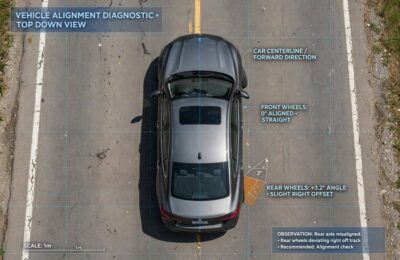
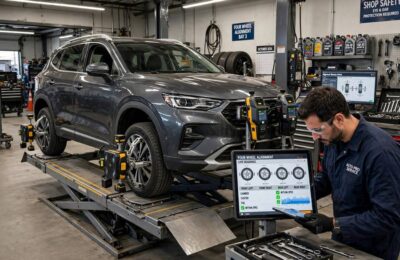
When both front tires get equal torque, the left and right moments cancel out and you go straight. But the moment the left and right tires differ — different grip, different shaft twist, different anything — the imbalance yanks the steering. Cars with large scrub radius (often from wide wheels with aggressive offset) are more sensitive to this. This is also why wheel alignment matters: alignment settings change the geometry, and bad alignment makes torque steer worse.
Performance cars with big power sometimes use special front suspension designs (like Ford’s RevoKnuckle or GM’s HiPer Strut) specifically to reduce the scrub radius and decouple the steering from drive forces. They work — a 300-hp car with HiPer Strut feels notably calmer than the same power through a basic MacPherson setup.

Cause #3: Tires, Grip, and Road Surface
Torque steer needs a grip imbalance to show itself, and tires are where imbalances live:
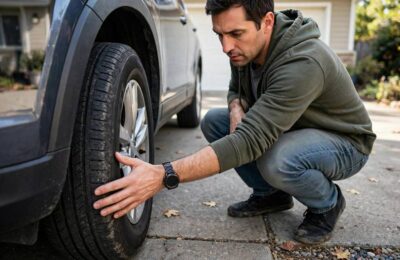
- Uneven tire wear or pressure. If one front tire has less grip than the other, it gets less traction, the torque distribution shifts, and the steering pulls. This is one reason I harp on keeping tires matched — same model, same wear, correct pressure. A tire that’s 5 PSI low has a different contact patch and different grip, and under hard acceleration you’ll feel it. (Related basics: knowing how to change a tire won’t fix torque steer, but understanding your tires is the foundation of everything.)
- Road crown and surface. Roads are crowned for drainage — the center is higher than the edges. Under hard acceleration on a crowned road, the car naturally wants to follow the crown, and torque amplifies the drift. Rutted pavement does the same thing; the tires follow the ruts and the steering wheel dances.
- One wheel on a slippery patch. Hit a patch of gravel, paint, or wet leaves with one front tire while accelerating hard, and that tire spins while the other grips. The differential sends power to the spinning wheel, the grip imbalance spikes, and the steering jerks. Traction control usually intervenes, but there’s a moment of excitement first.
Cause #4: Suspension Flex and Engine Movement
The engine and transmission are mounted on rubber bushings that let them move slightly — that’s by design, to isolate vibration. But under hard acceleration, the whole powertrain twists on its mounts (this is the “torque” in the old-school sense — the engine trying to rotate opposite to the wheels).
When the powertrain twists, it changes the half-shaft angles and the suspension geometry slightly. Worn engine mounts let it twist more, which is why a car that never torque-steered much suddenly starts doing it at 120,000 miles — the mounts are shot and the engine is flopping around under load. I’ve diagnosed “mysterious pulling under acceleration” as bad engine mounts more times than I can count. The fix is new mounts, not an alignment.
Similarly, worn control arm bushings let the front wheels shift position under load, changing toe angle dynamically. The car steers itself as the geometry changes mid-acceleration. Fresh bushings restore the calm.
How Engineers Fight It
Car manufacturers hate torque steer — it makes their cars feel crude — and they’ve developed a whole toolkit against it:
- Equal-length half-shafts (via intermediate shaft) — the baseline fix, near-universal now.
- Reduced scrub radius through suspension geometry — RevoKnuckle, HiPer Strut, and similar designs.
- Electronic limited-slip differentials — brake-based torque vectoring that manages left-right torque distribution to cancel the pull. Many modern hot hatches lean heavily on this.
- Torque-steer compensation in electric power steering — the EPS system detects the pull and applies counter-assist automatically. You never feel it; the computer eats the problem. This is quietly doing enormous work in modern cars.
- Engine mount tuning — stiffer mounts in performance cars to limit powertrain twist.
- Just… less torque. Some manufacturers deliberately limit torque in first and second gear (torque management) specifically to keep the steering civil. Your car might be faster than it feels off the line because the computer is protecting your hands.
What You Can Do as a Driver
If your car torque-steers and it’s annoying you:
- Keep tires matched and properly inflated. Same tires, same wear level, correct pressures. This is the cheapest fix and the most commonly neglected.
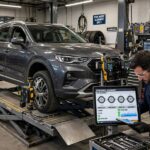
- Check alignment. Worn or misaligned front ends amplify every other cause.
- Inspect engine mounts and bushings if the problem appeared gradually with age and mileage. This is the classic “it used to be fine” pattern.
- Modulate the throttle. Smooth, progressive throttle application produces far less torque steer than stabbing the gas. The car is faster when the tires aren’t fighting the steering anyway.
- Hold the wheel firmly but don’t death-grip it. A relaxed-but-firm grip lets you correct smoothly. White-knuckling makes every correction an overcorrection.
- Don’t chase it with mods alone. Wider tires and more power both increase torque steer. If you’re modifying a FWD car, budget for the suspension and differential work too — power without chassis is just wheelspin and arm-wrestling.
And honestly? A little torque steer is character. The cars that do it are usually the fun ones — the hot hatches and turbo sleepers with more enthusiasm than their front tires can fully manage. Learn its habits, keep the car maintained, and it’s part of the charm.
Frequently Asked Questions
Torque steer is the tendency of a front-wheel-drive car to pull to one side under hard acceleration. It happens because the front wheels handle both steering and power delivery, and torque doesn’t distribute perfectly evenly between left and right.
The main causes are unequal-length half-shafts (the longer shaft twists more under load), steering geometry (scrub radius turns tire torque into steering force), tire grip imbalances, worn engine mounts or bushings, and road surface conditions.
Technically the physics applies to all FWD cars, but it’s only noticeable in powerful ones. Low-power economy cars produce too little torque for it to matter, and modern engineering (equal-length shafts, electronic torque vectoring, EPS compensation) has tamed it considerably.
Proper alignment helps — bad alignment amplifies torque steer — but it can’t eliminate it since the root causes are powertrain geometry and physics. If torque steer appeared gradually with age, worn engine mounts or suspension bushings are more likely culprits than alignment.
No — in RWD cars the front wheels steer and the rear wheels drive, so there’s no conflict. RWD cars can have their own quirks under hard acceleration (like the rear stepping out), but torque steer specifically is a front-wheel-drive phenomenon.