The first time a customer asked me what a transmission leak would cost to fix, I gave them the honest mechanic’s answer: “Somewhere between fifty bucks and the price of a decent used car.” They laughed. Then they learned I wasn’t joking.
A transmission fluid leak is one of those repairs where the price depends almost entirely on where the fluid is escaping from. A pan gasket is a Saturday afternoon job. A front pump seal means the transmission has to come out of the car, and that’s a very different invoice. The good news: most leaks I saw in the shop were the cheap kind. This guide breaks down the typical price ranges, what each leak source involves, and how to keep your bill on the low end.
Contents
- Why the Price Range Is So Wide
- The Cheap Fixes: Pan Gasket and Drain Plug
- Middle Ground: Cooler Lines and Axle Seals
- The Expensive Ones: Front Pump and Torque Converter Seals
- What Drives the Price Up (or Down)
- DIY vs Shop: What’s Realistic
- Stopping Leaks Before They Start
Why the Price Range Is So Wide
Transmission fluid doesn’t burn off or get used up like engine oil — if it’s disappearing, it’s leaving through a seal, gasket, or line that’s given up. The repair cost is really the cost of accessing the leak. A pan gasket sits right under the car with maybe a dozen bolts between you and it. The front seal sits between the engine and transmission, which means separating the two — hours of labor just to see the problem.
Typical ranges I saw across independent shops in my area, and they hold up well in 2026:
- Pan gasket replacement: $150–$350 (parts are cheap, labor is 1–2 hours plus fluid)
- Drain plug / filler plug: $50–$150
- Cooler lines: $200–$500 depending on how many lines and how rusty the fittings are
- Axle / output shaft seals: $250–$450
- Shifter shaft or speed sensor seals: $100–$300
- Front pump / torque converter seal: $800–$2,000+ (transmission removal required)
- Case crack or housing damage: $1,500 and up, often means a remanufactured unit instead
Labor rates make a big difference. An independent transmission shop might charge $100–$140 an hour; a dealership can be $180–$250. That alone can nearly double the same job. Geography matters too — big-city labor costs more than small-town.
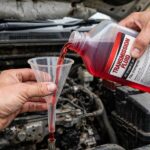
One more cost people forget: the fluid itself. Fresh ATF runs $8–$15 a quart for the common stuff, more for CVT-specific fluid or dealer-only specs. A pan drop replaces 4–6 quarts; if the shop drains the whole system, budget for 10–14 quarts. Always make sure the quote includes the fluid — some shops list it separately.
The Cheap Fixes: Pan Gasket and Drain Plug
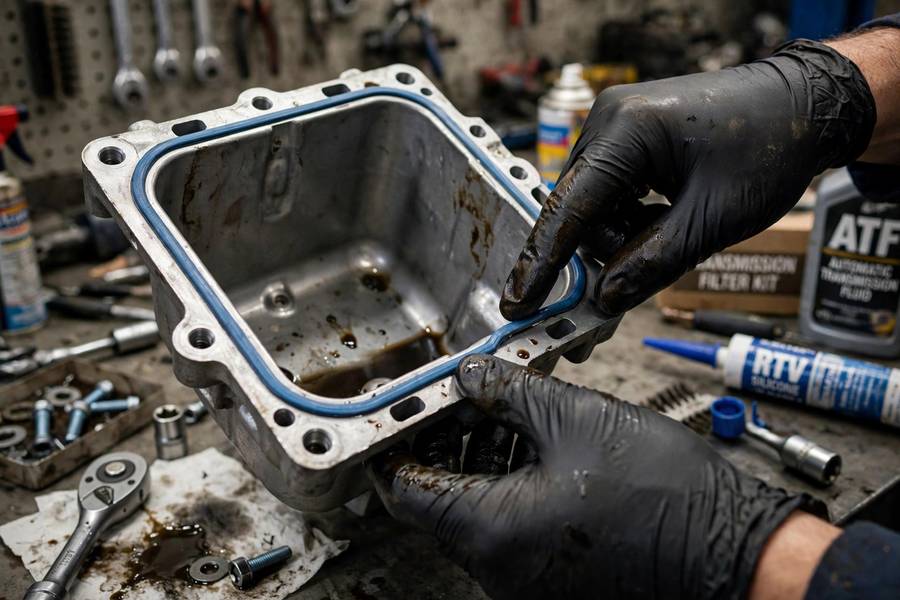
The transmission pan gasket is the number one leak source on high-mileage cars, and it’s the best-case scenario. The pan sits at the bottom of the transmission, held on by bolts, with a gasket (rubber or cork, depending on age) sealing the joint. Heat cycles and age flatten that gasket until it weeps.
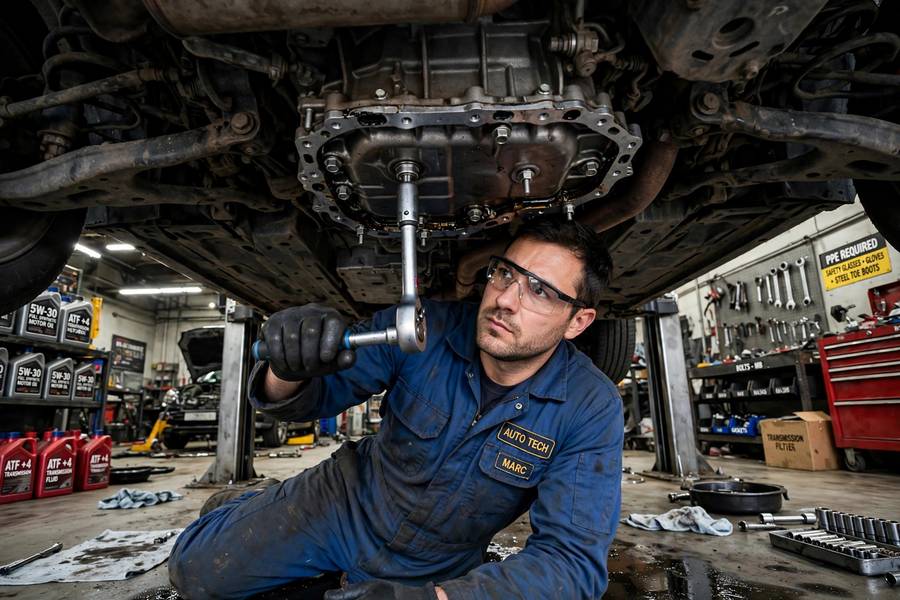
The repair: drop the pan, clean the mating surfaces, install a new gasket and filter (smart to do while you’re in there), refill with fluid. Parts typically run $30–$80 for gasket plus filter. An honest shop charges 1–2 hours of labor plus fluid, landing around $150–$350 total.
The drain plug is even simpler — a loose or damaged plug, or a crushed washer, can be fixed for the cost of a washer and a few minutes. $50–$150 is the usual range, mostly because you’re paying for the fluid top-off and a lift.
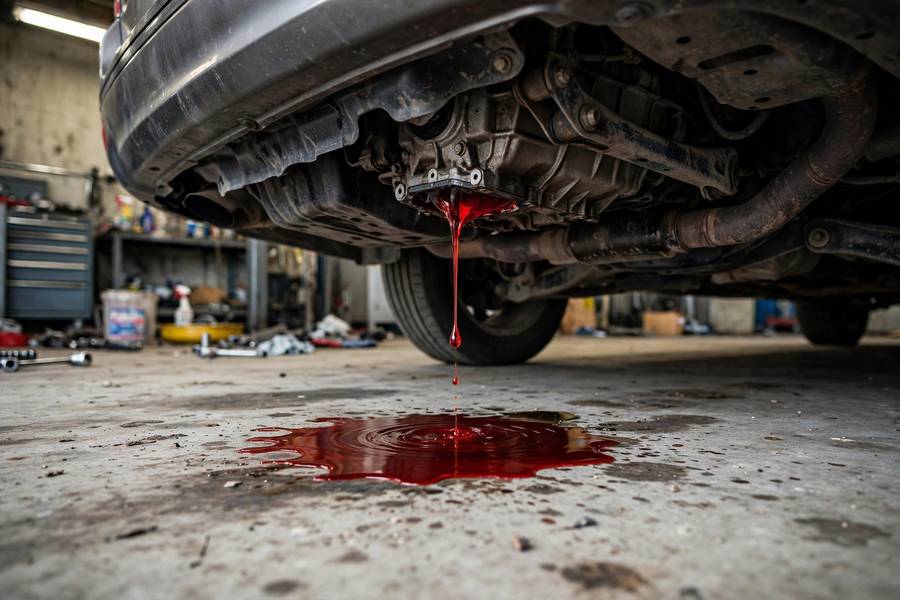
My shop trick: before authorizing anything, ask the tech to show you exactly where it’s leaking. A pan gasket leak leaves a distinctive wet ring around the pan’s edge. If the whole undercarriage is wet and they can’t point to a source, you want a proper inspection — UV dye and a recheck — not a guess with your money.
Middle Ground: Cooler Lines and Axle Seals
Transmission cooler lines run from the transmission to the radiator (or an external cooler), carrying hot fluid to cool down. The rubber sections harden and crack with age; the metal fittings corrode, especially in road-salt country. I’ve seen lines that looked like they were held together by rust and optimism.
Line replacement usually runs $200–$500. The parts aren’t expensive — often $50–$150 for the lines — but rusted fittings can turn a one-hour job into a three-hour fight. Shops in the salt belt charge more for this work because they know what they’re in for. Pre-soaking fittings with penetrating oil the night before can genuinely save you labor money if you mention it (or do it yourself in the driveway).
Axle seals (on front-wheel-drive cars) or output shaft seals (on rear-wheel-drive) sit where the driveshafts or axles exit the transmission. When they fail, you’ll see fluid collecting near the wheels or dripping off the axle. The seal itself is a $15–$40 part, but replacing it means pulling the axle — typically 2–3 hours of labor. $250–$450 total is the common range.

The Expensive Ones: Front Pump and Torque Converter Seals
Here’s where bills get serious. The front pump seal and torque converter seal sit at the front of the transmission, where it bolts to the engine. There’s no shortcut to them: the transmission (or the engine) has to come out. On most front-wheel-drive cars, that’s 6–10 hours of labor. On some trucks and RWD cars, it’s faster, but it’s never cheap.
Typical cost: $800–$2,000+, and honestly, once the transmission is out, most good shops will recommend inspecting and resealing the whole unit — because paying for removal twice would be a tragedy. Some owners in this situation decide to install a remanufactured transmission instead of resealing a high-mileage unit, which is worth discussing when your car has 180,000 miles on it.
When is it worth it? Quick math I used to walk customers through: if the repair costs more than about half the car’s current value, have the “is this car worth keeping” conversation honestly. A $1,500 seal job on a car worth $4,000 that you love and that runs well? Fine. The same job on a car with three other major problems? Time to think.
What Drives the Price Up (or Down)
A few factors consistently moved estimates up or down in my experience:
- Vehicle design. Transverse (FWD) layouts are tighter to work around than longitudinal (RWD) ones. Some cars require dropping a subframe for access — that adds labor before the real job even starts.
- Fluid type. Standard ATF is cheap. CVT fluid, dual-clutch fluid, and some European specs run $20–$35 a quart. If you’ve got CVT transmission problems, make sure the shop uses the exact spec your manufacturer requires — this is not the place to save $20.
- Shop type. Independent transmission specialists are usually the sweet spot: they do this work all day, their labor rates are fair, and they know the shortcuts. Dealerships are pricier but sometimes necessary for warranty work or unusual vehicles.
- Multiple leaks. Old cars often leak from more than one place. Ask whether fixing one will reveal another — a good tech will tell you.
- Rust. Everything takes longer on a rusty car. Fittings seize, bolts snap, and the clock keeps running.
What doesn’t move the needle: the brand of gasket or seal, within reason. OEM or quality aftermarket both work. Don’t pay a premium for a “performance” gasket on a daily driver.
DIY vs Shop: What’s Realistic
Pan gasket and drain plug leaks are genuinely DIY-friendly if you’re comfortable under a car: basic hand tools, jack stands, a drain pan, and patience. Budget $50–$100 in parts and fluid, and a Saturday. The critical parts: torque the pan bolts to spec in a crisscross pattern (too tight warps the pan and makes it leak worse), and fill to the correct level — I covered the technique in my guide on how to check transmission fluid.
Axle seals and cooler lines are intermediate — doable with mechanical experience and the right tools, but the “right tools” part is doing real work in that sentence. Seals are easy to damage during installation, and a botched seal job means doing it all again.
Front pump seals: shop job, full stop. Nobody does this in a driveway on jack stands. Don’t be the person who tries.
The leak-sealer question. Every auto parts store sells transmission stop-leak additives. Do they work? Sometimes, briefly, for very small seeps — they swell old seals. But they also swell seals you don’t want swollen, and they can gum up valve bodies. My take: acceptable as a short-term measure to get a dying car to a shop, never as a repair. If a shop recommends it as the fix, find a different shop.
Stopping Leaks Before They Start
You can’t prevent seals from aging, but you can keep the conditions gentle:
- Change the fluid on schedule. Fresh fluid has conditioners that keep seals supple; degraded fluid doesn’t. (Yes, how often to change engine oil gets all the attention — transmissions deserve a schedule too.)
- Don’t overheat the transmission. Towing beyond your rating, aggressive driving in heat, or a failing cooler cooks seals fast. If you tow, a transmission cooler is cheap insurance.
- Fix small seeps early. A weep becomes a drip becomes a puddle. Catching it at the weep stage often means a $30 gasket instead of a $400 bill plus the fluid you lost in between.
- Check your parking spot. Glance under the car now and then. Reddish spots are the transmission’s way of asking for help before it becomes a shout.
Most transmission leaks I’ve fixed started as problems owners could have caught six months earlier for a fraction of the price. The cheapest leak repair is the one you catch early.
Frequently Asked Questions
It depends on the source: pan gaskets typically run $150–$350, cooler lines $200–$500, axle seals $250–$450, and front pump seals $800–$2,000+ because the transmission must be removed. The fluid itself adds $40–$150 depending on type.
A slow seep is usually safe for short trips if you keep the fluid topped off — but low fluid causes slipping and overheating that can destroy the transmission. A fast drip or puddle means fix it now, not later.
The pan gasket is the most common leak source on high-mileage vehicles — heat and age flatten it until it weeps. Cooler lines and axle seals are the next most common culprits.
Stop-leak additives can slow very small seeps temporarily by swelling old seals, but they’re not a real repair and can cause problems in valve bodies. Treat them as a short-term measure to reach a shop, not a fix.
Look for red fluid and trace it upward — a wet ring around the pan edge means pan gasket, fluid near the wheels points to axle seals, and wetness along the lines to the radiator means cooler lines. A shop can use UV dye to pinpoint hard-to-find leaks.