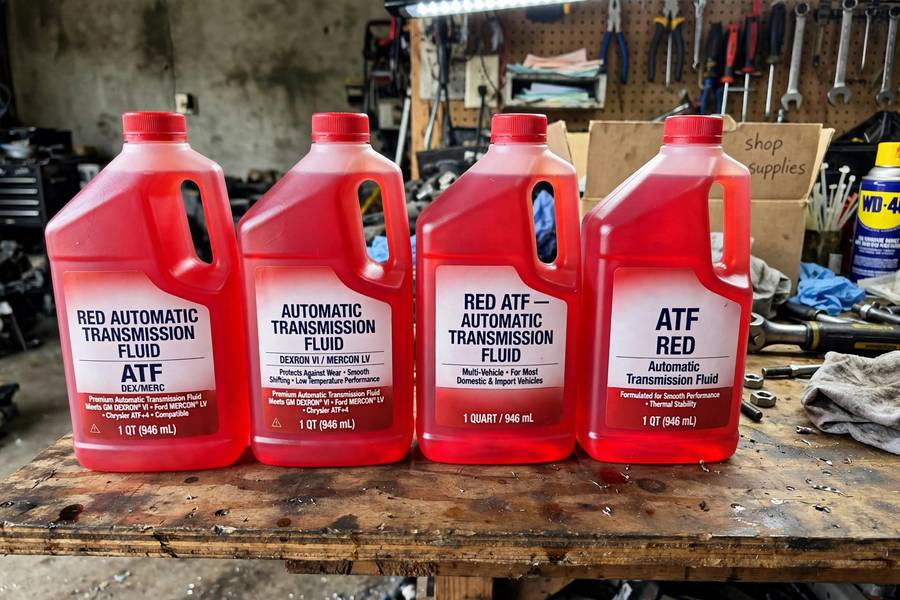
“How much fluid do I need?” sounds like it should have a simple answer — one number, done. But the real answer is “it depends on what you’re doing,” because a drain-and-fill, a flush, and a dry rebuild all need wildly different amounts. Buy too little and you’re making a second trip to the parts store with the car half apart. Buy way too much and… well, at least you’ll have extra for next time.
Here’s how to figure out the right amount before you start, with typical ranges by vehicle and service type, and where to find your exact number.
Table of Contents
- Why the Answer Depends on the Job
- Typical Capacities: Drain and Fill
- Typical Capacities: Full Flush or Exchange
- Total (Dry) Capacity: Rebuilds and Replacements
- Where to Find Your Exact Number
- The Golden Rule: Measure What Came Out
- My Shopping List Math: Buying Fluid Without Wasting Money
- Frequently Asked Questions
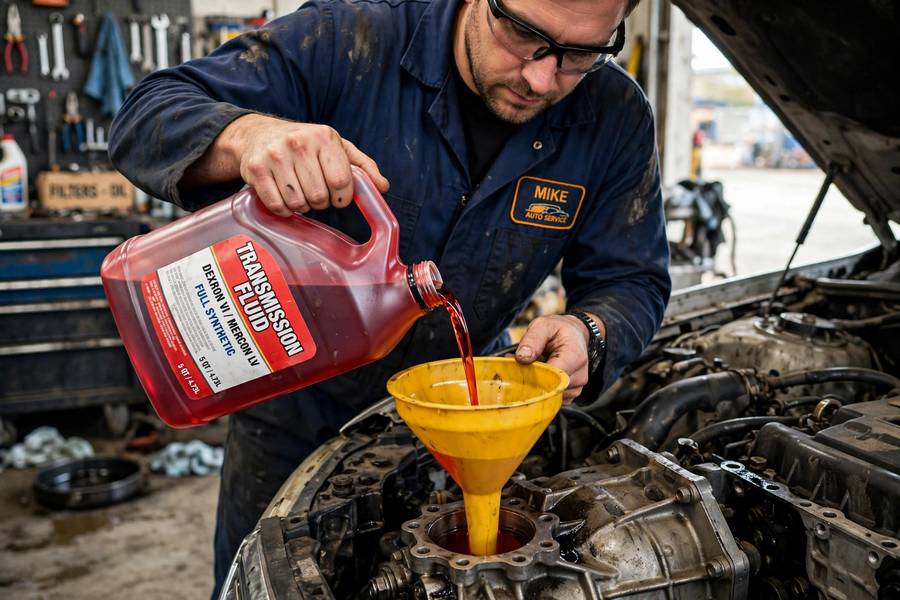
Why the Answer Depends on the Job
A transmission holds fluid in several places: the pan (the sump at the bottom), the torque converter (a big fluid-filled doughnut on automatics — holds a LOT), the valve body passages, the cooler lines, and the cooler itself.
When you do a drain and fill, gravity only empties the pan — roughly 30-50% of the total. The torque converter doesn’t drain (no drain plug on most modern ones), and the lines and cooler hold their fluid. So a “service” needs far less fluid than the transmission’s total capacity.
A flush exchanges fluid through the cooler lines with the engine running, cycling until the outgoing fluid runs clean — that needs roughly the total capacity, sometimes a bit more since you’re pushing new fluid through to chase out the old.
A dry fill (fresh rebuild, new transmission, torque converter replaced) needs the full total capacity, filled carefully in stages.
Three different jobs, three different numbers. Know which job you’re doing before you buy.
Typical Capacities: Drain and Fill
These are ballpark ranges for a standard pan-drop drain and fill (including filter change). Your exact number varies — always verify — but this gets you in the right neighborhood for buying fluid:
- Compact cars (Civic, Corolla, Mazda3): 3-4 quarts
- Midsize sedans (Camry, Accord, Altima): 3.5-5 quarts
- Full-size sedans and small SUVs: 4-6 quarts
- Larger SUVs and crossovers: 5-7 quarts
- Pickup trucks (F-150, Silverado, Ram): 5-8 quarts for a pan drop; some heavy-duty truck transmissions take more
- CVTs: often 4-6 quarts for a drain and fill, but CVT drain procedures vary — some drain more, some less
My buying advice: get one extra quart beyond your estimate. Having an extra quart on the shelf is cheap insurance; running short mid-job with the pan off is a special kind of misery. Unopened ATF keeps for years on the shelf.
And remember the procedure matters as much as the amount: add slowly, recheck at operating temperature. My guide on how to add transmission fluid covers the go-slow method that prevents overfilling.
Typical Capacities: Full Flush or Exchange
A machine flush needs roughly the transmission’s total capacity, plus a little extra for the exchange process itself (the machine pushes new fluid in to displace old fluid, and some extra cycles through to get it clean):
- Compact/midsize cars: 8-12 quarts
- Larger sedans and SUVs: 10-14 quarts
- Trucks and large SUVs: 12-16+ quarts
This is why flushes cost more — you’re buying two to three times the fluid of a drain and fill. When a shop quotes a flush, the fluid cost is a big chunk of the price, especially with expensive OEM or CVT fluid.
If you’re comparing service options, my transmission fluid change vs flush breakdown covers the cost and benefit math in detail.
Total (Dry) Capacity: Rebuilds and Replacements
If the transmission is bone dry — fresh rebuild, replacement unit, new torque converter — you need the full system capacity:
- Small cars: 7-9 quarts
- Midsize cars: 8-11 quarts
- SUVs and trucks: 11-16 quarts
- Heavy-duty trucks: up to 18+ quarts
Dry fills are done in stages: add a few quarts, start the engine, shift through the gears (foot on brake, car safely secured), add more, recheck, repeat. The torque converter fills as the pump circulates fluid, so the level drops as you cycle it. Never dump the full capacity in at once and call it done — you’ll overfill, then the level will drop as fluid circulates, and you’ll chase it around.
Honestly, dry fills after a rebuild are usually the rebuilder’s job, not a DIY project. But if you’re doing a torque converter replacement or a cooler-line replacement that drained significant fluid, knowing the total capacity helps you buy the right amount.
Where to Find Your Exact Number
Ballparks get you to the store; exact numbers get the job done right. In order of reliability:
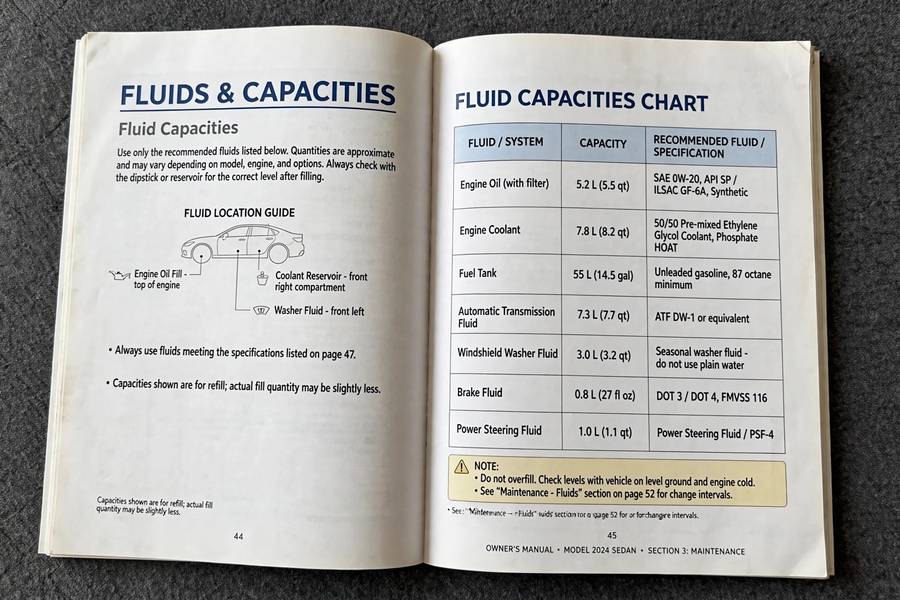
- Owner’s manual — the capacities chart lists transmission fluid capacity, often broken into “drain and refill” vs “total.” This is the definitive answer.
- Factory service manual — more detail than the owner’s manual, including procedure-specific amounts.
- Dealer parts counter — give them your VIN, ask for the drain-and-fill capacity and the fluid spec. Free, fast, accurate.
- Reputable online lookup tools — fluid makers and parts sites have fitment tools. Good for cross-checking, but verify against the manual.
What to watch for: some manuals list only total capacity, not drain-and-fill amount. If you only have the total, estimate the drain-and-fill at 40-50% of total for a pan drop — then confirm by measuring what actually came out (next section).
Also note: some manufacturers list capacity in liters. A US quart is about 0.95 liters — close enough that rounding works, but don’t mix up quarts and liters on the shopping list if you’re buying in bulk.
The Golden Rule: Measure What Came Out
Here’s the trick that makes exact specs almost unnecessary: measure the fluid you drain, and put the same amount back in (plus a touch for the filter).
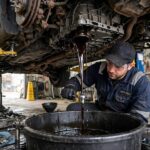
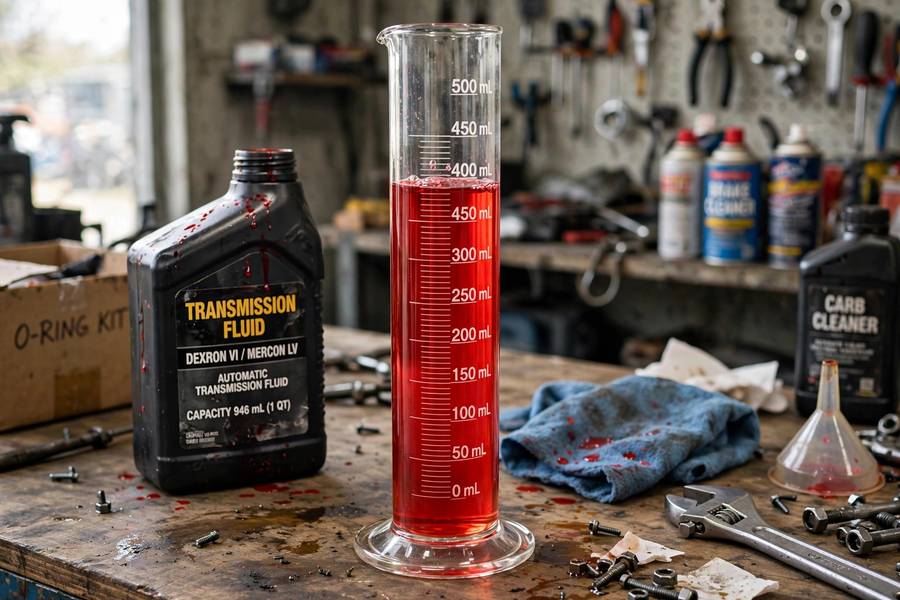
Drain into a graduated container — a cheap plastic measuring pitcher from the parts store, or even a clean oil drain pan with quart markings. Note exactly how much came out. When you refill, start with that amount, then check the level properly: engine running, in Park, level ground, at operating temperature. Adjust from there.
This works because the transmission was presumably at the correct level before you drained it (if it wasn’t, you’d have noticed symptoms — and you’d be checking your transmission fluid level anyway).
Caveats: this assumes the transmission was full to begin with. If it was low (leak, neglected), measuring what came out gives you the wrong target — you’ll just refill it to “low” again. So always do a proper level check at temperature as the final step, regardless of what you measured. The measurement gets you close fast; the dipstick (or fill plug) gets you exactly right.
One more: if you’re changing the filter, the new filter and a dry pan absorb a little extra fluid — usually a few ounces, not enough to worry about, but it’s why you always do the final check at temperature rather than trusting the measurement alone.
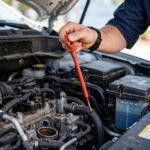
This measure-what-came-out discipline is the same habit that keeps engines alive — checking your oil level regularly is the five-minute version every driver should already be doing. The drivers who check fluids on a schedule are the ones who never meet me on a tow truck.
My Shopping List Math: Buying Fluid Without Wasting Money
The most common question I get at the parts counter — from customers and from my own junior techs — is how many bottles to actually buy. Buy too few and you’re making a second trip mid-job with the car on jack stands. Buy too many and you’ve got $60 of fluid collecting dust. Here’s the math I use.
Start with the job type. Drain-and-fill on a car: plan for the typical range in this article (3–6 quarts for most cars, 5–8 for trucks and big SUVs) and buy one quart more than the top of the range for your vehicle. Flush or full exchange: buy the total capacity plus two quarts, because exchange machines need extra fluid to push the old fluid out.
Work from a real number when you have one. If the owner’s manual says “drain and refill: 3.7 quarts,” buy 5. That covers the drain amount, the filter soak, and the top-off you’ll do during the hot level check. If the manual only lists total capacity — say, 8.2 quarts — a pan drop replaces roughly 40–50% of that, so buy 5 and plan on the same insurance quart.
The filter tax is real but small. A new filter and a dry pan absorb a few ounces — not a quart, despite what internet forums claim. But if you’re also replacing cooler lines or the radiator’s internal cooler drained back, add half a quart. Cooler lines hold more than people think.
Buy the right fluid, then worry about quantity. This matters more than the count: one wrong-spec jug poisons the whole job. OEM fluid or a licensed equivalent that lists your exact spec (ATF+4, Mercon V, CVT fluid type, whatever your manual demands). Universal “multi-vehicle” fluid is fine for topping off in an emergency; it’s not what you buy when you’re doing the service properly.
What to do with leftovers. Unopened quarts keep for years in a cool, dry garage — keep one in the trunk as your top-off insurance. Opened bottles absorb moisture over time; use them within a year or demote them to shop rags and parts cleaning. And write the mileage on the leftover bottle with a marker, so next time you know exactly when this fluid went in.
One last trick: buy from a store with a good return policy and keep the receipt until the job is done and the level checks out. Most parts stores take back unopened fluid for 30–90 days. That’s your free insurance policy — buy the extra quart, return it if you don’t need it, and never get caught short mid-job.
Frequently Asked Questions
Most cars need 3-6 quarts for a pan-drop drain and fill; trucks and large SUVs need 5-8 quarts. Check your owner’s manual capacities chart for the exact number, and buy one extra quart as insurance.
A full fluid exchange uses roughly the transmission’s total capacity plus extra for the exchange process — typically 8-14 quarts for cars and up to 16+ quarts for trucks. That’s why flushes cost more in fluid alone.
Your owner’s manual capacities chart is the definitive source, often listing both drain-and-refill and total amounts. The dealer parts counter can also look it up by VIN. As a practical shortcut, measure what you drain and refill the same amount, then verify with a proper level check at operating temperature.
Underfilling causes low hydraulic pressure, clutch slipping, overheating, and accelerated wear — the same damage as running low from a leak. Always do the final level check with the engine running, in Park, on level ground, at operating temperature.
Yes — that’s the most reliable DIY method, as long as the transmission was at the correct level before draining. Measure the drained fluid, refill the same amount, then confirm with a proper hot level check. If the transmission was low before service, measure-plus-verify still needs the dipstick check to get it right.