The puddle in your driveway is trying to tell you something. The question is whether you’re reading it right — because not every red spot is a transmission leak, and not every transmission leak leaves a spot. I’ve seen people ignore a slow seep for a year (fine, mostly) and I’ve seen people panic over power steering fluid (wrong fluid, wrong panic). Knowing how to read a transmission leak — by color, location, smell, and behavior — saves you from both mistakes.
Here’s the full diagnostic rundown: what a transmission leak looks like, where they happen, how to tell them apart from other leaks, and how urgent each one is.
Table of Contents
- The First Sign: What to Look For
- Is It Actually Transmission Fluid? (Color and Smell Test)
- The 5 Common Leak Locations
- Leak Symptoms While Driving
- The Cardboard Test: Pinpointing the Source
- How Urgent Is It? A Leak Triage Guide
- What Leaks Cost to Fix: A Shop Pricing Walkthrough
- Frequently Asked Questions
The First Sign: What to Look For
Transmission leaks announce themselves in a few ways, roughly in order of how you’ll notice them:
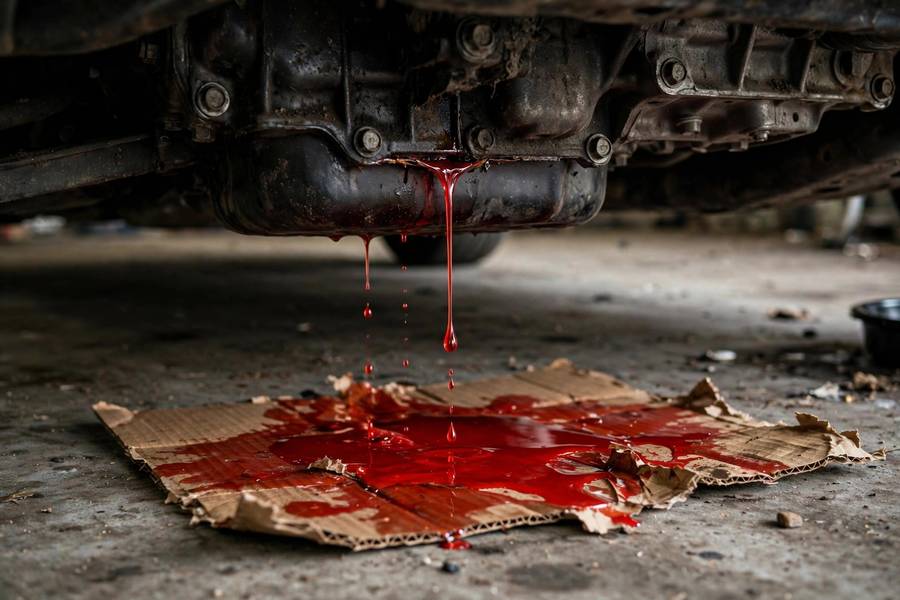
Spots on the ground. The classic. Reddish or pinkish spots under the car, usually toward the middle or front-middle of the vehicle (where the transmission sits). Fresh ATF is bright red; older fluid is darker. Either way, if it’s red and oily and under the middle of the car, suspect the transmission first.
Low fluid level. If you check your transmission fluid and it’s low with no recent service, it’s going somewhere. Transmissions don’t burn fluid — low means leaking, period.
Burning smell after driving. Fluid dripping onto the hot exhaust produces a distinctive acrid burning smell. If you smell burning and there’s no smoke from the engine bay, look underneath.
Shifting changes. Delayed engagement, slipping, harsh shifts — these are symptoms of the low fluid the leak caused, not the leak itself. By the time you’re feeling these, the leak has been going on a while.
Is It Actually Transmission Fluid? (Color and Smell Test)
Before you diagnose a transmission leak, make sure it’s actually transmission fluid. Cars leak several fluids, and they can look similar on concrete:
- Transmission fluid (ATF): red or pink when fresh, brownish-red when old. Slightly sweet, petroleum smell. Oily but thinner than motor oil.
- Engine oil: amber to dark brown/black. Thicker. Usually found toward the front of the car.
- Coolant: green, orange, pink, or blue depending on type — but it’s watery, not oily, and smells sweet. (Pink coolant can be confused with ATF at a glance — touch it; coolant isn’t oily.)
- Power steering fluid: often the SAME red as ATF on many cars (some use ATF as power steering fluid). Usually found toward the front, near the steering rack or pump.
- Brake fluid: clear to light amber, very thin, often near wheels.
The touch test is definitive: rub it between your fingers. ATF is distinctly oily and slick. Coolant feels watery. If it’s red AND oily AND roughly under the middle of the car, you’ve got a transmission leak.
One more trick: put white paper or cardboard under the suspected area overnight. In the morning you’ll have a clean sample to examine in good light, and the location will tell you a lot.
The 5 Common Leak Locations
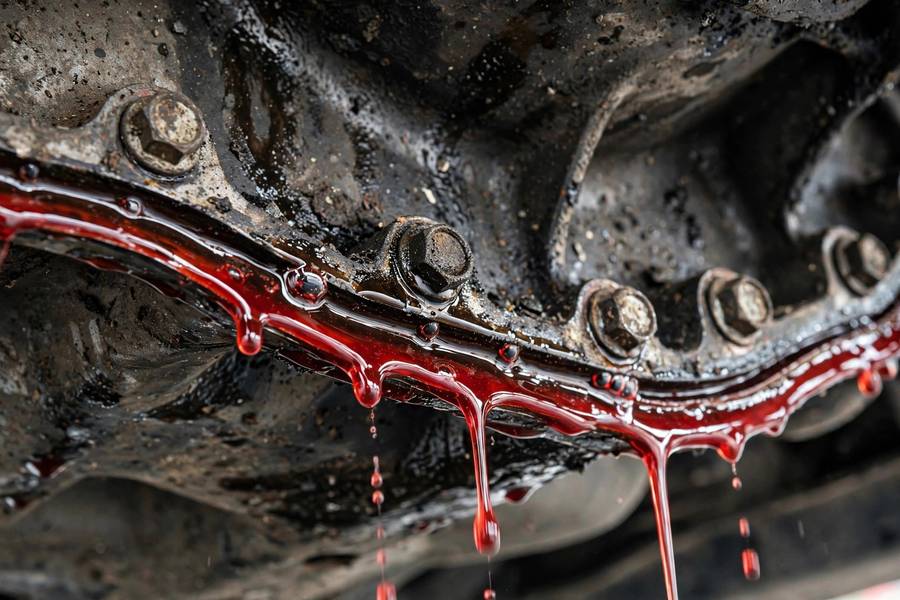
1. Transmission pan gasket. The most common leak, full stop. The pan gasket seals the fluid pan to the bottom of the transmission case, and over years of heat cycles it hardens, shrinks, and starts weeping. Symptom: wetness or dripping around the edges of the transmission pan (the flat pan under the middle of the car). Usually a slow seep that gets worse over time. Fix: new gasket and filter while the pan’s off — routine work.
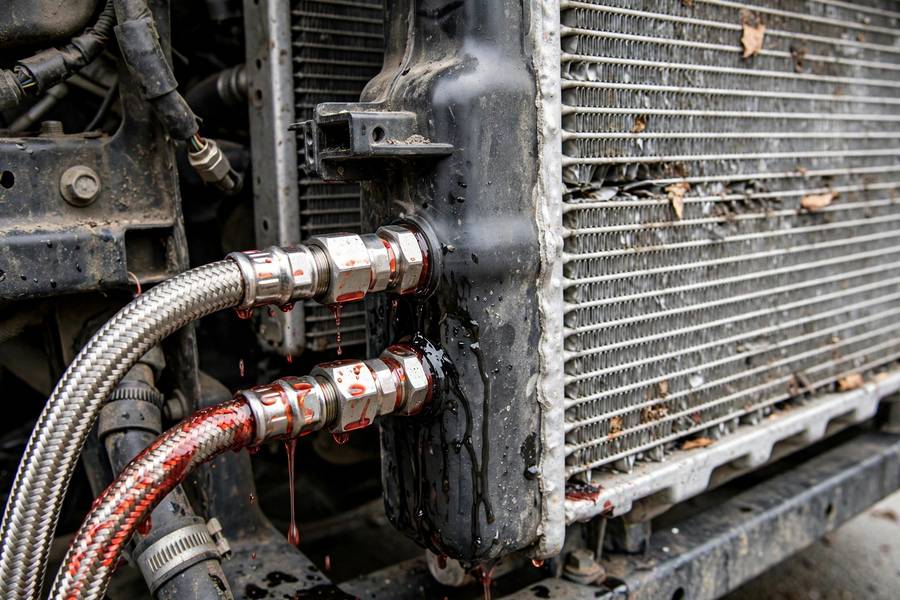
2. Cooler lines and fittings. Transmission fluid circulates to a cooler (usually in the radiator) through metal lines with rubber sections and threaded fittings. These corrode, crack, and loosen — especially the rubber sections and the fittings at the radiator. Symptom: wet lines, dripping near the front of the car or along the line route, sometimes a spray pattern if a line is split. These can go from seep to gusher fast — a blown cooler line can empty a transmission in minutes.
3. Axle seals (output shaft seals). Where the drive axles (FWD) or driveshaft (RWD) enter the transmission, seals keep fluid in. They wear with age and mileage. Symptom: fluid flung around the area — look for spray patterns on nearby components, inner fender, or the underside. Often worse after driving (centrifugal force throws the fluid). Fix: seal replacement; the axle has to come out, so there’s labor involved.
4. Dipstick tube O-ring. Small seal where the dipstick tube enters the transmission case. Cheap part, easy fix, but often overlooked. Symptom: seepage around the base of the dipstick tube. If everything else looks dry and the tube base is wet, this is your culprit.
5. Front pump seal / torque converter seal. The seal between the torque converter and the transmission’s front pump. When this goes, fluid drips from the bellhousing area — between the engine and transmission. Symptom: dripping from the bottom of the bellhousing, often with no other visible source. This is the expensive one: the transmission has to come out to replace a $20 seal. Labor is the killer here.
Leak Symptoms While Driving
A leak doesn’t just leave spots — it changes how the car behaves as the level drops:
- Delayed engagement when shifting into Drive or Reverse, especially when cold.
- Slipping under acceleration — RPMs climb without matching speed.
- Harsh or late shifts as hydraulic pressure becomes inconsistent.
- Transmission overheating — less fluid means less cooling.
- Whining noise from the pump as it starts cavitating.
If you’re experiencing these, the leak has already cost you fluid — check the level now. And if the symptoms are severe, read my piece on whether you can drive with low transmission fluid before you go anywhere — the answer might be “don’t.”
The Cardboard Test: Pinpointing the Source
This is the single most useful DIY leak diagnostic, and it costs nothing:
- Park on a level surface where you always park.
- Slide a large piece of clean cardboard under the engine/transmission area.
- Leave it overnight (or for a full day if the leak is slow).
- In the morning, check: color, approximate location relative to the car, and size of the spot.
Mark the cardboard with “front of car” so you can orient it. The spot’s position tells you roughly where the leak is: front-middle suggests cooler lines or front seal; center suggests pan gasket; toward the wheels suggests axle seals.
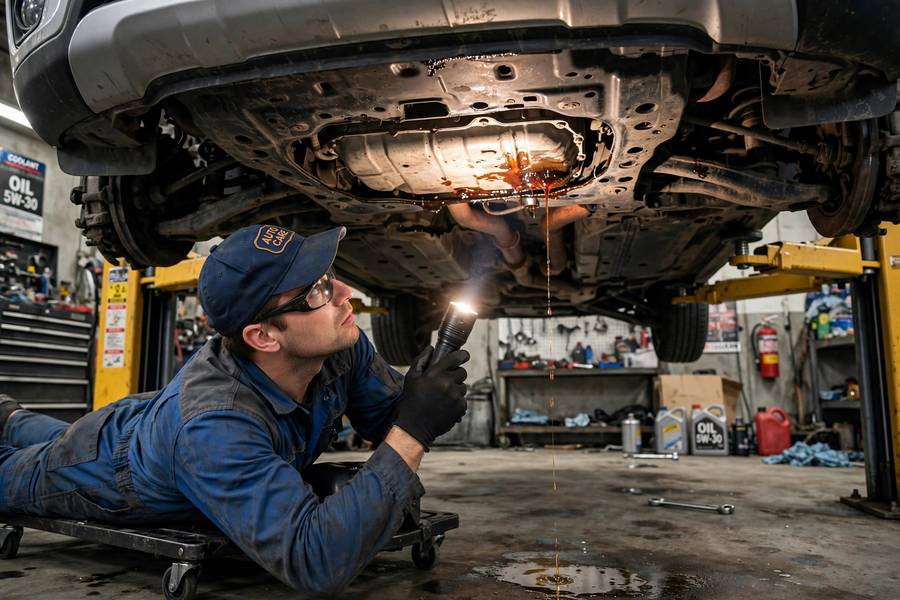
Then get under there with a flashlight (car safely on stands, engine OFF and cool) and trace upward from the wettest point. Fluid runs down and blows backward while driving, so the source is always higher and more forward than the drip. Clean the area with brake cleaner, drive briefly, and recheck — fresh wetness on a clean surface is unmistakable.
How Urgent Is It? A Leak Triage Guide
Not all leaks demand the same response:
- Slow seep, no drips on the ground, level barely dropping: monitor it. Check the level monthly. Schedule the repair when convenient. Many cars live years with a weeping pan gasket.
- Active dripping, spots on the driveway, level dropping between checks: fix it soon. Top off the fluid in the meantime — here’s how to add transmission fluid properly. Don’t let it run low.
- Steady stream, large puddles, shifting symptoms: fix it now. Top off and drive gently to the shop, or tow it if symptoms are severe.
- Blown cooler line (fluid pouring out): do not drive. Shut it off. A transmission can pump itself dry in minutes through a split cooler line, and running dry destroys it fast. Tow.
The golden rule: the leak itself is almost always cheaper to fix than the damage from running low. A $150 gasket job ignored becomes a $4,000 rebuild. Leaks never get better on their own — they only get worse, usually at the worst possible time.
What Leaks Cost to Fix: A Shop Pricing Walkthrough
Nobody likes surprise bills, so here’s what each of the common leak locations typically runs at an independent shop — parts and labor, in normal US dollars, not dealership pricing.
- Pan gasket: $150–300. The cheapest common leak. New gasket, fresh filter while the pan is down, fluid to refill. If your leak is here, congratulations — this is the good news version.
- Axle (output shaft) seals: $200–400 per side. Seals are cheap; the labor is pulling the axle. We usually replace both sides if one is leaking, since the other is the same age.
- Cooler lines and fittings: $150–350. Lines corrode or fittings weep. Straightforward on most cars, annoying on the ones where the lines snake behind everything.
- Torque converter seal (front pump seal): $800–1,500. This is the expensive one — the transmission has to come out to reach it. The seal itself costs less than lunch; the eight hours of labor is the bill.
- Speed sensor or electrical connector seals: $100–250. Small leaks, small bills, but they drip onto the same spots as the expensive ones, so they get misdiagnosed a lot.
Two rules I give every customer: fix cheap leaks fast — a $200 pan gasket ignored becomes a $4,000 transmission if the level drops low enough. And get the source identified before authorizing the repair — UV dye in the fluid takes one drive cycle to reveal exactly where the leak starts, and it costs less than guessing wrong.
Frequently Asked Questions
Red or pink spots under the middle of the car, low fluid level on the dipstick, burning smell after driving, and shifting problems like delayed engagement or slipping. Transmissions don’t consume fluid, so a low level always means a leak.
Fresh transmission fluid is bright red or pink; older fluid is darker reddish-brown. It’s oily to the touch with a slightly sweet petroleum smell. Pink coolant can look similar — the touch test (oily vs watery) tells them apart.
The five common spots are the pan gasket (most common), cooler lines and fittings, axle seals, the dipstick tube O-ring, and the front pump/torque converter seal (most expensive to fix, since the transmission must come out).
A slow seep with the level maintained is drivable short-term while you schedule a repair — keep topping off the fluid. Active dripping with shifting symptoms means drive gently to a shop or tow it. A blown cooler line means don’t drive at all.
Put cardboard under the car overnight to pinpoint the drip location, then trace upward and forward from the wettest point with a flashlight — fluid runs down and blows backward while driving. Cleaning the area and rechecking after a short drive confirms the exact source.