If there’s one piece of advice I’d tattoo on every CVT owner’s forehead, it’s this: change your fluid. Not when the transmission starts whining. Not at 100,000 miles “when you get around to it.” On a schedule, with the right fluid, every time.
The “lifetime fluid” claim in some owner’s manuals has probably killed more CVTs than any design flaw. Lifetime of what — the fluid, or the transmission? Because in practice, neglected fluid ends the transmission’s life early. I’ve watched it happen too many times.
Before we get into schedules, make sure you understand what the fluid actually does — my explainer on what a CVT transmission is and how it works covers the belt-and-pulley system that depends on this fluid so completely.
Table of Contents
- Why CVT Fluid Matters More Than Regular ATF
- The Real Interval: 30,000 to 50,000 Miles
- Severe Service: When to Go Shorter
- Drain and Fill vs Flush: Which Is Right
- Using the Correct Fluid: Non-Negotiable
- What a CVT Fluid Service Costs
- Signs Your Fluid Is Overdue
- Can You Change CVT Fluid Yourself
- Frequently Asked Questions
Why CVT Fluid Matters More Than Regular ATF
In a conventional automatic, transmission fluid lubricates gears and clutch packs and carries hydraulic pressure. Important, sure. In a CVT, the fluid does all of that PLUS one critical extra job: it creates the friction that lets the steel belt grip the pulleys.
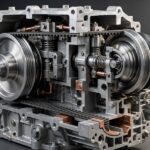
Read that again. The belt has no teeth. It doesn’t mesh with anything. It holds onto smooth metal pulley faces through friction alone, under enormous clamping force. The fluid’s friction characteristics are precisely engineered for this — too slippery and the belt slips, too grabby and you get shudder.
On top of that, CVT fluid manages the hydraulic pressure that squeezes the pulleys, cools the belt-pulley contact zone (one of the hottest spots in any transmission), and protects against the metal-on-metal wear that happens at a microscopic level every second you drive. When this fluid degrades, every single one of those jobs gets worse simultaneously. That’s why fluid condition correlates so tightly with how long a CVT lasts — neglected fluid is the number one cause of premature CVT failure.
The Real Interval: 30,000 to 50,000 Miles
Here’s my recommendation, based on years of watching CVTs live and die:
- Normal driving: every 40,000–50,000 miles. This covers typical commuting, highway cruising, and mixed use in moderate climates.
- Mixed/harder use: every 30,000–40,000 miles. Frequent stop-and-go, hot climates, hilly terrain.
- Severe service: every 25,000–30,000 miles (details below).
“But my manual says the fluid is lifetime!” I hear you. Here’s the thing: “lifetime” in manufacturer-speak often means the lifetime of the warranty, or the lifetime they designed around for the first owner. It does not mean the fluid never degrades. Heat cycles, shear forces, and contamination degrade every fluid ever made. The laws of chemistry don’t care about marketing copy.
Some manufacturers have quietly walked back lifetime claims — Nissan, after their well-publicized CVT issues, now recommends 60,000-mile intervals on many models (I’d still go shorter). Honda and Toyota have maintenance minders that call for fluid service based on driving conditions. If your car has a maintenance minder, follow it — it’s smarter than a fixed “lifetime” claim.
Severe Service: When to Go Shorter
Your owner’s manual probably defines severe service in the fine print. For CVTs, treat any of these as a reason to service every 25,000–30,000 miles:
- Towing anything, even within the rated limit
- Rideshare or delivery driving — constant stop-and-go is brutal on CVT fluid temperatures
- Mountain or hilly driving — sustained grades heat the belt-pulley contact hard
- Extreme heat — desert summers, Phoenix traffic, that kind of thing
- Frequent short trips — the fluid never fully warms up, which accelerates contamination
- Dusty conditions — contamination finds its way in
I put my own cars on the severe schedule if they check even two of these boxes. Fluid is cheap. Transmissions are not. This is the easiest math in car ownership.
Drain and Fill vs Flush: Which Is Right
This is where CVT service gets controversial, so let me be clear:
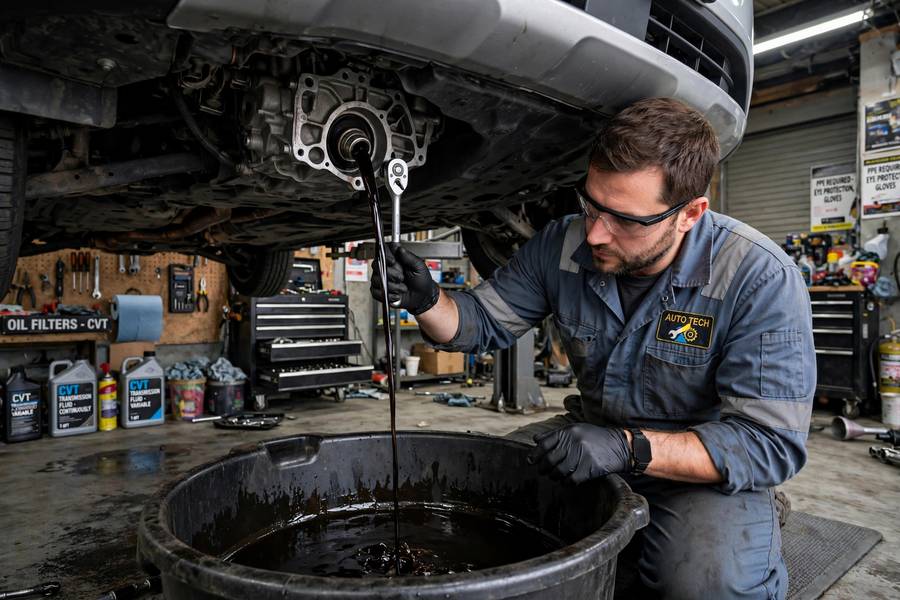
Drain and fill removes the drain plug, lets 4–6 quarts flow out (roughly half the total capacity — the rest stays in the torque converter and valve body), and refills with fresh fluid. It’s gentle, it’s safe, and I recommend it for every CVT service.
Flush (or fluid exchange) uses a machine to push all the old fluid out and replace it — a complete exchange. On a well-maintained transmission, it’s fine. On a high-mileage CVT that’s never been serviced, it can be risky: the pressure and detergents can dislodge accumulated debris and varnish, which then circulates into the valve body and solenoids.
My rule: if the fluid has been changed on schedule all along, either method works. If you’re servicing a CVT at 90,000+ miles for the first time, do a drain-and-fill. Then do another drain-and-fill in 10,000–15,000 miles. Two gentle services beat one aggressive flush on a neglected unit.
Some shops push flushes because the machine does the work and the ticket is bigger. A good shop will discuss your service history before recommending. If they push a flush on your 120,000-mile never-serviced CVT without asking questions, find another shop.
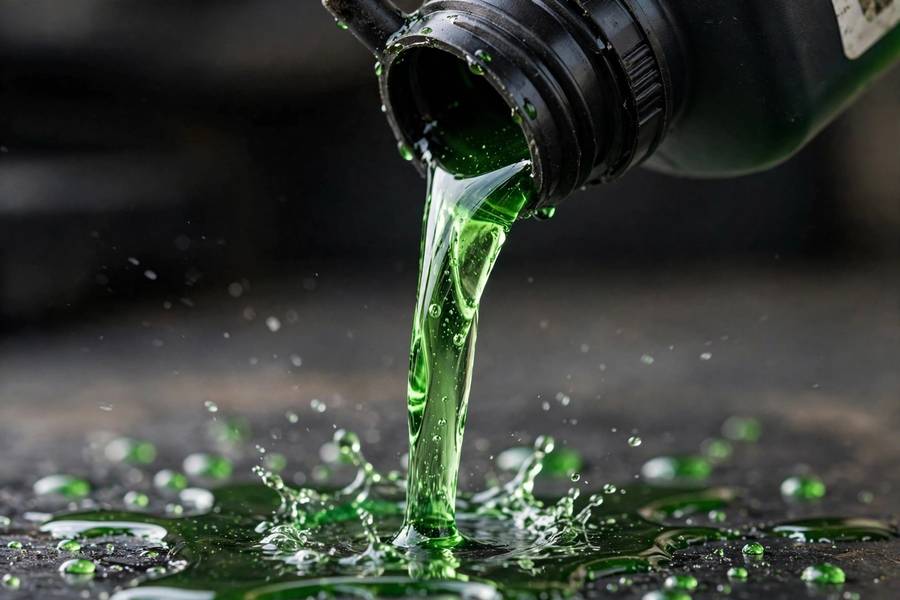
Using the Correct Fluid: Non-Negotiable
This deserves its own section because getting it wrong destroys transmissions:
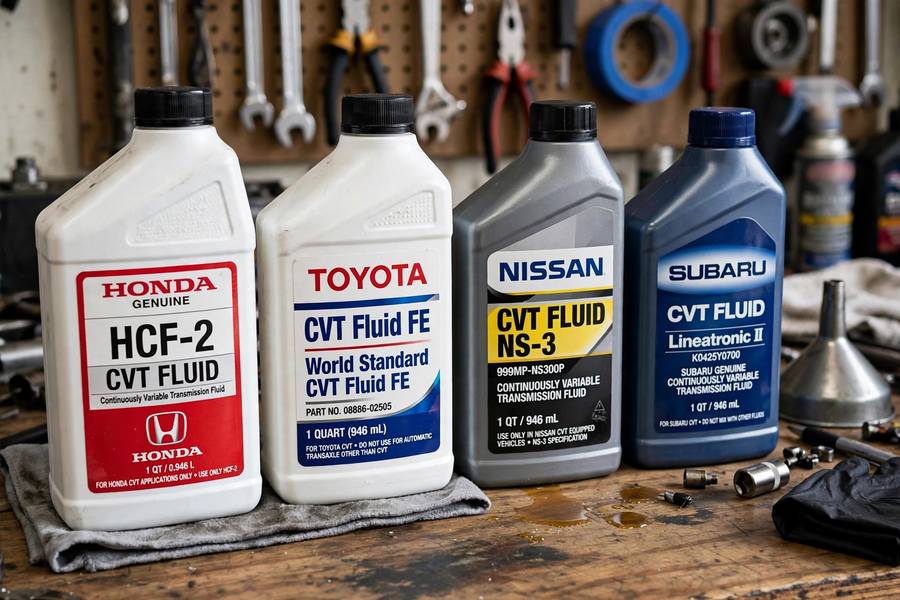
- Nissan: NS-2, NS-3 (not interchangeable — use exactly what your model specifies)
- Honda: HCF-2 (older models used different specs — check your manual)
- Toyota/Lexus: Toyota CVT Fluid FE or TC, depending on model
- Subaru: Lineartronic CVT fluid (Subaru-specific)
- Mitsubishi: DiaQueen CVTF-J1/J4
Notice the pattern: every manufacturer has its own specification. That “universal CVT fluid” on the shelf? It’s a compromise formulation trying to cover all of these specs at once. Some are decent; none are what the engineers designed around. For a $100–$200 service protecting a $5,000 transmission, I use the OEM fluid every single time. This is not the place to save $30.
And never — ever — use regular automatic transmission fluid (ATF) in a CVT. The friction characteristics are completely different. ATF in a CVT causes belt slip almost immediately, and sustained use will kill the unit. I’ve seen it happen when a quick-lube shop grabbed the wrong drum. Devastating and completely avoidable.
What a CVT Fluid Service Costs
Realistic price ranges (these are estimates, not quotes — prices vary by region and shop):
- Drain-and-fill at an independent shop: $150–$300, including OEM fluid
- Drain-and-fill at a dealership: $250–$400 (you’re paying for OEM fluid and brand labor rates)
- Full fluid exchange/flush: $250–$450
- DIY: $60–$120 in fluid plus a Saturday afternoon
Compare that to a CVT replacement at $3,500–$7,500, and the economics are absurdly one-sided. Three fluid changes over 150,000 miles cost less than a tenth of one replacement. I genuinely don’t understand owners who skip this.
Signs Your Fluid Is Overdue
Don’t wait for the schedule if you notice:
- Whining that wasn’t there before, especially under acceleration
- Shuddering at low speeds or when pulling away
- Dark or burnt-smelling fluid on the dipstick (if your car has one — many CVTs are sealed)
- Delayed engagement when shifting into drive or reverse
- You’re past the mileage interval and can’t remember the last service
If you can check your fluid, learn how to check transmission fluid properly — color and smell tell you most of what you need to know.
Can You Change CVT Fluid Yourself
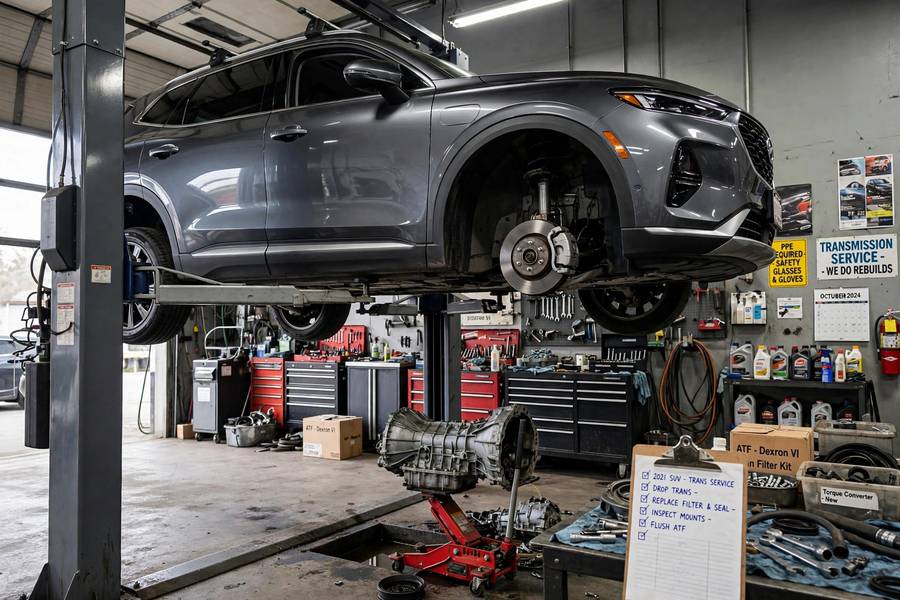
Yes, with caveats. A drain-and-fill is mechanically simple: warm up the car, remove the drain plug, measure what came out, refill the same amount through the fill port. But CVTs have quirks:
- Many have no dipstick — the fill level is checked via an overflow plug at a specific fluid temperature, which means you need a scan tool that reads transmission temperature.
- Getting the level exactly right matters more on a CVT than a conventional automatic. Overfilling causes foaming and overheating; underfilling starves the hydraulics.
- Some models require a fluid temperature check procedure that involves cycling through gears with the car level on jack stands.
If you’re comfortable with that, DIY saves real money. If any of it sounds intimidating, pay a shop — a $200 service is still cheap insurance. And whatever you do, don’t let a general quick-lube place do it unless you’ve confirmed they know your specific CVT and stock the correct fluid.
One more DIY trap specific to CVTs: the fluid temperature window for the level check. On many units the overflow-plug check is only valid between roughly 95°F and 115°F fluid temp — too cold and you’ll overfill, too hot and you’ll underfill. A $25 Bluetooth OBD adapter and a phone app that reads transmission temperature turns this from guesswork into a procedure. Without a temp reading, you’re not doing the job; you’re approximating it.
Frequently Asked Questions
Every 30,000–50,000 miles for most drivers — 40,000–50,000 for normal use, 30,000–40,000 for harder use, and 25,000–30,000 for severe service like towing or rideshare driving. Ignore “lifetime fluid” claims.
Drain-and-fill is safer, especially on high-mileage CVTs that haven’t been serviced regularly. A flush is fine on a well-maintained unit but can dislodge debris in a neglected one. When in doubt, drain-and-fill.
It’s a gamble I don’t recommend. Each manufacturer specifies its own fluid with precise friction characteristics for the belt-pulley grip. Use the exact OEM-spec fluid — the $30 savings isn’t worth risking a $5,000 transmission.
The fluid degrades, loses its friction properties and hydraulic precision, and the belt starts slipping and wearing the pulleys. This leads to whining, shuddering, overheating, and eventually transmission failure — often well before 150,000 miles.
Typically $150–$300 at an independent shop or $250–$400 at a dealership for a drain-and-fill with OEM fluid. DIY costs $60–$120 in fluid. Either way, it’s a fraction of a $3,500–$7,500 replacement.