An old car battery is one of the most hazardous things in your garage and one of the easiest to dispose of properly — which makes it baffling how many end up in trash bins, ditches, and backyard corners. A single battery contains 15-20 pounds of lead and about a gallon of sulfuric acid. In a landfill, that’s an environmental disaster. At a recycler, it’s raw material for the next battery. Here’s exactly where to take it, how to transport it safely, the money you get back, and what the law says. When your battery reaches end of life (see how long car batteries last), this is the responsible next step.
Table of Contents
- Why You Can’t Just Throw It Away
- The Free Options: Where to Take It
- The Core Charge: Getting Your Money Back
- How to Transport It Safely
- What Happens at the Recycler
- Storing an Old Battery Before Disposal
- What the Law Says
- Dealing With Leaking or Damaged Batteries
- Frequently Asked Questions
Why You Can’t Just Throw It Away
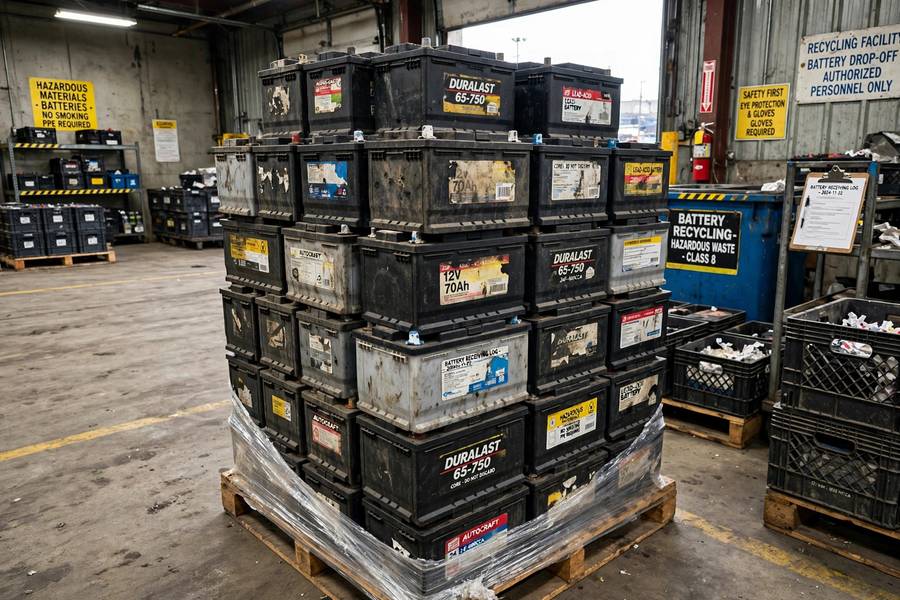
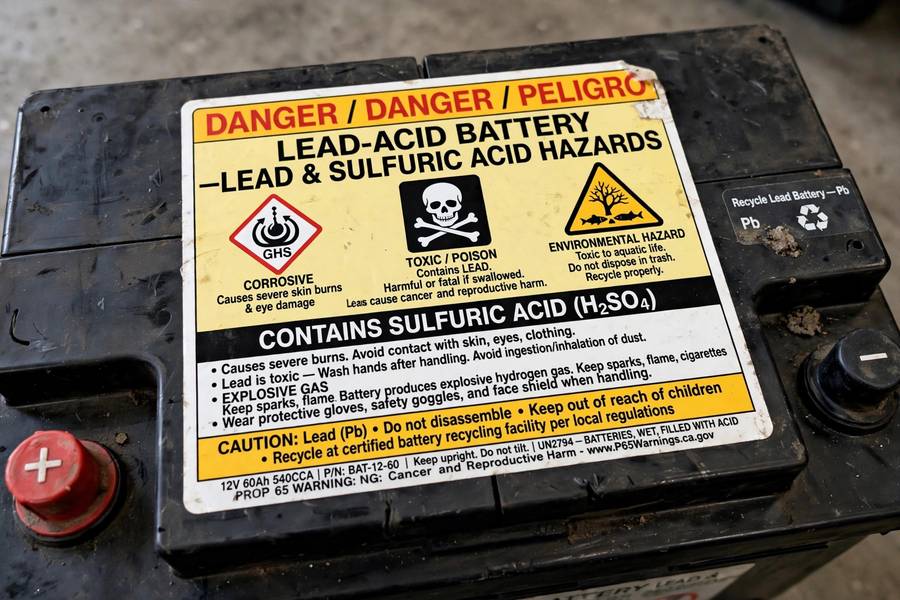
The contents, plainly: 15-20 pounds of lead (a potent neurotoxin), roughly a gallon of sulfuric acid (corrosive enough to burn skin and destroy ecosystems), and plastic casing. In a landfill, the case eventually cracks, acid leaches into soil and groundwater, and lead contaminates everything it touches. Lead doesn’t biodegrade — it persists, accumulating in soil and water systems essentially forever. One battery in a landfill is a small toxic waste site.
The flip side is the good news: car batteries are the most recycled consumer product in the United States, with a recycling rate of 98-99 percent. The lead is infinitely recyclable — melted down and cast into new battery plates with no quality loss. The plastic becomes new battery cases. Even the acid is neutralized and converted into sodium sulfate for laundry detergent, glass, and textiles. A recycled battery becomes a new battery with remarkable efficiency. Throwing one away isn’t just harmful — it’s wasteful, because the material is genuinely valuable.
This isn’t a guilt trip; it’s a practical point. The recycling infrastructure exists, it’s free, and in many cases it pays you. There is no reason — convenience, cost, or otherwise — to dispose of a battery improperly.
The Free Options: Where to Take It
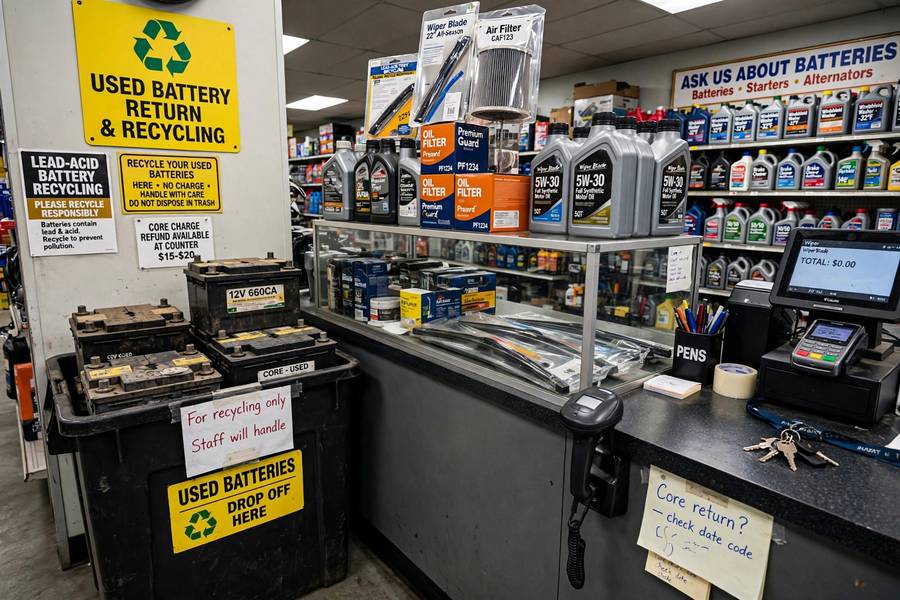
Auto parts stores: the easiest option. AutoZone, O’Reilly, Advance Auto Parts, NAPA, and most independents accept used batteries free — no purchase required, though they’ll happily sell you the replacement. Just carry it in and hand it over. They aggregate them for recyclers and it’s built into their business model.
Battery retailers and warehouse clubs: anywhere that sells batteries typically takes old ones — Costco, Sam’s Club, Walmart’s auto center, Batteries Plus. If you bought the new battery there, the core return happens in the same transaction.
Repair shops and dealerships: any shop that replaces batteries accepts old ones — they have recycler pickup arrangements. If a shop did your replacement, the old battery never touches your hands; the core is handled in their pricing.
Municipal options: most cities and counties have household hazardous waste (HHW) drop-off sites or periodic collection events that accept batteries free. Scrap metal yards also take them — and unlike parts stores, scrap yards pay by weight for the lead (typically $5-$15 per battery depending on lead prices). It’s not a fortune, but it’s more than free.
What I’d do: if buying a replacement, return the old battery at purchase (simplest, core refund in one trip). If you just found an old battery in the garage, nearest parts store, no appointment needed. And if the dead battery is still in a car that won’t start, you’ll need a jump to drive it to the drop-off — how to jump start a car covers the safe cable order.
The Core Charge: Getting Your Money Back
When you buy a new battery, you pay a core charge — typically $10-$25 depending on state — which is a deposit, not a fee. Return the old battery and you get it back. The mechanics: buy the new battery, pay the core charge; bring the old battery (same trip if you’re replacing it yourself, or later with the receipt); get the refund as cash or credit.
No receipt, no problem at most stores for the core itself — the core charge refund is tied to the battery return, and many stores refund it with just the battery. But keep the receipt anyway; it documents the warranty on your new battery, which matters more than the core.
If someone else replaced your battery (shop or dealership), the core is invisible to you — they keep the old battery and the core value is baked into their pricing. That’s standard and fair. And if you have an old battery with no new purchase involved, the scrap yard route ($5-$15 by weight) beats the parts store route ($0) — though the parts store is closer for most people. Either way, the battery gets recycled; the only question is whether you get coffee money for it.
How to Transport It Safely
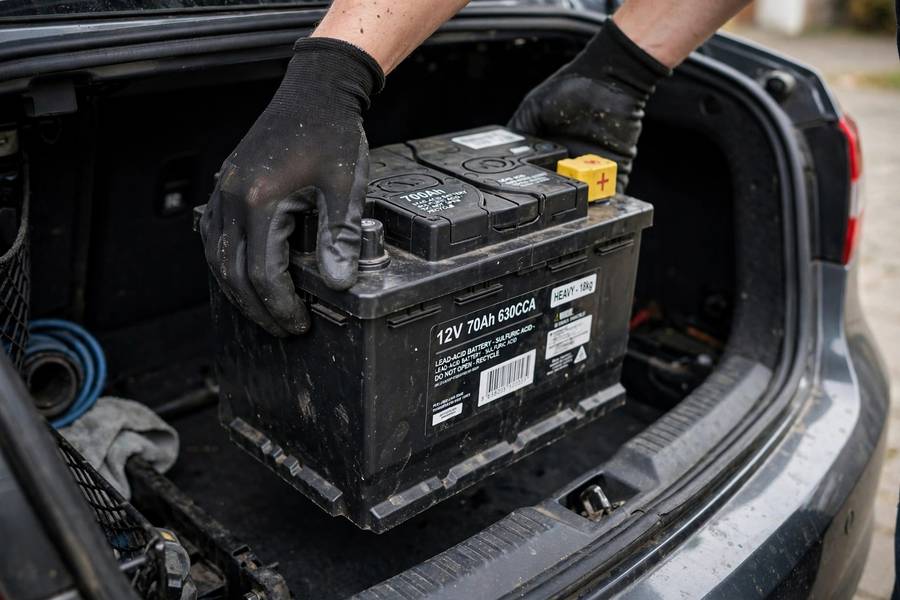
Batteries weigh 30-50 pounds and contain acid — transport them like it. Keep the battery upright at all times: tipping lets acid leak through the vents, even on “sealed” batteries. Place it in a sturdy plastic bin, tray, or heavy-duty trash bag as secondary containment — if it leaks, the acid stays in the bin, not in your trunk carpet (acid-eaten trunk carpet is a smell that never fully leaves).
Secure it so it can’t tip or slide: wedge it with towels, seatbelt it, whatever works — a 40-pound battery becoming a projectile in a sudden stop is dangerous, and a tipped battery leaking acid in the trunk is a mess. Wear gloves handling it, and wash your hands after — old batteries often have acid residue and lead dust on the case.
Ventilation: crack a window if it’s in the passenger compartment rather than the trunk. Batteries vent hydrogen, especially old or damaged ones. It’s a minor risk for a short trip, but free to mitigate. And never transport a visibly leaking or cracked battery in the passenger compartment — double-bag it, trunk only, gloves on, straight to the recycler.
What Happens at the Recycler
The recycling process is impressively thorough. Batteries are collected and shipped to secondary lead smelters. There, they’re crushed in a hammer mill; the components separate by density. The lead plates and grids go to furnaces, melted at around 600°F, refined, and cast into ingots — which become new battery plates. The polypropylene cases are washed, melted into pellets, and molded into new battery cases. The sulfuric acid is either neutralized into sodium sulfate (sold for industrial use) or converted back into electrolyte for new batteries.
The closed loop is nearly perfect: a new car battery contains 60-80 percent recycled lead. The energy to recycle lead is a fraction of mining new lead. This is why the economics work without subsidies — the material is worth recovering. Your old battery isn’t waste; it’s inventory for the next one.
The scale is enormous: over 100 million car batteries are recycled annually in the US alone. The system works because every link — consumer return, store aggregation, smelter processing — has an economic incentive. Your part is just the first link: getting it to a collection point instead of a trash can.
Storing an Old Battery Before Disposal
Sometimes disposal isn’t immediate — you’re waiting for the weekend, the HHW event is next month. Store it right. Location: a cool, dry place on a concrete floor or in a plastic bin — garage floor is ideal. Not on bare earth (moisture accelerates case degradation), not anywhere children or pets access, not near anything flammable.
Position: upright, always. Terminals: cover them — a plastic bag secured with a rubber band, or terminal caps if you have them. This prevents accidental shorting if something metal falls across the terminals (a wrench across battery terminals is a welding demonstration you don’t want in your garage).
Don’t: store it on its side, stack things on it, store it near the water heater or furnace (heat + hydrogen + ignition source), or leave it indefinitely. “I’ll deal with it later” is how batteries sit for three years, leak, and stain the concrete. Set a date within a month. And don’t try to drain the acid yourself thinking it makes the battery “safe” — it doesn’t (the lead plates are still hazardous), it’s dangerous to handle, and recyclers want the battery whole.
What the Law Says
In the US, it’s illegal in all 50 states to dispose of lead-acid batteries in household trash or landfills — every state has some form of battery disposal law, and most require retailers to accept used batteries. Penalties vary by state but include fines; more practically, trash haulers increasingly refuse loads with visible batteries, and transfer stations surcharge them.
Retailer take-back is also law in most states: stores that sell batteries must accept used ones (usually up to a reasonable quantity per visit). This is why the parts store option is universal — it’s not courtesy, it’s compliance. Some states add the core charge by statute to enforce the return loop.
Internationally, the picture is similar: the EU’s Battery Directive mandates collection and recycling (with even higher targets than the US achieves), the UK has battery regulations requiring retailer take-back, Canada has provincial stewardship programs. Wherever you are, the pattern holds: batteries are regulated hazardous waste with free collection infrastructure. “I didn’t know where to take it” isn’t a defense and isn’t true — the parts store down the street is the answer almost everywhere.
Dealing With Leaking or Damaged Batteries
A leaking battery needs care, not panic. Gear up: chemical-resistant gloves (not just work gloves — acid eats through leather eventually), eye protection, old clothes. Ventilate the area. If acid has spilled on a surface: neutralize with baking soda (generous amounts — it fizzes on contact with acid), let it work, then wipe up with disposable rags and rinse. Baking soda neutralizes; water alone just dilutes and spreads.
On skin: flush with water immediately, 15+ minutes, remove contaminated clothing. In eyes: flush 15+ minutes and seek medical attention — this is the emergency scenario, don’t wait. On concrete: baking soda, scrub, rinse — the stain may remain but the acid is neutralized. On car paint or metal: rinse immediately and neutralize — acid etches paint fast and corrodes metal.
Transport a leaking battery double-contained: heavy-duty bag inside a plastic bin, upright, gloves on. Tell the receiving store it’s leaking — they’ve handled it before and have procedures. And if the battery is swollen, hot, or hissing: that’s beyond leaking — keep your distance, ventilate, don’t transport it hot. Let it cool, then contain and transport. A thermally runaway battery is rare in lead-acid (more a lithium concern), but respect the warning signs regardless.
Frequently Asked Questions
Any auto parts store (AutoZone, O’Reilly, Advance, NAPA) accepts used batteries free with no purchase required. Also: battery retailers, warehouse clubs, repair shops, municipal hazardous waste drop-offs, and scrap yards (which pay $5-$15 by weight for the lead).
No — it’s illegal in all 50 US states and most countries. Batteries contain 15-20 pounds of lead and a gallon of sulfuric acid; in landfills they leach toxins into soil and groundwater permanently. Recycling is free, widely available, and recovers 98-99% of the battery’s materials.
Typically $10-$25, depending on the state. It’s a deposit added to the new battery price, refunded when you return the old battery. Bring the old battery when buying the new one to handle it in a single trip. Without a new purchase, scrap yards pay about $5-$15 per battery by weight.
They’re crushed and separated: lead is melted and cast into new battery plates (new batteries contain 60-80% recycled lead), plastic cases become new cases, and acid is neutralized into industrial sodium sulfate. Over 100 million car batteries are recycled annually in the US at a 98-99% rate.
Keep it upright in a plastic bin or heavy bag (secondary containment for leaks), secure it so it can’t tip or slide, wear gloves, wash hands after handling, and cover the terminals to prevent shorting. Never transport a leaking battery in the passenger compartment — trunk only, double-bagged.