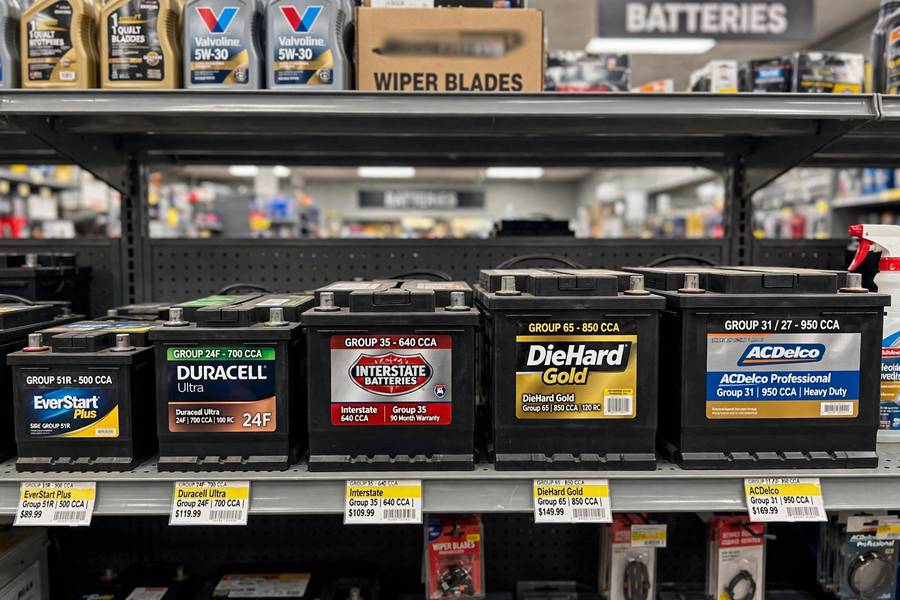
“What size battery does my car take?” might be the most-asked question at every parts counter in America, and the answer is more specific than most people expect. It’s not just “a 12-volt” — it’s a group size (physical dimensions and terminal layout), a CCA rating (starting power), and a reserve capacity. Get any of them wrong and you’re looking at fitment headaches, winter no-starts, or a battery sliding around the tray. Here’s how to find exactly what your car needs and what the specs mean. For when that battery eventually wears out, see how long car batteries last.
Table of Contents
- The Short Answer: Check Three Places
- Battery Group Sizes Explained
- Common Group Sizes and What They Fit
- CCA: Cold Cranking Amps
- Reserve Capacity and Amp-Hours
- Terminal Types and Orientation
- Can You Use a Different (Bigger/Smaller) Battery?
- Special Cases: Start-Stop, Hybrids, and Oddballs
- Frequently Asked Questions
The Short Answer: Check Three Places
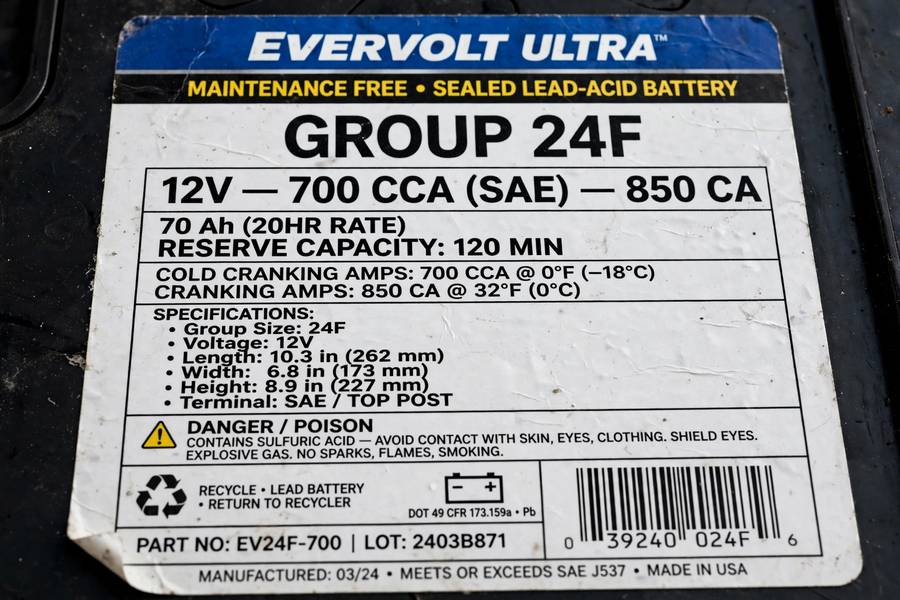
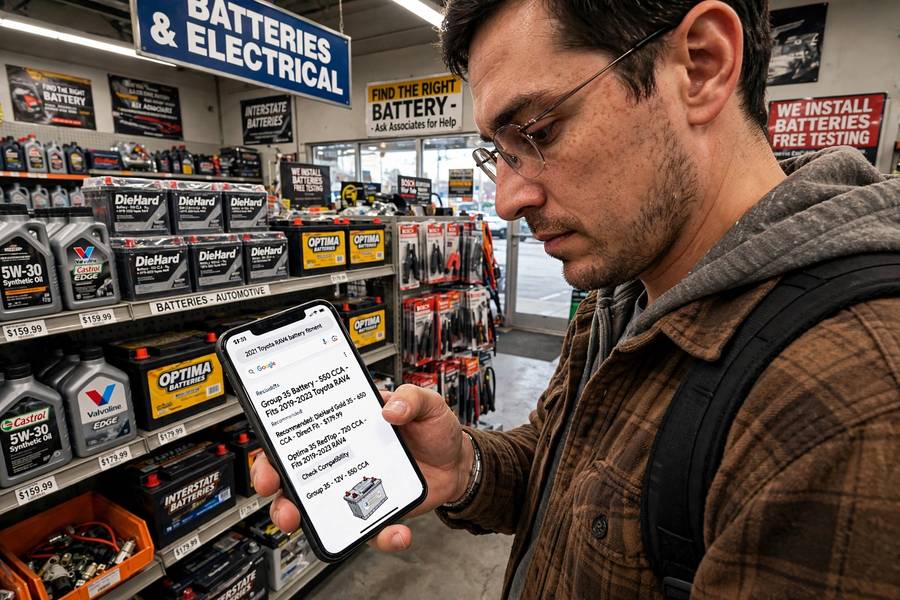
The fastest way to find your battery size: first, look at the battery currently in the car — the group size is printed on the label (e.g., “Group 24F,” “Group 35,” “H6”). If it’s the original or correct battery, just buy the same group size. Second, check your owner’s manual — the specifications section lists the required group size and CCA. Third, use any parts store’s fitment lookup (in-store or online): enter year, make, model, engine, and it returns the exact group sizes that fit.
My recommendation: use the fitment lookup and cross-check against what’s in the car. If they agree, you’re done. If they disagree — the current battery is the wrong size, which happens more than you’d think (previous owners improvising) — trust the fitment guide, not the improvisation. And when in doubt, the owner’s manual is the tiebreaker. It’s the manufacturer’s spec, not a suggestion.
Battery Group Sizes Explained
The “group size” is a standardized code defined by the BCI (Battery Council International) that specifies a battery’s physical dimensions — length, width, height — plus terminal type and terminal placement. It’s the reason batteries are interchangeable at all: a Group 35 from any manufacturer fits any car designed for Group 35.
Why it matters beyond fit: the tray, hold-down clamp, and cable lengths are all designed around the group size. Wrong size means the hold-down doesn’t secure it (a loose battery vibrates, and vibration kills plates), the hood might not close on a too-tall battery (I’ve seen hoods dented from inside by tall batteries shorting on the hood — exciting in all the wrong ways), or the cables won’t reach the terminals.
Note the letter suffixes: 24 vs 24F, for example. The F means reversed terminal polarity — positive and negative swapped side-to-side. A 24 won’t substitute for a 24F because the cables won’t reach across. The group size code includes terminal position for exactly this reason. Match the full code, letter included.
Common Group Sizes and What They Fit
The usual suspects, though always verify for your specific vehicle. Group 35: common in many Japanese cars (Honda, Toyota, Nissan, Subaru) — compact footprint, top terminals. Group 24/24F: full-size Japanese and many American cars — 24F (reversed) is the Toyota/Honda standard. Group 48/H6: common in European cars and many newer American vehicles — larger, higher capacity. Group 94R/H7: bigger European and American cars, trucks — high capacity for big engines and electrical loads.
Group 65: Ford trucks and full-size SUVs — big footprint, high CCA for V8s. Group 78: GM vehicles — side-terminal variant common in older GMs. Group 34/78 (dual terminal): versatile aftermarket favorite with both top and side terminals. Group 51R: Honda Civic and similar compacts — small, reversed terminals.
Trucks and diesels often use Group 65, 31 (commercial), or dual-battery setups. Motorcycles, lawn equipment, and powersports use entirely different small-format sizes — don’t try to cross-reference those with automotive groups.
The pattern: Japanese compacts cluster around 35/24F/51R, American trucks around 65, Europeans around H6/H7 (48/94R). But “usually” isn’t “always” — trim levels, engines, and model years change requirements. Verify, don’t assume.
CCA: Cold Cranking Amps
CCA — cold cranking amps — is the battery’s starting power: the number of amps it can deliver for 30 seconds at 0°F while maintaining at least 7.2 volts. It’s the spec that decides whether your car starts on a January morning. Typical values: 500-650 CCA for compacts, 650-800 for midsize and V6s, 750-900+ for trucks, V8s, and diesels.
The rule: meet or exceed the original equipment CCA. More CCA is fine — it means more reserve starting power, which is pure upside (slightly bigger, slightly pricier, but never harmful). Less CCA than spec is asking for trouble: the battery works harder every start, wears faster, and fails exactly when you need it most — the coldest morning of the year.
Don’t overthink chasing maximum CCA either. Beyond the vehicle’s requirement plus a reasonable margin, extra CCA buys little — the starter only draws what it needs. I’d rather have a fresh 650-CCA battery than a 3-year-old 800-CCA battery. Freshness and condition beat headline numbers. And in warm climates, CCA matters less than reserve capacity — you’re rarely cold-cranking, but you might run accessories with the engine off.

Reserve Capacity and Amp-Hours
Reserve capacity (RC) is the underrated spec: the number of minutes a fully charged battery can deliver 25 amps before dropping to 10.5 volts. In plain terms, it’s how long your battery keeps the essentials running if the alternator fails — or how much accessory use it tolerates with the engine off. Typical values: 90-160 minutes.
Why it matters more than people think: modern cars have significant parasitic loads and owners run accessories (phone charging, dashcams, audio) with the engine off. Higher RC means more margin. When comparing two batteries of the same group size and similar CCA, pick the higher reserve capacity — it’s free insurance.
Amp-hours (Ah) is the related metric: total charge capacity, typically 45-100Ah for car batteries. A 70Ah battery theoretically delivers 70 amps for one hour (or 7 amps for ten hours — the relationship isn’t perfectly linear, but close enough for comparison). Ah matters most for vehicles that sit or run accessories engine-off: work trucks with lights and equipment, overlanding rigs, cars with dashcams in parking mode. For normal daily drivers, RC and CCA tell you what you need.
Terminal Types and Orientation
Terminals seem trivial until the cables don’t fit. Top-post terminals (SAE): the classic lead posts on top — most American and Japanese cars. Side terminals: threaded posts on the side — older GM vehicles. Both: dual-terminal batteries (like Group 34/78) have both, for flexibility. European cars often use slightly different post diameters (DIN standard) — close to SAE but not identical, another reason to match group size.
Orientation — which side the positive terminal is on — is critical and it’s encoded in the group size (remember the F suffix). With the battery oriented with terminals facing you (or per the standard reference position), positive-left versus positive-right determines whether your cables reach. Cables have limited slack; a reversed battery means the positive cable can’t reach the positive post, and stretching cables to fit is how you get chafed insulation and eventual shorts.
When buying: confirm the terminal type AND orientation match. The fitment guide handles this if you enter your exact vehicle — but if you’re cross-referencing manually from the old battery’s label, check the polarity diagram on the new battery’s label before you leave the store. Five seconds of verification beats a return trip.
Can You Use a Different (Bigger/Smaller) Battery?
Bigger (higher group, more capacity): sometimes. If it physically fits the tray, the hold-down secures it, the hood closes, and the terminals are in the right position with cables reaching — a larger battery works fine and gives more reserve. Truck owners do this deliberately (fitting a Group 65 where a 24 was spec’d) for winter margin. But “fits” means all four conditions, not just “it sits in the tray.” An unsecured battery is a hazard; a too-tall battery shorting on the hood is a fire risk.
Smaller: don’t. A smaller battery means less CCA and less reserve than the vehicle was designed for — shorter life (it works harder), winter starting problems, and potential electrical gremlins from voltage sag under load. The $20 saved isn’t worth it. I’ve replaced too many undersized batteries that died in 18 months doing a job they were never rated for.
Different chemistry (flooded vs AGM): match what the car came with, or upgrade (flooded → AGM is fine; AGM → flooded is a downgrade that shortens life, especially in start-stop vehicles). The car’s charging system is calibrated for the original chemistry — mismatches cause chronic under- or over-charging.
Special Cases: Start-Stop, Hybrids, and Oddballs
Start-stop vehicles: these restart the engine dozens of times per trip, which murders conventional batteries. They require AGM or EFB batteries — non-negotiable. A conventional battery in a start-stop car will fail within months. The battery is also often larger than you’d expect for the vehicle size, because the cycling demands are brutal. And many start-stop cars need battery registration after replacement (the computer tracks battery age and adjusts charging) — factor that into DIY plans.
Hybrids: most hybrids have TWO batteries — the high-voltage traction battery (the expensive one, not this article’s topic) and a conventional 12V auxiliary battery that runs the computers and accessories. The 12V is often a small AGM in an odd location (trunk, under the rear seat). It needs the correct size and type; the car’s computers are sensitive to 12V health, and a weak 12V causes bizarre hybrid-system warnings.
Oddball locations: batteries under seats (some BMWs, Chryslers), in trunks, behind fenders. The group size still follows the same rules, but replacement difficulty varies — some are easy, some require seat removal. Check a video for your specific car before deciding DIY vs shop. And European cars with battery management systems: registration required, as noted — the $200 scan tool or the shop visit is part of the job.
Once the right-sized battery is installed and you’re back on the road, keep the safe starting procedure in your back pocket too — how to jump start a car is the guide I hand to every driver who asks, because the day you need it is never the day you want to be guessing.
Frequently Asked Questions
Check the group size on your current battery’s label, your owner’s manual specs, or a parts store fitment lookup (year/make/model/engine). Match the full group code including letter suffixes (e.g., 24F vs 24), meet or exceed original CCA, and confirm terminal type and orientation.
Group size is a BCI standard code specifying the battery’s physical dimensions, terminal type, and terminal placement. It ensures interchangeability — any Group 35 fits any car designed for Group 35. The letter suffix (like F) indicates reversed terminal polarity.
If it fits the tray, the hold-down secures it, the hood closes, and cables reach the correctly positioned terminals — yes, and you’ll gain reserve capacity. Never use a smaller battery than specified: less CCA and reserve means shorter life and winter starting problems.
At least the original equipment spec: roughly 500-650 CCA for compacts, 650-800 for midsize/V6, 750-900+ for trucks, V8s, and diesels. More CCA than required is fine (extra reserve); less is asking for winter failures. Freshness matters more than chasing maximum CCA.
Yes — start-stop vehicles require AGM or EFB batteries; conventional batteries fail within months under constant restarting. Replace with the same chemistry or upgrade (never downgrade), and note that many start-stop cars require battery registration with a scan tool after replacement.