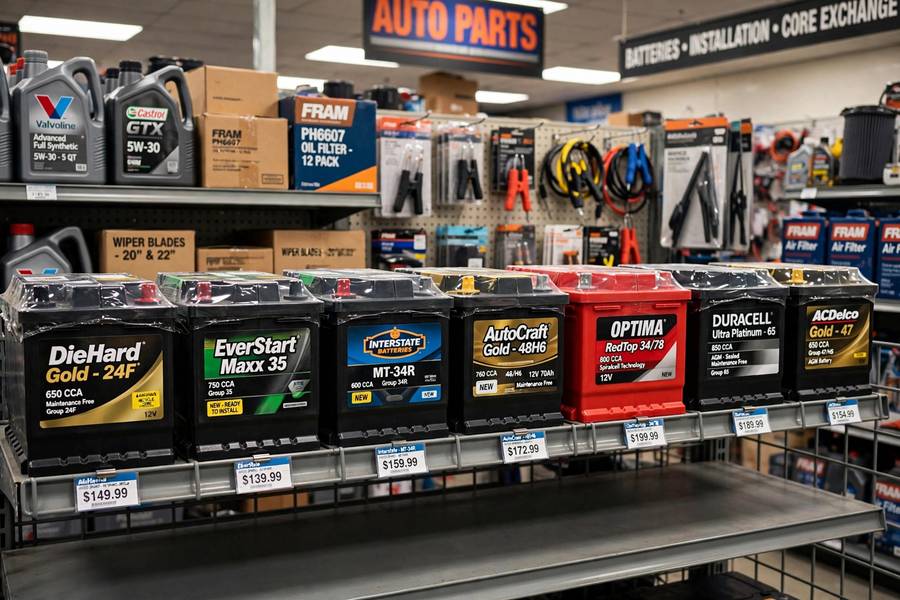
A car battery is one of the most price-transparent repairs in the business — and still, people overpay regularly. They buy the wrong battery, pay dealership labor for a 15-minute job, or get upsold on services they don’t need. I’ve replaced thousands of batteries, at shops and in driveways, and the pricing logic is simple once you see it. Here’s what batteries actually cost in 2026, what labor should run, when DIY makes sense, and how to avoid the common overcharges. For when replacement becomes necessary, see how long car batteries last.
Table of Contents
- The Short Answer: $150-$250 All-In
- Battery Prices by Type
- What Affects the Price
- Labor Costs: Shop vs Dealership
- DIY Replacement: 15 Minutes and $0 Labor
- The Core Charge and Recycling
- Upsells to Decline (and One to Accept)
- How to Avoid Overpaying
- Frequently Asked Questions
The Short Answer: $150-$250 All-In
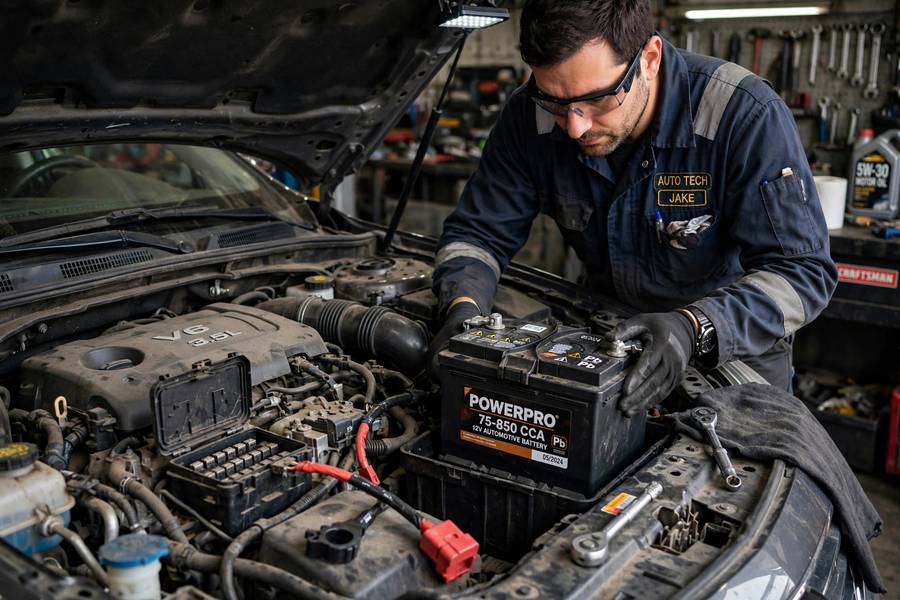
For most cars in 2026, a quality replacement battery costs $120-$200, and professional installation adds $20-$50 at an independent shop or parts store (many parts stores install free with purchase). All-in at a reputable independent shop: $150-$250. At a dealership: $200-$350, for the same job with an OEM-branded battery.
AGM batteries (required in start-stop vehicles, common in European cars) run $180-$300 for the battery alone, pushing all-in costs to $200-$350 at independents and $300-$450 at dealerships. Specialty batteries — some hybrids, EVs’ 12V auxiliaries, odd sizes — can exceed $400, but those are edge cases.
The price floor: budget batteries at $90-$110 exist, usually with 1-year warranties. I don’t recommend them — the failure rate I’ve seen is notably higher, and a battery that dies at 14 months costs you more than the premium battery would have. The sweet spot is the mid-tier battery with a 3-year free-replacement warranty: $140-$180, reliable, honestly warranted.
Battery Prices by Type
Conventional flooded lead-acid: $100-$180. The standard battery for most cars without start-stop. Mature technology, perfectly adequate, the best value for conventional vehicles. Within this category, price tracks warranty length and CCA (cold-cranking amps) more than anything else — a 3-year warranty battery costs $30-$50 more than a 1-year unit, and it’s worth it.
AGM (absorbent glass mat): $180-$300. Sealed, spill-proof, better vibration resistance, handles deep cycling better. Required for start-stop vehicles (the constant restarting murders conventional batteries) and common in European cars with high electrical demands. If your car came with AGM, replace with AGM — downgrading to flooded causes premature failure and can confuse the car’s battery management system.
EFB (enhanced flooded battery): $140-$220. The middle ground — a tougher flooded battery for basic start-stop systems. Common in European and some Asian cars. Replace EFB with EFB or AGM, never downgrade to conventional.
Lithium 12V: $400-$900+. Niche — performance cars, some EVs as auxiliary batteries. Excellent lifespan and weight savings, but the price keeps them rare. If your car didn’t come with lithium, don’t retrofit without research; charging profiles differ.
What Affects the Price
Group size is the primary price driver within a type — bigger batteries (trucks, diesels) cost more than smaller ones (compacts). A Group 24F for a Camry might be $140; a Group 65 for an F-150 might be $180; dual batteries for a diesel truck double everything. Diesel trucks need high CCA (750-900+) and often two batteries — budget $300-$500 for the pair.
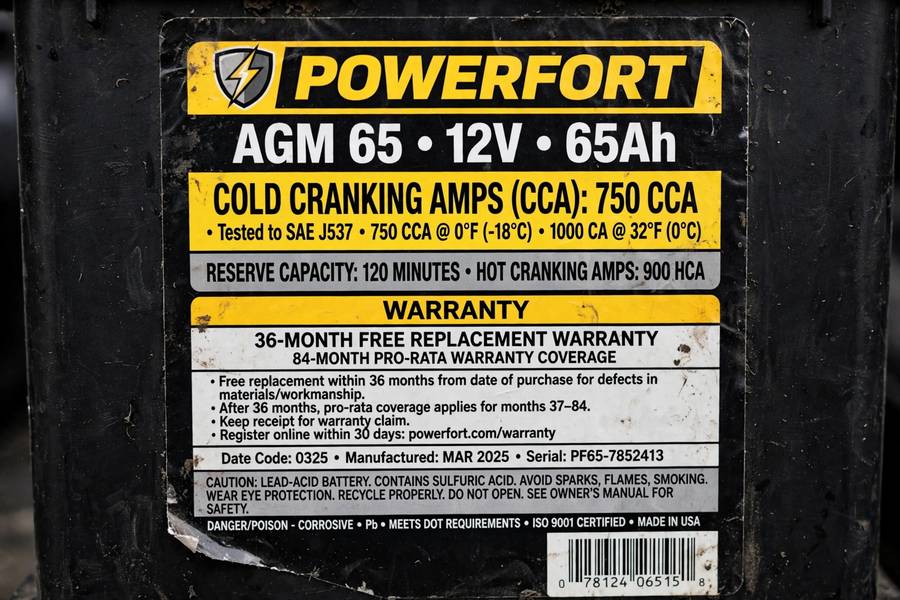
CCA rating affects price modestly: within the same group size, higher CCA costs $10-$30 more. Buy at least the original equipment CCA — more is fine (it just means more reserve capacity), less is asking for winter trouble. Reserve capacity (how long the battery powers essentials if the alternator fails) is the underrated spec; more is better, especially if you run accessories with the engine off.
Brand matters less than people think. The dirty secret of the battery industry: a handful of manufacturers (Clarios, Exide, East Penn) make most batteries sold under dozens of brand names. The $180 “premium” battery and the $140 mid-tier battery are often identical internally with different stickers and warranties. Buy on warranty terms and freshness (check the date code — buy the freshest), not brand mythology.
Labor Costs: Shop vs Dealership
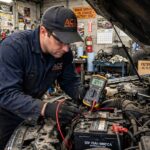
Battery replacement is among the simplest shop jobs: disconnect, remove hold-down, lift out old battery (they weigh 30-50 pounds — the heaviest part of the job is literal), drop in new, reconnect, test. Book time is typically 0.3 to 0.5 hours. At independent shop rates ($100-$150/hour), that’s $30-$75 in labor — though many shops charge a flat $20-$40 battery installation fee.
Parts stores (AutoZone, O’Reilly, Advance, and their equivalents) often install free with purchase — it’s a loss leader that earns your future business. The catch: they won’t install in every vehicle. Batteries in hard-to-reach locations (under seats, in trunks, behind wheel wells — looking at you, certain Chryslers and BMWs) get declined, and some stores won’t touch vehicles requiring battery registration.
Dealerships charge $50-$100+ in labor plus a premium on the battery itself (OEM-branded, often identical to aftermarket). The dealership advantage: they handle battery registration for BMW/Mercedes/VW vehicles that require it (the car’s computer needs to know the new battery’s specs — skip this and charging goes wrong), and they reset the various modules properly. For registration-required vehicles, the dealership premium is often worth it. For a Honda Civic, it’s money for nothing.
DIY Replacement: 15 Minutes and $0 Labor
Battery replacement is the ideal beginner DIY job — simple, safe with basic precautions, and impossible to get subtly wrong. The procedure: engine off, everything off. Disconnect negative cable first (10mm or 13mm wrench usually), then positive. Remove the hold-down clamp or bracket. Lift out the old battery — bend your knees, they’re heavy and awkward. Clean the tray (baking soda solution neutralizes acid residue). Set the new battery in, secure the hold-down. Connect positive first, then negative. Tug-test both clamps. Start the car, verify voltage if you have a meter.
Total time: 10-20 minutes, most of it wrestling the battery’s weight. Total savings versus a shop: $20-$75 in labor. The gotchas: have your radio code if your car needs one (check the manual beforehand); don’t let the wrench bridge the terminals; negative off first, negative on last — always. And if your car requires battery registration (BMW, Mercedes, many VWs/Audis, some newer everything), DIY replacement without registration causes charging issues — either pay for registration service or let the shop/dealer do the whole job.
Where to buy for DIY: parts stores (free testing of your old battery to confirm the diagnosis, fresh stock, warranty honored nationally), warehouse clubs (often the best prices on quality batteries), or online (competitive prices but you’re on your own for the core return and warranty claims are shippier).
One practical note: if the old battery is too dead to even get you to the store, a jump start will get you there — review how to jump start a car first so you do it without spiking the electronics.
The Core Charge and Recycling
Every new battery price includes (or adds) a core charge — typically $10-$25 — refunded when you return the old battery. It’s not a fee; it’s a deposit ensuring the old battery gets recycled. Bring the old battery when you buy the new one and the charge is waived or refunded on the spot.
The recycling story is genuinely good: car batteries are the most recycled consumer product in existence, with 98-99 percent recycled in the US. The lead, plastic, and acid are all recovered and remanufactured into new batteries. Your old battery isn’t waste — it’s raw material. This is also why you should never throw a battery in the trash: it’s illegal in most places (lead and acid are hazardous), and parts stores take them free even if you didn’t buy there.
If a shop replaces your battery, the core is handled invisibly — they keep the old battery and pocket the core value as part of their margin. That’s fair; it’s built into their pricing. For DIY, don’t forget the return trip — that $15-$20 core refund is real money, and the recycling matters.
Upsells to Decline (and One to Accept)
The battery aisle attracts upsells. Decline: “premium” terminal cleaner sprays at 5x the price of baking soda (same chemistry). Extended warranties beyond the standard free-replacement period (the prorated tail of battery warranties is nearly worthless — read the fine print: after the free-replacement period, you get a small discount on a new battery at that store only). “Battery system flush” or similar nonsense services (not a thing). High-output alternator upgrades sold with the battery (unless you’ve added serious electrical loads, your stock alternator is correctly sized).
Consider: a battery maintainer/trickle charger ($40-$60) if the vehicle sits for weeks at a time — it genuinely extends battery life and it’s cheaper than one premature replacement. Terminal protection (felt washers, dielectric grease — a few dollars) is cheap and effective. And a charging system test with the new battery ($0-$25, often free) is the one upsell I’d accept — it verifies the alternator isn’t the reason the old battery died, which is valuable information at any price.
The golden rule: the battery either tests bad (replace it) or it doesn’t (don’t). Everything else is optional.
How to Avoid Overpaying
The playbook: get the battery tested first (free at parts stores) — confirm it’s actually bad before spending anything. Check the date code on any battery you buy — fresher is better, and a battery that’s sat on the shelf for a year has aged without you. Match group size exactly and meet-or-exceed original CCA — wrong size causes fitment headaches, under-spec CCA causes winter failures.
Price-compare across at least two sources: parts store, warehouse club, and online. The spread on identical group sizes is often $30-$50. Ask about installation: free at most parts stores for standard locations, which eliminates the labor question entirely. And time your purchase: battery prices spike slightly in winter (demand) — if your battery tests marginal in fall, replace it then rather than in the January emergency when you’re paying tow-truck prices for urgency.
For registration-required vehicles (BMW/Mercedes/VW/Audi and growing), get quotes from both the dealer and a well-equipped independent — independents with the right scan tools do registrations for less. The registration itself takes 10 minutes with the tool; you’re paying for the tool’s existence, and independents amortize it cheaper.
Frequently Asked Questions
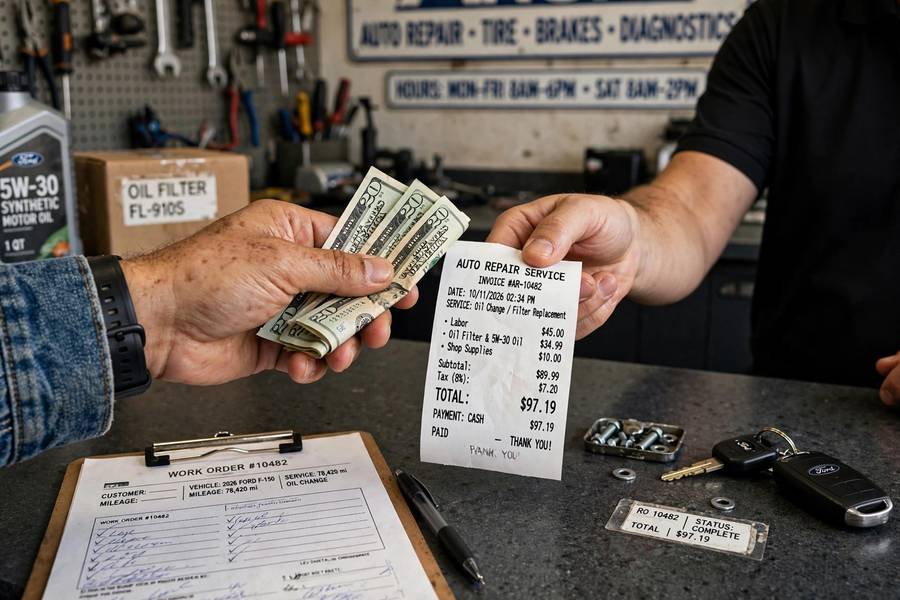
Most cars: $150-$250 all-in at an independent shop ($120-$200 battery + $20-$50 labor; many parts stores install free). Dealerships run $200-$350. AGM batteries (start-stop vehicles) cost $200-$350 installed at independents, $300-$450 at dealers.
Yes — it’s a 15-minute beginner job: disconnect negative first then positive, remove hold-down, swap batteries, reconnect positive first then negative. You’ll need a 10mm or 13mm wrench. Exception: BMW, Mercedes, VW/Audi and some newer cars require battery “registration” with a scan tool — DIY without it causes charging problems.
A $10-$25 deposit added to the battery price, refunded when you return the old battery for recycling. Bring the old battery when buying the new one to avoid the charge. Car batteries are 98-99% recycled — never put one in the trash; parts stores accept them free.
Up to a point. The mid-tier battery with a 3-year free-replacement warranty ($140-$180) is the sweet spot — budget 1-year batteries fail notably more often in my experience. Beyond that, most brands come from the same few manufacturers; buy on warranty terms and date-code freshness, not brand prestige.
Dealerships typically charge $200-$350 (more for AGM) versus $150-$250 at independents for the same job. The dealer premium buys OEM branding and proper battery registration for vehicles that require it. For standard vehicles without registration needs, independents and parts stores deliver identical results for less.