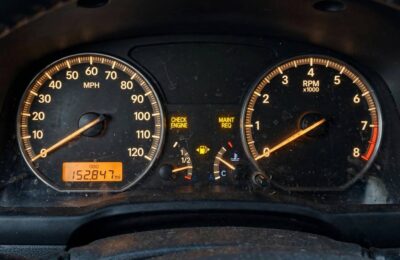
Batteries rarely die without warning — they send signals for weeks, and most drivers ignore every one of them until the morning the starter just clicks. I’ve lost count of the “it was fine yesterday” tow-ins that had been cranking slowly for a month. Your battery is talking to you. Here’s how to listen: the nine warning signs, what each one actually means mechanically, and what to do about each before you’re stranded. For context on typical battery lifespan, see my guide on how long car batteries last.
Table of Contents
- Slow Engine Crank: The Classic Warning
- The Click of Doom (and What Different Clicks Mean)
- Dim Headlights and Electrical Gremlins
- Battery Warning Light on the Dash
- Corroded or Swollen Battery Case
- Old Age: The Calendar Doesn’t Lie
- Needing Frequent Jump Starts
- Rotten Egg Smell Under the Hood
- What to Do When You Spot the Signs
- Frequently Asked Questions
Slow Engine Crank: The Classic Warning
The number one sign, and the one everyone ignores: the engine turns over sluggishly. Instead of the crisp rrr-rrr-rrr-VROOM you’re used to, you get a labored ruh… ruh… ruh… that eventually catches. That’s the starter motor telling you it’s not getting enough current.
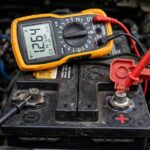
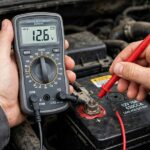
Here’s what’s happening inside: a healthy 12-volt battery delivers around 12.6 volts at rest and can push hundreds of cold-cranking amps to the starter. As the battery’s lead plates sulfate with age — lead sulfate crystals hardening on the plates, reducing active surface area — its internal resistance climbs and its voltage sags under load. The starter still works, just slower, because it’s starving.
The trap: slow cranking is gradual. You adapt to it day by day, the way you adapt to a dimming hallway bulb. Then one cold morning pushes it past the threshold and nothing happens. If your crank sounds even slightly lazier than it did last month, get the battery tested. Most auto parts stores test free, and it takes five minutes. That test is the cheapest insurance in car ownership.
The Click of Doom (and What Different Clicks Mean)
Turn the key (or push the button) and get clicking instead of cranking? The click pattern is diagnostic. A single loud click usually means the starter solenoid is engaging but the starter motor isn’t getting enough current to turn — classic dead-battery territory, though a failed starter can mimic it. Rapid machine-gun clicking (click-click-click-click) means the solenoid is engaging and dropping out repeatedly as voltage collapses under load — the battery has some charge but not enough to sustain cranking.
No click at all, but dash lights work? That points away from the battery toward the starter circuit, ignition switch, or a security-system issue. No click and no lights? Check the battery connections first — a loose or corroded terminal can cut all power as cleanly as a dead battery, and it’s a two-minute fix.
The key distinction for battery diagnosis: if a jump start gets you going and the car restarts fine after a drive, the battery was the problem (it just needed charge it can no longer hold). If it needs jumping every morning, the battery can’t hold a charge anymore — replacement time. My how to jump start a car guide covers the safe procedure.
Dim Headlights and Electrical Gremlins
Your battery powers everything electrical, so a weakening battery shows up across the whole system. Headlights dimmer than you remember, especially at idle, brightening when you rev the engine? That’s the alternator compensating for a battery that can’t hold voltage — at idle the alternator output dips, and the weak battery can’t fill the gap.
The subtler signs: power windows moving slowly, the radio cutting out during cranking, dash lights flickering, the clock resetting, seat memory forgetting positions. Modern cars are computers on wheels, and computers hate unstable voltage. A failing battery causes a constellation of weird electrical behavior that looks like five separate problems but has one root cause.
One caveat: dim lights at idle with a healthy battery can indicate an alternator issue instead. The diagnostic split: if problems appear mainly during cranking and starting, suspect the battery. If they appear while driving — lights dimming at speed, battery warning light on — suspect the charging system. A proper test distinguishes them in minutes; guessing between a $150 battery and a $500 alternator is an expensive game.
Battery Warning Light on the Dash
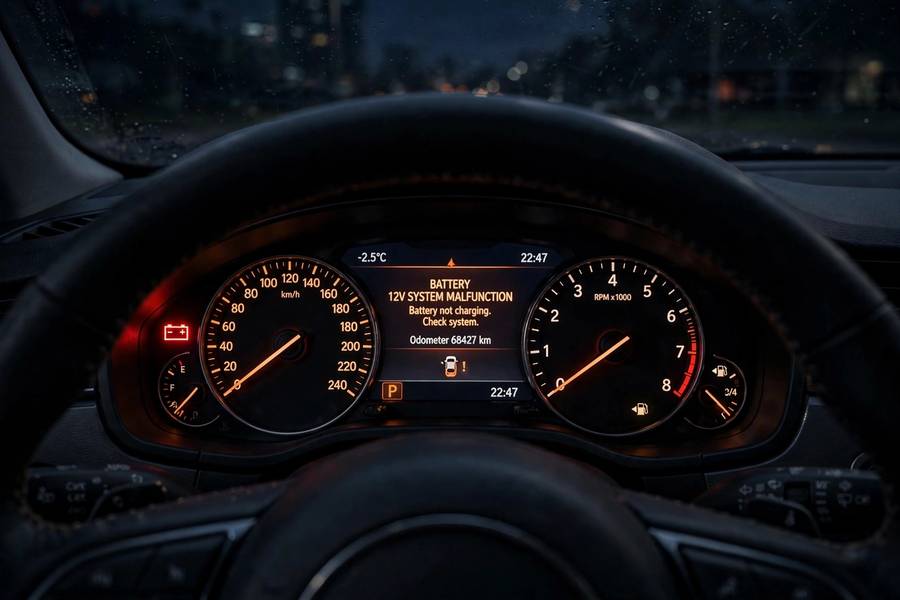
The battery-shaped warning light on your dash is widely misunderstood: it doesn’t mean “battery bad.” It means “charging system problem.” The light illuminates when system voltage drops below the expected range while the engine runs — which usually indicates the alternator isn’t charging properly, though a battery with an internal short can trigger it too.
If this light comes on while driving, take it seriously but don’t panic. You have limited time: the car is now running on battery power alone, and a typical battery gives you 20 to 60 minutes of driving before voltage drops too low to run the ignition and fuel systems. Turn off everything electrical — AC, heated seats, stereo, phone chargers — and head for the nearest shop or safe stopping point. Every amp you save is another minute of runtime.
Common causes in my experience: worn alternator brushes or failed voltage regulator (the usual), a snapped serpentine belt (you’ll usually hear this, and you’ll lose power steering simultaneously), corroded battery cables, or a battery with a shorted cell dragging the whole system down. Diagnosis starts with a voltmeter at the battery terminals with the engine running: you want 13.7 to 14.7 volts. Below 13.5, the charging system isn’t keeping up.
Corroded or Swollen Battery Case
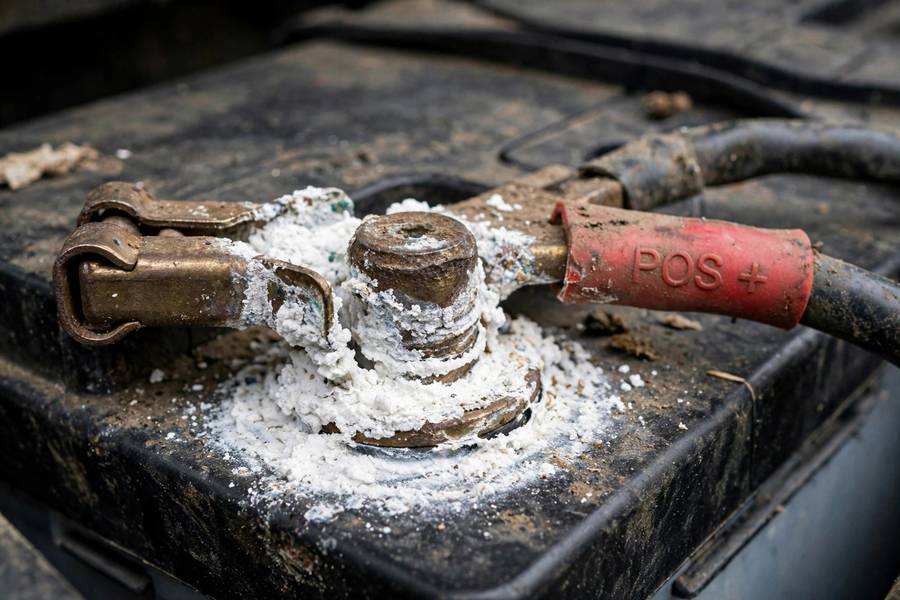
Pop the hood and look at the battery — it tells stories. White, blue, or greenish crusty buildup on the terminals is corrosion: acid vapor reacting with the metal terminals. Light corrosion is normal aging and cleans off easily. Heavy, recurring corrosion — cleaned last month, back already — signals the battery is venting excessively, which means it’s working too hard or failing internally.
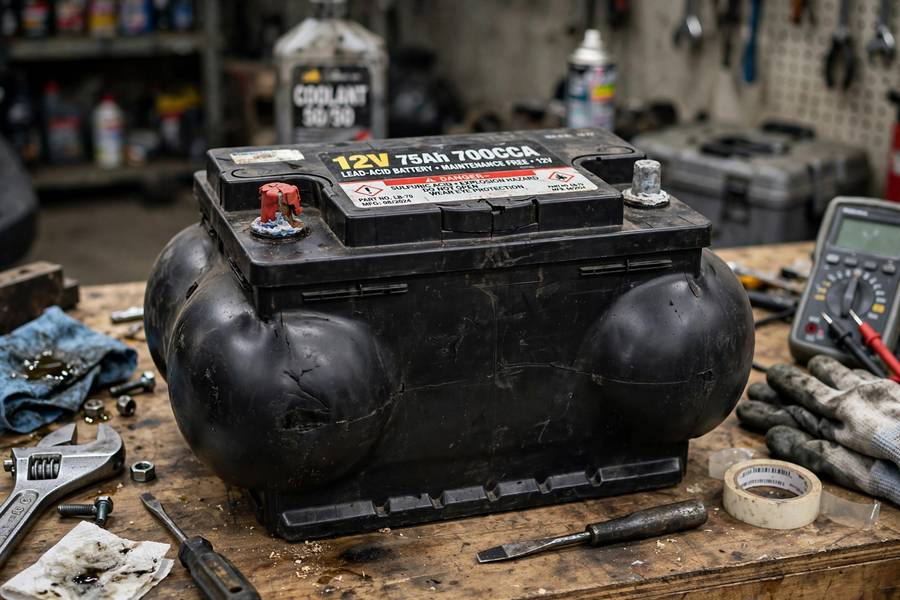
A swollen or bloated battery case is more serious. The sides bulge out, the case looks pregnant. That’s internal gas pressure from overcharging or internal failure, and it’s a battery living on borrowed time — in rare cases, a swollen battery can crack or leak acid. Don’t ignore it, don’t try to “fix” it, replace it promptly.
Also check for: a cracked case (acid leaks are corrosive and dangerous — neutralize with baking soda and water, wear gloves and eye protection), low electrolyte in non-sealed batteries (topped with distilled water only, never tap water), and a missing or illegible date sticker. The date sticker tells you the battery’s age, which brings us to the calendar.
Old Age: The Calendar Doesn’t Lie
Car batteries are consumables with a typical life of 3 to 5 years — 3 years in hot climates, up to 5 in mild ones. Heat is the great killer: every 15°F above 77°F roughly halves battery life, because heat accelerates the internal corrosion of the lead plates. A battery in Phoenix lives a hard, short life; the same battery in Seattle lasts years longer.
Find the date code on your battery — usually a sticker with month/year, or a code stamped into the case. If it’s approaching year 4 (or year 3 in a hot climate), you’re on borrowed time regardless of how it behaves. I recommend proactive replacement at 4 years for most drivers: a $150 battery on your schedule beats a $150 battery plus a $100 tow on the battery’s schedule.
The age rule has one nuance: a battery that tests well at 4 years isn’t necessarily doomed tomorrow, but its failure curve steepens sharply. Testing buys information, not immortality. If a load test shows marginal capacity at year 4, replace it before winter — cold is the executioner that finishes what heat started.
Needing Frequent Jump Starts
Needing one jump start can happen to anyone — you left the lights on, the trunk didn’t latch, it happens. Needing jump starts repeatedly is a diagnosis: either the battery can’t hold a charge, or something is draining it.
The battery-can’t-hold-it case is straightforward: after a good long drive (30+ minutes to fully recharge), the battery should start the car strongly the next morning. If it can’t, its capacity is gone — sulfated plates, shed active material, done. Replacement is the only fix; no additive or charger restores lost plate capacity.
The parasitic-drain case is sneakier: something electrical stays awake when the car sleeps — a trunk light, a faulty module, an aftermarket accessory wired to constant power. Normal parasitic draw is 25-50 milliamps; a stuck relay or module can pull amps. Diagnosis means measuring draw with everything off and pulling fuses one by one until the draw drops. It’s tedious but definitive. If your new battery also dies overnight, you’re chasing a drain, not a battery.
Rotten Egg Smell Under the Hood
A sulfur or rotten-egg smell near the battery means hydrogen sulfide gas — the battery is overcharging, overheating, or has an internal short causing excessive gassing. This is the one symptom I’d call urgent: the gas is flammable, the overcharging can damage the vehicle’s electronics, and a battery venting heavily can leak acid.
Causes: a failed voltage regulator letting the alternator push 15+ volts continuously (cooking the battery), an internal short in one cell, or a battery charger left on too high a setting. If you smell sulfur, check for a hot battery case (careful — don’t touch with bare hands if it’s very hot) and get the charging system tested immediately. Don’t keep driving on an overcharging system; the excess voltage stresses every electronic module in the car.
Ventilation note: batteries produce hydrogen gas normally during charging — that’s why you never smoke or create sparks near a battery, and why jump-starting procedures specify connecting the final ground away from the battery. The rotten-egg smell is abnormal gassing, beyond the normal trace amounts. Trust your nose.
What to Do When You Spot the Signs
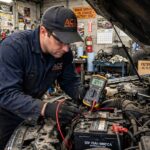
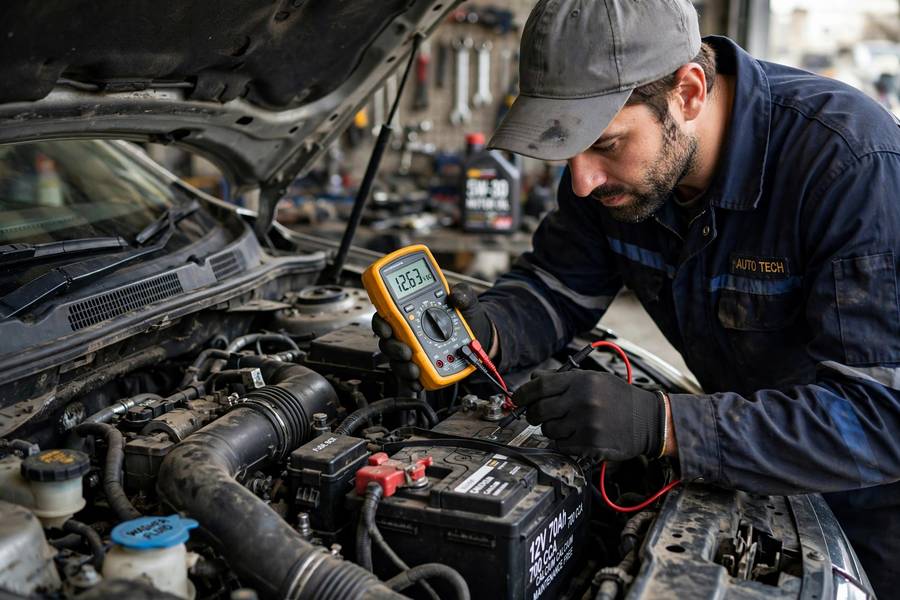
The action plan, in order. First: get the battery tested — free at most parts stores, or with a $20 multimeter (12.6V resting is healthy; under 12.4V is discharged; a load test is definitive). Second: clean the terminals — disconnect negative first, wire-brush both terminals and cable ends, reconnect positive first, snug but not gorilla-tight. Third: check the charging system — 13.7-14.7V at the terminals with the engine running.
If the battery tests bad or is past its age: replace it. Match the group size (it must fit the tray and terminal layout), meet or exceed the original cold-cranking amps (CCA), and don’t cheap out on the warranty — the 3-year free-replacement batteries are worth the premium over the 1-year units. Installation is a 15-minute DIY job: negative off first, negative on last, and don’t let the wrench bridge the terminals.
And keep a set of jumper cables or a lithium jump pack in the car regardless. Even a perfect battery can be defeated by a dome light left on overnight. The $60 jump pack in your trunk is the cheapest roadside assistance you’ll ever buy.
Frequently Asked Questions
The main signs: slow engine cranking, clicking instead of starting, dim headlights (especially at idle), dashboard battery warning light, corroded or swollen battery case, frequent need for jump starts, electrical glitches, rotten egg smell, and age over 3-5 years.
If problems appear mainly during starting (slow crank, clicking), suspect the battery. If they appear while driving (dimming lights at speed, battery warning light on), suspect the alternator. Test: with the engine running, voltage at the battery terminals should read 13.7-14.7 volts — below 13.5 indicates a charging problem.
Rarely. Most dying batteries show symptoms for weeks — slow cranking, dim lights, electrical quirks. What feels “sudden” is usually a gradual decline crossing a threshold, often triggered by the first cold snap. Regular testing after year 3 catches the decline before it strands you.
A single loud click usually means the starter solenoid engages but the motor lacks current — likely a dead battery. Rapid repeated clicking means voltage collapses under cranking load — a weak battery. No click with working dash lights points to the starter circuit rather than the battery.
Once symptoms appear, days to weeks — it’s unpredictable. A battery that cranks slowly today may fail completely on the next cold morning. If the battery warning light comes on while driving, you have roughly 20-60 minutes on battery power alone. Get tested immediately and replace proactively rather than waiting for a tow.