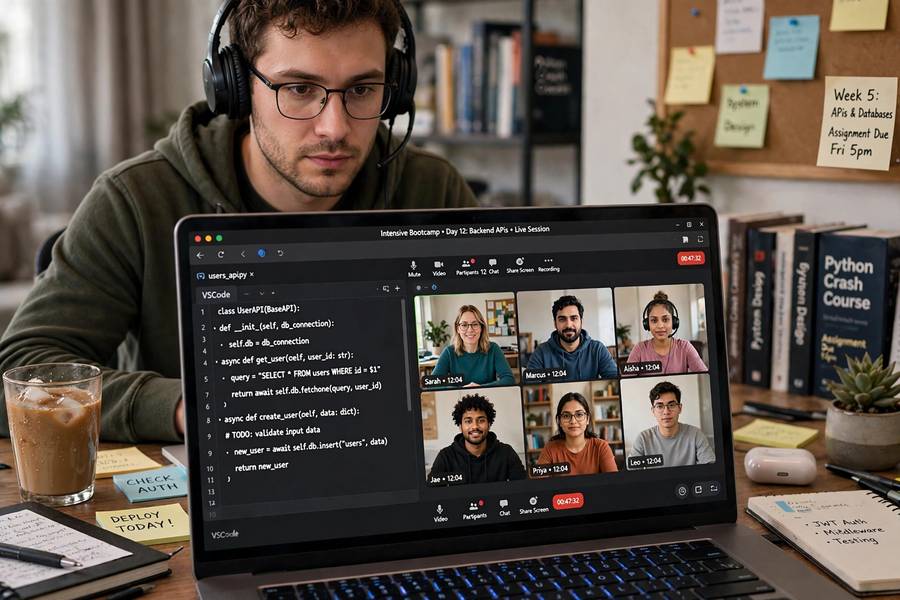
AI bootcamps are the most expensive way to learn AI online — thousands of dollars for weeks of intensive instruction — which makes them the category where the “worth it?” question matters most. I’ve watched people transform their careers through good bootcamps and watched others burn savings on programs that delivered little more than structured YouTube playlists. The difference isn’t luck; it’s selection, and selection requires understanding what bootcamps actually sell.
This guide breaks down the bootcamp proposition honestly: what you’re really buying, who benefits, the costs, and how to evaluate programs. For lighter-weight options, see the best AI courses online.
Table of Contents
- What You’re Actually Buying (It’s Not Information)
- Who Bootcamps Work For
- The Cost Landscape
- Bootcamp vs Self-Study: The Honest Math
- What Good Bootcamps Have in Common
- Red Flags: Bootcamps to Avoid
- The ISA Question
- Maximizing a Bootcamp If You Enroll
- The Bootcamp Selection Mistakes I See
- Frequently Asked Questions
What You’re Actually Buying (It’s Not Information)
The information in a bootcamp is free elsewhere — that’s the open secret. What you’re buying:
Structure and pacing. A curated path with deadlines. For people who don’t self-direct well, this alone justifies the cost. Most self-study attempts die from drift, not difficulty.
Cohort and network. Learning alongside others — peer pressure, study groups, connections that become job referrals. The network effects are real and undervalued.
Feedback. Instructors and mentors reviewing your work, unblocking you in minutes instead of the hours self-study debugging takes. Time is money; fast unblocking has quantifiable value.
Accountability. Someone notices when you fall behind. For many learners, this is the difference between finishing and quitting.
Career services. Resume help, interview prep, employer connections. Quality varies enormously — from genuine pipelines to resume-template PDFs.
Credential. The weakest component, honestly — but non-zero for screening.
Notice: none of these is “knowledge.” You’re buying an environment optimized for learning, not information. Evaluate bootcamps on the environment, not the syllabus.
Who Bootcamps Work For
Career changers with urgency. You need to transition in months, not years, and can dedicate full-time effort. The intensity that breaks casual learners is exactly what career changers need.
People who don’t self-direct well. Honest self-assessment: if you’ve started and abandoned multiple self-study attempts, structure isn’t a luxury — it’s the missing ingredient. Paying for it is rational.
Those who value cohorts. Some people learn dramatically better with peers. If that’s you, the cohort alone may justify the cost.
Employer-funded learners. When someone else pays, the ROI math changes completely. Take the structure, keep the knowledge.
Who SHOULDN’T enroll: self-directed learners who finish what they start (you’ll overpay for structure you don’t need), the merely curious (too expensive for exploration), people who can’t dedicate the time (bootcamps punish part-time attention), and anyone expecting a job guarantee to substitute for effort.
The Cost Landscape
Online AI bootcamps typically run $3,000–$15,000, with most serious programs in the $5,000–$10,000 range. What drives the price:
- Duration and intensity — longer, full-time programs cost more
- Mentorship ratio — 1:1 mentorship is expensive to provide
- Career services depth — real employer pipelines cost real money
- Brand — established names charge premiums
Compare against: self-study ($0–$500), university courses ($1,000–$5,000 per course), and the opportunity cost of your time (often the largest number in the equation).
The financing options — upfront, installments, income-share agreements, employer sponsorship — each have trade-offs (more on ISAs below). Never finance a bootcamp you wouldn’t pay cash for; debt amplifies both the upside and the regret.
Bootcamp vs Self-Study: The Honest Math
Let’s do the math honestly. Self-study costs ~$0–$500 and takes 6–18 months of disciplined evenings. A bootcamp costs $5,000–$10,000 and takes 3–6 months full-time.
Bootcamp wins when: your time is valuable (the months saved exceed the tuition), you need structure to finish, you want the cohort/network, or you’re making a clean career break where speed matters.
Self-study wins when: you’re self-directed, time-flexible, budget-constrained, or exploring rather than committing. The AI skills worth learning this year are all learnable free with discipline.
The hidden variable: completion rates. Bootcamp completion rates (60–90% for good programs) crush self-study completion (single digits for unstructured attempts). If your self-study completion probability is 10% and bootcamp is 80%, the expected-value math favors bootcamp even at high tuition — an unfinished free course is worth $0.
Be brutally honest about your own completion probability. It’s the most important number in this decision, and most people overestimate it.
What Good Bootcamps Have in Common
Selective admissions. Programs that accept everyone accept your money, not your potential. Selectivity (even mild — a technical screen, an interview) signals they care about outcomes.
Published outcomes with methodology. Job placement rates, salary data — with clear methodology (who’s counted, over what timeframe). Vague “90% hired!” claims without methodology are marketing.
Instructor quality. Practitioners teaching, not just curriculum deliverers. Check who’s actually in front of the cohort.
Project-heavy curriculum. You should graduate with 3+ substantial portfolio projects. This is non-negotiable — it’s what gets you hired.
Capped cohorts. Small enough for individual attention. If the cohort is hundreds, the “mentorship” is a forum.
Alumni access. Talk to graduates — not the testimonials on the site, but real alumni via LinkedIn or communities. Their unfiltered experience is the best data available.
Career services with teeth. Employer partnerships, real interview pipelines, dedicated career staff — not just resume templates and “good luck.”
Red Flags: Bootcamps to Avoid
Job guarantees with fine print. “Get hired or your money back” usually has conditions that void the guarantee (must apply to X jobs weekly, accept any offer, etc.). Read the actual terms.
No published outcomes. If they won’t show placement data, assume it’s bad.
Pressure sales. Enrollment advisors with quotas, exploding discounts, “cohort filling fast” for the tenth time. Education doesn’t need used-car tactics.
Curriculum you can’t preview. If they won’t show detailed syllabi, the content won’t survive inspection.
Instructors you can’t identify. “Our team of experts” with no names or backgrounds. Real experts have verifiable histories.
Brand-new programs with premium pricing. Unproven programs should price like unproven programs. Paying premium for v1.0 is speculation.
All online, no live component, premium price. At bootcamp prices, you should get live instruction and interaction. Expensive async video is just an overpriced course.
The ISA Question
Income Share Agreements — pay nothing upfront, pay a percentage of salary after getting hired — sound ideal but deserve scrutiny:
The math: typical ISAs take 10–17% of income for 2–4 years, often with caps ($20,000–$30,000). For high earners, the cap binds and it’s a good deal. For modest earners, the percentage can exceed what upfront payment would have cost.
The incentives: ISAs align the bootcamp’s incentives with yours — they only get paid if you succeed. This is genuinely good and selects for programs confident in outcomes.
The fine print: minimum salary thresholds, what counts as “hired,” deferment terms, the cap. Read everything. Some ISAs are fair; some are predatory with friendly branding.
My take: a fair ISA from a proven program is often the best financing option — it shares risk. But “fair” and “proven” do heavy lifting in that sentence. Verify both.
Maximizing a Bootcamp If You Enroll
Enrolled? Extract full value:
Pre-work seriously. Most bootcamps have pre-work — do all of it. Starting behind in an intensive program compounds painfully.
Treat it like a job. Full attention during program hours, plus evening review. Half-effort in a bootcamp wastes the entire tuition.
Build beyond the curriculum. The assigned projects are the floor. The students who get hired fastest build extra things that show initiative.
Network deliberately. Your cohort is your future professional network. Those relationships are part of what you paid for — nurture them.
Start job prep early. Don’t wait until graduation. Interview prep, portfolio polishing, and networking should run parallel to the final weeks.
Document everything. Blog your learning, keep your projects public, build in the open. The bootcamp ends; the public record compounds.
The Bootcamp Selection Mistakes I See
Expensive decisions deserve extra care. The bootcamp mistakes that cost people thousands:
Choosing on marketing, not outcomes. Slick websites and impressive partner logos are cheap; verified placement data is expensive to fake. If a program won’t show you methodology-backed outcomes, that’s your answer about their outcomes.
Ignoring the time math. Enrolling part-time in a full-time-intensity program, or enrolling while working 60-hour weeks. Bootcamps punish divided attention brutally — the dropout stories almost always start with “I thought I could manage both.”
Skipping the alumni check. Testimonials on the website are curated. Real alumni on LinkedIn, asked directly about their experience, tell you the truth. Thirty minutes of alumni conversations is worth more than thirty hours of marketing material.
Paying for prestige over fit. The famous-name bootcamp with a generic curriculum versus the lesser-known program perfectly matched to your goals. Employers hire for what you can do, not where you learned it.
Treating enrollment as the achievement. The high of “I’m doing a bootcamp!” fades by week three; what remains is the work. People who thrive enter with a plan — pre-work done, schedule cleared, specific goals. People who struggle enter with excitement. Excitement is not a plan.
Frequently Asked Questions
For the right person — career changers needing speed, people who need structure to finish, those valuing cohorts — yes, often decisively. For self-directed learners, usually not; you’d overpay for structure you don’t need. The key variable is your honest self-study completion probability.
Typically $3,000–$15,000, with serious programs at $5,000–$10,000. Price reflects duration, mentorship ratio, career services, and brand. Compare against self-study ($0–$500) and factor in your time’s opportunity cost — often the largest number.
Selective admissions, published outcomes with clear methodology, practitioner instructors, project-heavy curriculum (3+ portfolio projects), capped cohorts, alumni you can contact, and career services with real employer pipelines. Avoid job guarantees with fine print and pressure sales.
Fair ISAs from proven programs are often the best financing — they align incentives and share risk. But verify: the percentage, cap, minimum salary threshold, and what counts as hired. For high earners the cap makes it cheap; for modest earners the percentage may exceed upfront cost.
Bootcamps win on speed, structure, and completion rates (60–90% vs single digits for unstructured self-study). Self-study wins on cost and flexibility. If you’ve abandoned self-study attempts before, the structure premium is rational. Be honest about your completion probability — it’s the decisive number.