Ask “who is the father of AI?” at a conference and you’ll start an argument — which tells you the title is genuinely contested, not just trivia. Several pioneers have plausible claims, and they represent different ideas about what AI fundamentally is. The answer you get reveals what the answerer thinks intelligence means.
I’ve always found this debate more illuminating than most “founder” arguments in tech, because each candidate embodies a different origin story for the field. Here’s the honest breakdown: the leading candidates, their cases, and why the question might be unanswerable in principle. For the full historical context, see history of artificial intelligence.
Table of Contents
- Why the Title Is Contested
- Alan Turing: The Philosophical Father
- John McCarthy: The Founder (Official Answer)
- Marvin Minsky: The Architect
- The Other Claimants
- The Godfathers of Deep Learning
- My Take: Four Fathers, Not One
- Frequently Asked Questions
Why the Title Is Contested
“Father of AI” is contested for a structural reason: AI has multiple independent origins. The philosophical origin (can machines think?), the institutional origin (the field’s founding as a discipline), the technical origin (the first working systems), and the modern origin (deep learning’s triumph) each point to different people. Asking for one father is like asking for the single inventor of “the wheel” — the question assumes a unity the history doesn’t have.
There’s also a sociological layer: the title confers legacy, and legacies are political. Different communities — symbolic AI veterans, connectionists, philosophers, engineers — champion different founders because each founder validates their tradition. The debate is partly about history and partly about what AI should be.
Alan Turing: The Philosophical Father
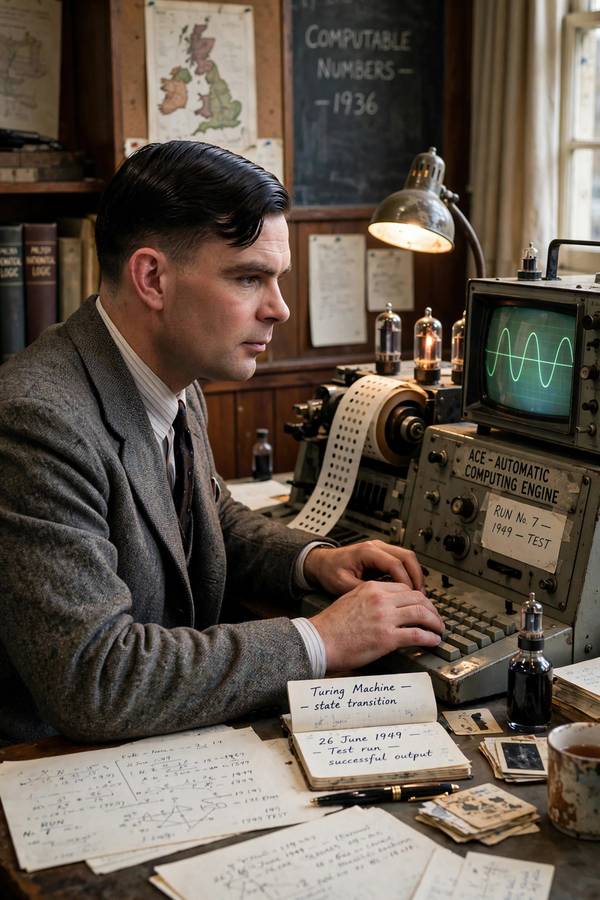
The case: Before anyone built anything, Turing asked the question that defines the field. His 1950 paper “Computing Machinery and Intelligence” proposed the imitation game (the Turing Test) as an operational definition of machine thinking, dismantled objections to the possibility, and predicted — with eerie accuracy — that machines would eventually pass as intelligent. His 1936 work on computability established the theoretical foundation: the universal machine that could, in principle, compute anything computable — including, arguably, thought.
The honest assessment: Turing is the philosophical father — the one who made machine intelligence thinkable. But he founded no lab, trained no students in AI (he died in 1954, two years before Dartmouth), and built no AI systems. His influence is foundational but indirect: he defined the question, not the field. Calling him the father of AI is like calling Darwin the father of genetic engineering — the lineage is real, but there are missing links.
Why people choose him: he’s the most famous, the most tragic, and the most quotable. “Can machines think?” is a better origin story than a conference proposal. Turing’s cultural stature — codebreaker, martyr, genius — makes him the romantic choice.
John McCarthy: The Founder (Official Answer)
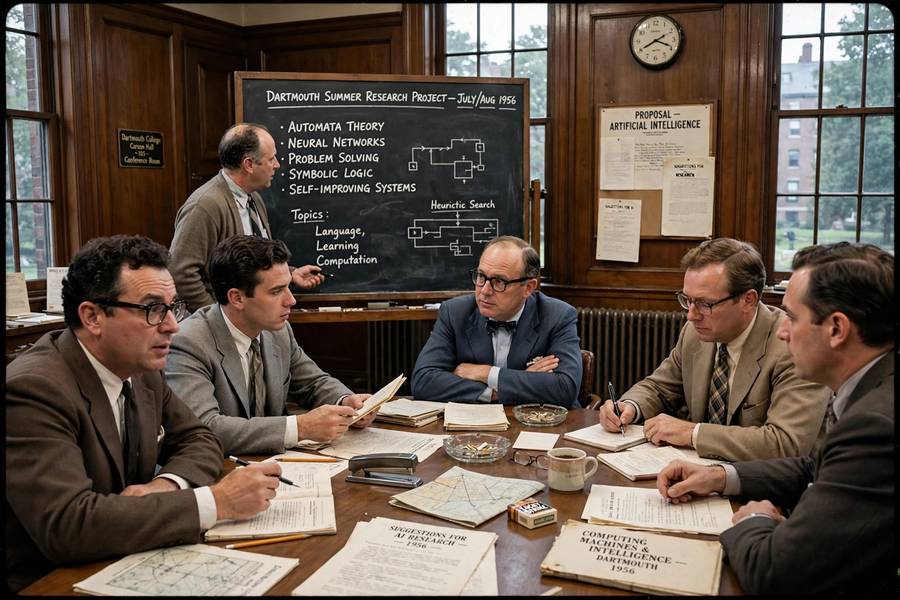
The case: McCarthy coined the term “artificial intelligence” (1955, in the Dartmouth proposal), organized the 1956 Dartmouth Conference that founded the field, invented Lisp (AI’s native language for decades), pioneered time-sharing, and developed foundational ideas in knowledge representation and commonsense reasoning. If “father” means “the person most responsible for AI existing as an organized field,” McCarthy wins clearly.
The honest assessment: This is the institutional fatherhood — and it’s the strongest claim in the conventional sense. McCarthy didn’t just contribute; he named the thing, convened the founders, and built the tools. The Dartmouth proposal’s famous line — that “every aspect of learning or any other feature of intelligence can in principle be so precisely described that a machine can be made to simulate it” — set the field’s founding optimism.
The complications: McCarthy’s symbolic, logic-based vision dominated AI for decades and then lost decisively to the statistical and neural approaches. His intellectual children were overthrown by a different family. Does the father of symbolic AI remain the father of AI when AI became something else? It’s a fair question — and part of why the title stays contested.
Why institutions choose him: he’s the safe, official answer. Textbooks cite him. The Dartmouth story is clean. When in doubt, say McCarthy.
Marvin Minsky: The Architect
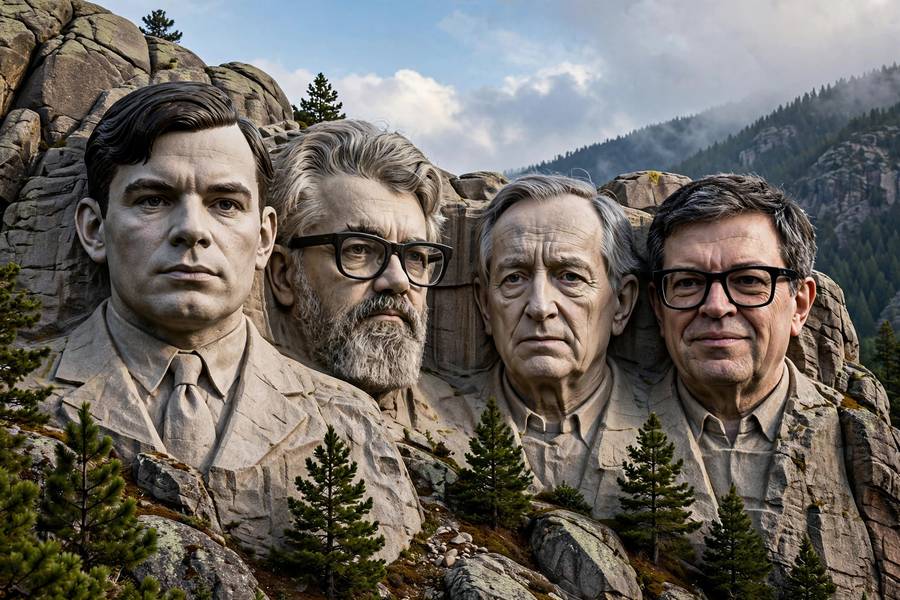
The case: Minsky co-founded the MIT AI Lab (with McCarthy, 1959), wrote Perceptrons (with Papert, 1969), developed the Society of Mind theory of intelligence, and mentored generations of AI researchers. His lab produced an astonishing fraction of the field’s leaders. If McCarthy founded the field, Minsky built its cathedral and trained its priesthood.
The honest assessment: Minsky is the architectural father — the builder of institutions and ideas. But he’s also the field’s most controversial figure: the Perceptrons book arguably killed neural network research for a decade (fairly or not), and his symbolic orthodoxy put him on the losing side of history’s biggest AI debate. Brilliant, influential, and complicated — like the field itself.
The Society of Mind (1986) deserves special mention: Minsky’s theory that intelligence emerges from societies of simple agents prefigured multi-agent systems and remains philosophically influential. It’s his most durable idea — and ironically, it’s about not having a single central intelligence, which complicates his own fatherhood.
The Other Claimants
Herbert Simon and Allen Newell. Built the Logic Theorist (1956) and the General Problem Solver — arguably the first true AI programs. Simon’s Nobel Prize (Economics, 1978) recognized the decision-making research that grew from AI work. The technical fathers — they built the first working systems.
Arthur Samuel. Coined “machine learning” (1959) and built the checkers program that learned from experience. If the modern AI era is the machine learning era, Samuel named the paradigm.
Frank Rosenblatt. Built the Perceptron (1957) — the direct ancestor of modern neural networks. The connectionist lineage runs through him, making him the grandfather (or father) of deep learning specifically.
Joseph Weizenbaum. Created ELIZA and became AI’s conscience. Not a father of the technology, but arguably the father of AI ethics — the tradition that asks what machines should do.
The Godfathers of Deep Learning
Modern AI has its own founder-mythology, and it’s refreshingly honest about being collective: Geoffrey Hinton, Yann LeCun, and Yoshua Bengio — the “godfathers of deep learning” (Turing Award, 2018). They kept neural networks alive through the winters, developed the techniques (backprop, CNNs) that made modern AI possible, and trained the generation that built the current era.
Their claim is different: not founders of AI, but founders of the AI that actually worked. There’s a case that they matter more to your daily life than all the earlier pioneers combined — every model you use descends from their work. But “godfathers” is the right title: they inherited the field and rebuilt it, rather than founding it.
Fei-Fei Li deserves mention here too — ImageNet (2009) provided the data infrastructure the deep learning revolution needed. The godfathers built the engines; she built the roads. (For the paradigm shift, see machine learning vs deep learning.)
My Take: Four Fathers, Not One
Here’s how I’d divide the paternity, honestly:
- Philosophical father: Turing. He asked the question and defined the terms of the debate.
- Institutional father: McCarthy. He named the field, convened its founders, and built its first tools.
- Technical fathers: Simon and Newell. They built the first systems that did something recognizably intelligent.
- Modern fathers: Hinton, LeCun, and Bengio. They built the AI that actually works.
Each “father” represents what AI was at a different stage: a philosophical possibility, an academic discipline, an engineering practice, and a world-changing technology. The contested title isn’t a problem to solve — it’s a map of the field’s evolution. Each generation built on (and often overthrew) the last — that’s the pattern of the field.
And maybe that’s the real lesson: AI doesn’t have a father because it was never born — it accreted, idea by idea, winter by winter, breakthrough by breakthrough, from dozens of minds across seventy years. The search for a single founder says more about our love of simple stories than about how science actually happens.
Frequently Asked Questions
Most commonly John McCarthy, who coined the term “artificial intelligence,” organized the 1956 Dartmouth Conference founding the field, and invented Lisp. Alan Turing (philosophical foundations) and Marvin Minsky (MIT AI Lab, Society of Mind) are the other leading candidates. The title is genuinely contested because AI has multiple independent origins.
Turing is best described as AI’s philosophical father: his 1950 paper defined the central question (“can machines think?”) and proposed the Turing Test, and his 1936 work established computability theory. But he died in 1954 before the field was founded, built no AI systems, and founded no institutions — his influence is foundational but indirect.
Geoffrey Hinton, Yann LeCun, and Yoshua Bengio, who shared the 2018 Turing Award. They sustained neural network research through the AI winters, developed foundational techniques (backpropagation, convolutional networks), and trained the generation behind modern AI. Fei-Fei Li (ImageNet) provided the crucial data infrastructure.
He coined the term and founded the field institutionally (1956 Dartmouth Conference), invented Lisp, and pioneered knowledge representation. But “inventing AI” overstates it — Turing provided the philosophy, Simon and Newell built the first systems, and the modern deep learning era came from different pioneers. McCarthy founded the discipline; many built the science.
Because AI accreted rather than being founded: philosophical origins (Turing), institutional founding (McCarthy, Dartmouth), first working systems (Simon and Newell), and the working modern paradigm (Hinton, LeCun, Bengio) each point to different people. The contested title maps the field’s evolution across 70 years better than any single name could.