“ChatGPT” isn’t one model — it’s a product that routes your questions to different models depending on what you ask and what plan you’re on. Most users never notice the switching, but the model behind your conversation dramatically affects the quality, speed, and cost of your answers.
This confuses everyone, because OpenAI’s naming is genuinely terrible. Let me untangle the lineup: which models exist, what each is good at, and how to make sure you’re using the right one. For how these models actually produce answers, see my guide on how does ChatGPT work.
In This Guide
- The Short Answer
- GPT-4o: The Default Workhorse
- The o-Series: Models That “Think”
- The Mini Models: Fast and Cheap
- What Free Users Get vs. Paid Users
- How ChatGPT Chooses for You
- Which Model Should You Pick?
- A Brief History of ChatGPT Models
- Frequently Asked Questions
The Short Answer
As of 2026, ChatGPT primarily uses GPT-4o (the “o” stands for “omni”) as its default model, with the o-series (o1, o3, and successors) handling complex reasoning tasks, and lighter mini variants for speed. Free users get access to GPT-4o with limits plus minis; paid users get the full lineup with higher limits.
The exact lineup shifts every few months — OpenAI retires old models and launches new ones regularly. But the structure has stabilized: a flagship general model, reasoning-specialized models, and efficient small models. Understand that structure and you’ll never be confused by a new name again.
Under the hood, all of these are large language models — transformer-based systems trained on vast text. What differs is size, training, and special capabilities.
GPT-4o: The Default Workhorse
GPT-4o is the model most ChatGPT conversations use. The “omni” refers to its natively multimodal design — it handles text, images, and audio within a single model, rather than bolting separate systems together.
What it’s good at: general conversation, writing, coding help, analysis, image understanding, voice interaction. It’s the balanced choice — smart enough for hard tasks, fast enough for casual ones.
What to know: GPT-4o represented a shift in OpenAI’s strategy — instead of one giant model for everything, a strong general model as the default, with specialists for demanding tasks. When you just chat without selecting anything, this is almost certainly what’s answering.
Limitations: like all LLMs, it hallucinates, has a knowledge cutoff, and struggles with very long complex reasoning chains — which is exactly what the o-series was built for.
The o-Series: Models That “Think”
The o-series (o1, o3, and later versions) represents a different approach: reasoning models that “think” longer before answering. When you give an o-series model a hard problem, it generates an internal chain of thought — working through steps, checking its reasoning — before producing the final answer.
What they’re good at: complex math, multi-step logic, difficult coding problems, scientific reasoning, planning. On benchmarks measuring reasoning, o-series models dramatically outperform GPT-4o.
The trade-off: they’re slower (that “thinking” takes time — sometimes minutes) and more expensive. You wouldn’t use one to draft a quick email; you’d use one to solve a problem you’d otherwise struggle with for an hour.
How to think about it: GPT-4o is the brilliant generalist who answers instantly. The o-series is the careful analyst who thinks before speaking. Different tools for different tasks — and ChatGPT increasingly routes between them automatically.
The Mini Models: Fast and Cheap
The mini variants (GPT-4o mini and successors) are smaller, faster, cheaper versions of the flagship. They’re what power:
- High-volume simple tasks where speed matters more than depth
- Free-tier usage (so OpenAI can serve millions without going broke)
- Features like quick completions and lightweight background tasks
Don’t underestimate them. Minis handle the majority of everyday queries — drafting, summarizing, simple Q&A — nearly as well as the flagship, at a fraction of the cost and latency. The performance gap is real but narrow for routine tasks; it only widens on genuinely hard problems.
The lesson: bigger isn’t always better. Matching the model to the task — mini for simple, flagship for general, o-series for hard reasoning — is a genuine skill.

What Free Users Get vs. Paid Users
The model lineup is also a paywall structure:
Free tier: Access to GPT-4o with usage limits (a certain number of messages per period), plus mini models for overflow. When you hit the GPT-4o cap, you drop to a mini automatically. You generally don’t get the o-series reasoning models, or get them very sparingly.
Plus ($20/month): Much higher GPT-4o limits, access to o-series models, and priority during peak times. For heavy users, the difference is dramatic.
Pro/Team/Enterprise: Even higher limits, admin controls, and API access patterns suited to organizations.
I’ve compared model capabilities in my guide on how to get better answers from ChatGPT — including how model choice affects answer quality for different task types.
How ChatGPT Chooses for You
Here’s what most users miss: you often don’t choose the model — ChatGPT does. The system includes a router that classifies your prompt and sends it to the appropriate model. Simple greeting? Mini. Complex analysis? GPT-4o. Gnarly logic puzzle? Possibly o-series.
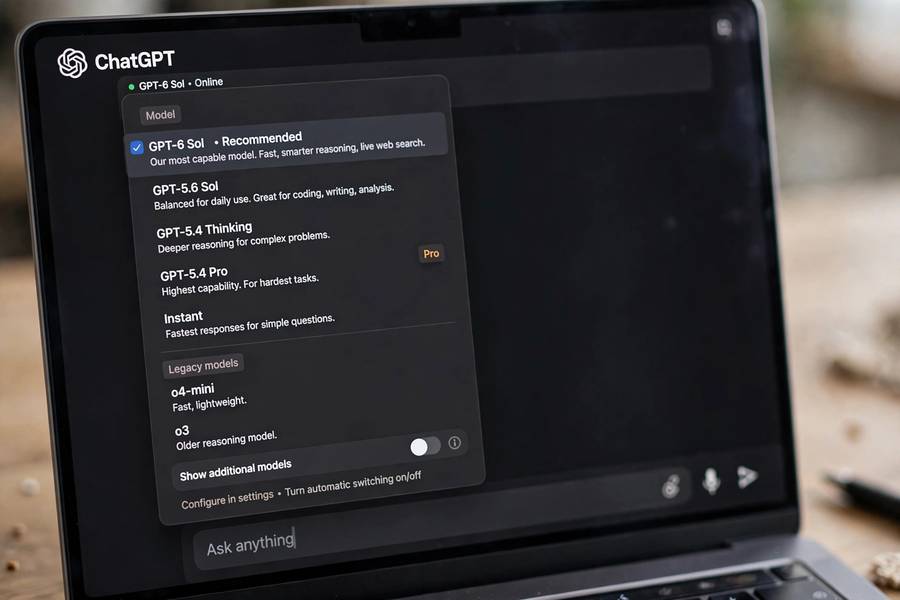
You can usually override this with the model selector (the dropdown at the top of the chat), but the default auto-routing is surprisingly good. It’s also why “ChatGPT” feels inconsistent sometimes — you might literally be talking to different models across conversations without realizing it.
My advice: leave it on auto unless you have a reason to override. But know that auto exists, so when quality varies mysteriously, you have a hypothesis: different model, different capabilities.
Which Model Should You Pick?
A practical decision guide:
- Quick questions, drafting, casual chat → default/auto (usually GPT-4o or mini). Don’t overthink it.
- Important writing, analysis, coding help → explicitly select GPT-4o (or best available flagship) to avoid being routed to a mini.
- Hard reasoning problems (complex math, tricky logic, difficult debugging) → o-series. Accept the wait; the quality difference is real.
- Speed-critical or high-volume → mini models deliberately. Faster, cheaper, good enough.
- Multimodal (images, voice) → GPT-4o — the omni design handles these natively.
The meta-skill: match model capability to task difficulty. Using o-series for “write a thank-you note” wastes time; using a mini for “prove this theorem” wastes the answer.
A Brief History of ChatGPT Models
For context on how we got here:
- Nov 2022: ChatGPT launches on GPT-3.5 — the model that started the boom
- Mar 2023: GPT-4 arrives — a major leap in capability, Plus-only initially
- 2023–2024: Turbo variants, then GPT-4o (May 2024) brings multimodality and speed
- Late 2024: o1 introduces reasoning models to the public
- 2025–2026: The lineup stabilizes into flagship/reasoning/mini tiers, with steady improvements
The trajectory: models get more capable and more specialized simultaneously. The future isn’t one giant model — it’s a well-orchestrated team of them.
“ChatGPT” is a storefront; the models are the inventory. Knowing what’s on the shelves — GPT-4o for most things, o-series for hard thinking, minis for speed — turns you from a passive user into someone who directs the right intelligence at each problem. In an age of AI abundance, that routing judgment is the skill.
Frequently Asked Questions
ChatGPT uses multiple models: GPT-4o as the default flagship, o-series models (o1, o3) for complex reasoning, and mini variants for fast simple tasks. The system auto-routes your prompt to the appropriate model, though you can override with the model selector.
The “o” stands for “omni” — GPT-4o is natively multimodal, handling text, images, and audio within a single model. It’s OpenAI’s flagship general-purpose model and the default for most ChatGPT conversations.
GPT-4o is a fast generalist for everyday tasks; o1 is a reasoning model that “thinks” through problems step-by-step before answering. O1 is better at complex math, logic, and coding but slower and more expensive. Use GPT-4o by default, o1 for hard reasoning.
Free users get limited access to GPT-4o (the current flagship generation) plus mini models. Heavy free usage gets routed to smaller models after hitting caps. Full GPT-4o access and o-series reasoning models require a paid plan.
Use the model selector dropdown at the top of the chat. Leave it on auto for most things; explicitly pick the flagship for important work and o-series for hard reasoning problems. Match the model to the task difficulty.