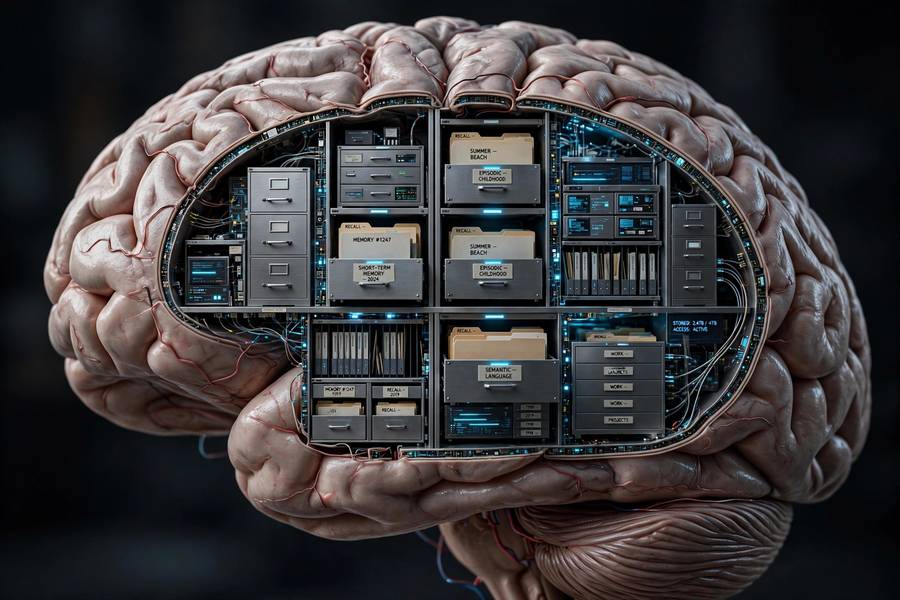
“Do you remember me?” It’s the first thing people ask a returning AI, and the answer reveals one of the most misunderstood aspects of agents. The model itself remembers nothing between conversations — every session starts with amnesia. What we call “agent memory” is infrastructure built around that amnesia: systems for storing, retrieving, and using information across time. Understanding it means understanding both the magic and the machinery.
I’ve built memory systems for agents ranging from toy note-files to production vector stores, and the pattern is consistent: memory makes agents feel dramatically more intelligent, while introducing failure modes that are subtle and underappreciated. This guide covers the types, the mechanics, and the honest limits. For the bigger picture, see what is an AI agent.
Table of Contents
- Why Agents Need Memory (The Amnesia Problem)
- Working Memory: The Context Window
- Episodic Memory: The Agent’s Diary
- Semantic Memory: The Agent’s Knowledge Base
- Procedural Memory: Skills and Habits
- How Retrieval Works
- Where Memory Fails
- Memory and Privacy
- Frequently Asked Questions

Why Agents Need Memory (The Amnesia Problem)
A language model is stateless. Each API call is independent — the model has no continuity, no recollection, no sense of “before.” Chat interfaces fake continuity by resending the conversation history with every message. But that trick only works within a session, and only until the history outgrows the context window.
Agents need more. A research agent working a multi-hour task must remember what it found in hour one. A personal assistant must remember your preferences across weeks. A coding agent must remember the project’s conventions across sessions. The types of AI agents in production today each solve this differently. Without memory infrastructure, every agent is an amnesiac genius — brilliant in the moment, blank beyond it.
The solution isn’t making the model remember (it can’t, architecturally). It’s building external systems that store information and feed the relevant parts back into the model’s context when needed. “Agent memory” is really “agent memory systems” — and the design of those systems determines how capable the agent feels.
Working Memory: The Context Window
What it is: the current conversation and recent actions, held directly in the model’s context window. Everything the model is “thinking about right now.”
Capacity: technically large (100K–1M+ tokens in current models), but effectively much smaller. Models reason best over recent, relevant context; performance degrades as contexts fill with noise. The usable working memory is a fraction of the technical limit.
How agents manage it: summarization (compressing old history into briefs), relevance filtering (dropping what’s no longer needed), and structured formatting (keeping the important stuff prominent). Good agent frameworks are obsessive about context hygiene — every wasted token adds cost and degrades reasoning.
The analogy: human working memory — the handful of things you’re actively thinking about. Limited, immediate, essential. Just like humans, agents think best when their working memory is uncluttered.
Episodic Memory: The Agent’s Diary
What it is: records of past experiences — previous tasks, conversations, observations, outcomes. The agent’s autobiography, stored externally.
How it’s built: after (or during) tasks, the agent writes summaries of what happened: what it did, what worked, what it learned. These get converted to embeddings and stored in a vector database. It’s literally a diary with semantic search.
How it’s used: when facing a new situation, the agent queries the diary: “have I seen anything like this before?” Relevant past episodes get retrieved and injected into working memory. A coding agent retrieves similar past bug fixes; a support agent retrieves similar past tickets.
The power: this is what makes agents feel like they learn. The tenth similar task goes faster than the first, because the diary has relevant experience. It’s not true learning (the model weights don’t change), but functionally, from the user’s perspective, the agent improves.
The catch: retrieval is similarity-based, not wisdom-based. The agent retrieves what looks similar, which isn’t always what’s relevantly similar. And the diary only contains what was written down — garbage in, garbage out, across sessions.
Semantic Memory: The Agent’s Knowledge Base
What it is: stable facts and knowledge — user preferences, domain facts, procedures, organizational context. Not “what happened” but “what is true.”
How it’s stored: often structured — databases, knowledge graphs, document stores — rather than vector embeddings, because precision matters. “The user’s timezone is EST” should be retrieved exactly, not approximately.
Examples: user profile (name, preferences, constraints), project conventions (coding standards, brand guidelines), domain knowledge (product catalogs, policy documents), procedural knowledge (how expense reports work here).
How it differs from episodic: semantic memory is about facts that don’t change (or change slowly); episodic is about experiences that accumulate. “The deployment process has five steps” is semantic; “last Tuesday’s deployment failed at step three” is episodic. Agents need both, and confusing them causes errors — treating a one-time incident as a permanent rule, or forgetting a stable preference.
The maintenance problem: semantic memory goes stale. People change preferences, projects change conventions, policies update. Without maintenance processes — expiration, verification, update mechanisms — the knowledge base becomes a liability of confident wrongness.

Procedural Memory: Skills and Habits
What it is: learned procedures and skills — how to do things, not facts about things. The agent’s muscle memory.
Current reality: mostly aspirational. Today’s agents don’t truly develop skills; they follow procedures described in prompts or retrieved from memory. But the direction is clear: systems that compile repeated successful patterns into reusable “skills” — like the “compute this report” procedure the agent worked out once and now reuses.
Emerging approaches: skill libraries (stored procedures the agent can invoke), demonstration learning (watching human workflows and encoding them), and reinforcement from human feedback on procedures. This is an active research frontier.
Why it matters: procedural memory is the difference between an agent that figures out the expense report process every time and one that knows it. The efficiency and reliability gains are enormous — when it works.
How Retrieval Works
The mechanics of “remembering”:
-
Encoding. Experiences and facts get converted to embeddings (vector representations capturing semantic meaning) and stored with metadata (timestamps, sources, confidence).
-
Querying. When the agent needs memories, it embeds the current situation and searches for similar stored items. “Similar” means close in vector space — semantically related, not keyword-matched.
-
Ranking and filtering. Retrieved candidates get ranked by similarity, recency, and relevance signals. Top-k are selected — usually 3–10 items.
-
Injection. Selected memories get formatted into the working context, often with source tags (“From your notes on 2024-03-15…”).
-
The model reasons over them as part of its current context — treating retrieved memories as (fallible) information about the past.
The retrieval quality problem: this pipeline has failure modes at every stage. Poor encoding loses nuance; similarity search returns plausible-but-irrelevant items; ranking favors recency over relevance; injection without source tags lets the model confuse memory with current reality. Each stage needs design attention.
Where Memory Fails
Hallucinated memories. The model sometimes “remembers” things that never happened — confabulating past interactions with the same confidence as real recall. Without source verification, these poison future behavior.
Stale memories. “The user prefers X” from two years ago, still applied after preferences changed. Memory systems need expiration and update mechanisms; most don’t have them.
Memory poisoning. Attackers plant false information in content the agent stores — a malicious document that becomes a “memory,” influencing future decisions. This is prompt injection with a time delay, and it’s nasty because the poison sits quietly until retrieved.
Context contamination. Retrieved memories mixing with current instructions — the model can’t always distinguish “this is what happened before” from “this is what you should do now.” Source tagging helps; it’s not foolproof.
The privacy paradox. The more useful the memory, the more sensitive it is. Detailed episodic memory is a surveillance record. Who can access it? How long is it kept? Can the user delete it? These aren’t technical questions — they’re the questions that determine whether memory systems are trustworthy.
Retrieval failures. The right memory exists but isn’t retrieved (bad query, poor embeddings), or the wrong memory is retrieved and acted on confidently. Silent failures — the agent doesn’t know what it doesn’t remember.
Understanding how AI agents make decisions shows how retrieved memories influence the decision process — and how that influence can go wrong.
Memory and Privacy
This deserves its own section because it’s the issue most builders underweight:
What gets stored is broader than users expect. Not just “preferences” but full interaction histories, inferred traits, behavioral patterns. The diary is detailed.
Retention is often indefinite. Many systems keep everything forever by default. There’s rarely a good reason for this and several bad consequences.
Deletion is hard. Vector databases don’t forget cleanly; derived summaries persist after source deletion; backups multiply copies. “Delete my data” is a promise most memory architectures can’t fully keep — yet.
Cross-session linkage. Memory connects sessions into a persistent profile. Users who understood each conversation as ephemeral may not realize they’re building a longitudinal record.
The design principles: data minimization (store what’s needed, not what’s possible), transparent controls (show users what you remember), genuine deletion (architect for it), purpose limitation (memories for the task, not for profiling), and default expiration. The agents that get memory privacy right will have a durable trust advantage.

Frequently Asked Questions
Agent memory is the infrastructure that lets AI agents retain information across time, since language models themselves are stateless and remember nothing between calls. It comprises working memory (current context), episodic memory (past experiences in vector stores), semantic memory (stable facts in structured stores), and emerging procedural memory (learned skills).
Through external memory systems: conversation summaries are encoded as embeddings and stored in vector databases; when a new situation arises, the agent retrieves semantically similar past experiences and injects them into its current context. It’s retrieval-based continuity, not true learning — the model weights don’t change.
Four types: working memory (active context window — immediate but limited), episodic memory (past experiences and outcomes — the agent’s diary), semantic memory (stable facts, preferences, procedures — the knowledge base), and procedural memory (learned skills and habits — still largely aspirational in current systems).
Yes — via memory poisoning: attackers plant false information in content the agent stores, which later gets retrieved and acted on as trusted memory. It’s prompt injection with a time delay. Defenses include provenance tracking on stored content, sanitization on retrieval, and source tagging so the model can weigh memory reliability.
Not truly — the model’s weights don’t change from interaction. What looks like learning is episodic memory: past experiences stored and retrieved, making the tenth similar task faster than the first. Functionally useful, but brittle: it retrieves what looks similar (not what’s wisely relevant) and can’t correct its own underlying reasoning flaws.