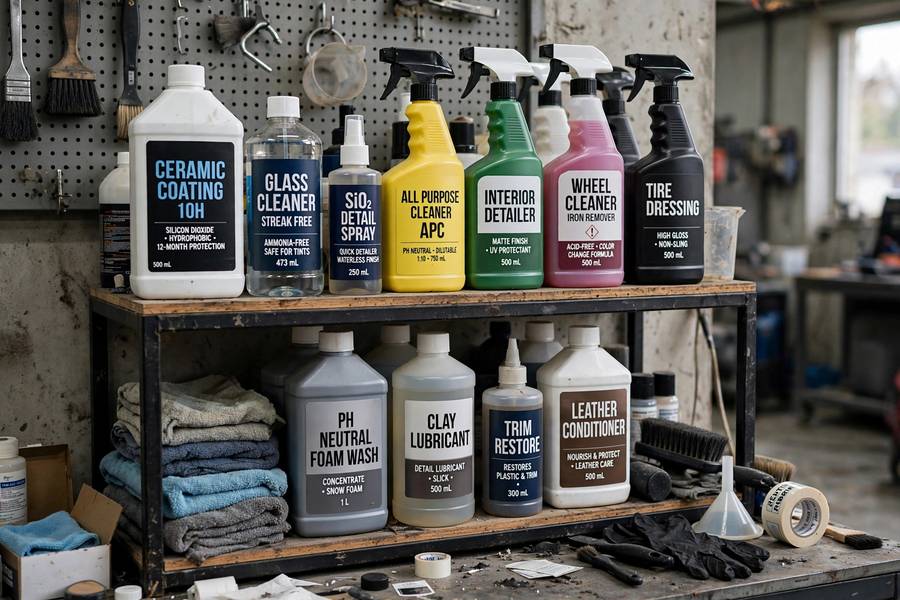
Walk into a professional detailer’s chemical shelf and you will see something surprising: fewer products than the enthusiast’s garage, not more. Pros do not collect chemicals — they curate them. Every bottle earns its place by doing a job nothing else does as well or as cheaply, because chemical cost per job is a line item in a business, not a hobby expense.
I have tested most of what the professional market offers, and I have watched what high-volume operators actually reorder. This guide is the curated shelf: the categories you need, what to look for in each, the pro buying principles that cut costs 30–50%, and what to skip. (For the hardware side, see best car detailing equipment for startups; for the business context, how to start a car detailing business.)
Table of Contents
- The Pro Buying Principles
- Exterior Wash Chemicals
- Decontamination Chemicals
- Polishing Compounds and Finishing Polishes
- Protection: Waxes, Sealants, and Coatings
- Interior Chemicals
- Specialty Problem-Solvers
- What to Skip
- Storage and Safety
- Frequently Asked Questions
The Pro Buying Principles
Before the product categories, the principles that separate professional purchasing from enthusiast collecting:
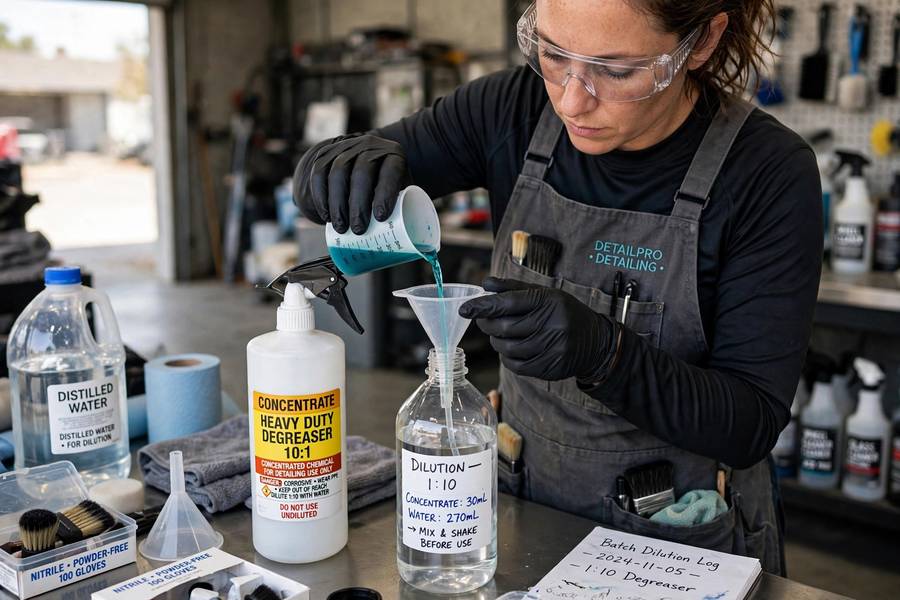
Buy concentrates. Professional chemical lines sell concentrates that dilute 4:1 to 20:1. A gallon of concentrated all-purpose cleaner at $35 that makes 10 gallons of usable product beats a $12 ready-to-use quart every time. Per-job chemical cost is a KPI — track it, and concentrates are how you keep it under control.
Fewer products, deeper knowledge. Ten products you know intimately outperform thirty you use randomly. Pros learn each chemical’s working time, dilution behavior, and failure modes. Mastery beats variety.
pH matters. Alkaline cleaners (degreasers, APCs) cut organic grime; acidic cleaners (wheel acids, water spot removers) dissolve mineral deposits; pH-neutral soaps clean without stripping protection. Understanding pH lets you choose correctly instead of reaching for “the strong stuff” — which is how paint and trim get damaged.
Dwell time is chemistry. Most chemicals need time to work. Spraying and immediately wiping wastes product and results. Pros apply, let dwell per the label, then agitate. Patience is a chemical multiplier.
Buy from pro suppliers. Professional detailing suppliers sell in gallons, offer bulk pricing, provide SDS sheets, and keep shelves consistently full. Retail auto parts stores sell small bottles at 3x the per-ounce cost with frequent stockouts. Once you are doing real volume, the pro supplier relationship is non-negotiable.
Exterior Wash Chemicals
pH-neutral car shampoo. Your daily driver chemical. Look for: good lubricity (prevents wash swirls), strong foam in a cannon, and no added waxes or “gloss enhancers” that interfere with correction work. Buy 5-gallon pails once you are established — the per-ounce savings are dramatic.
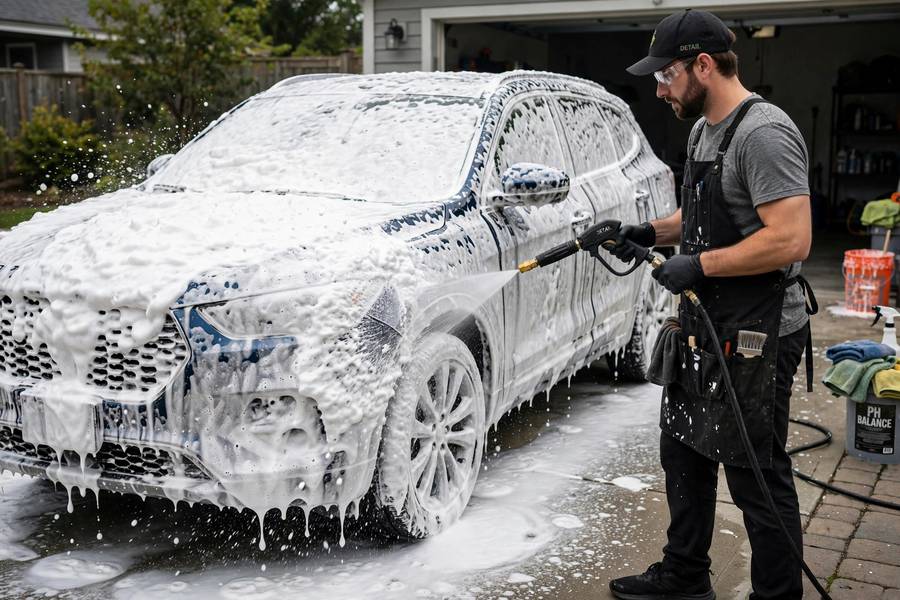
Pre-wash / snow foam. A dedicated alkaline pre-wash foam applied before contact washing loosens grime so your mitt touches less dirt. This single step prevents more swirls than any technique upgrade. Do not skip it on dirty vehicles.
All-purpose cleaner (APC). The workhorse. Diluted strong for engine bays and wheel wells, medium for door jambs and trim, weak for interior spot cleaning. One product, four jobs — this is why pros love concentrates.
Degreaser. For the truly nasty: engine bays, undercarriages, exhaust tips. Stronger than APC, used less often. Keep it off paint and raw aluminum unless the label says otherwise.
Bug and tar remover. Seasonal essential. Dedicated solvents dissolve what shampoo cannot. Apply, dwell, wipe — never scrub dried bugs, which is how clear coat gets scratched.
Decontamination Chemicals
Decontamination — removing bonded contaminants before polishing — is what separates detailing from washing. The chemical sequence:
Iron remover. Dissolves embedded brake dust and rail dust (the tiny orange dots on light paint). It bleeds purple as it works, which is both satisfying and diagnostic — heavy bleeding means the car needed it badly. Essential before any correction work.
Tar remover. Solvent-based, dissolves road tar and sap. Use after iron remover, before clay.
Clay lubricant and clay. Fine-grade clay with proper lubricant removes what chemicals leave behind. The baggie test (fingertip in a plastic bag, glided over paint) tells you when the surface is truly clean. Some pros have moved to clay mitts and towels for speed — same principle, faster execution.
Water spot remover. Mild acid that dissolves mineral deposits from hard water. Use carefully — acids etch if left too long. This is a specialty product, not a daily driver.
The order matters: wash → iron remover → tar remover → clay → polish. Each step removes what the previous one could not. Skipping decontamination before correction means polishing contaminants into the paint — the kind of mistake that separates professionals from pretenders.
Polishing Compounds and Finishing Polishes
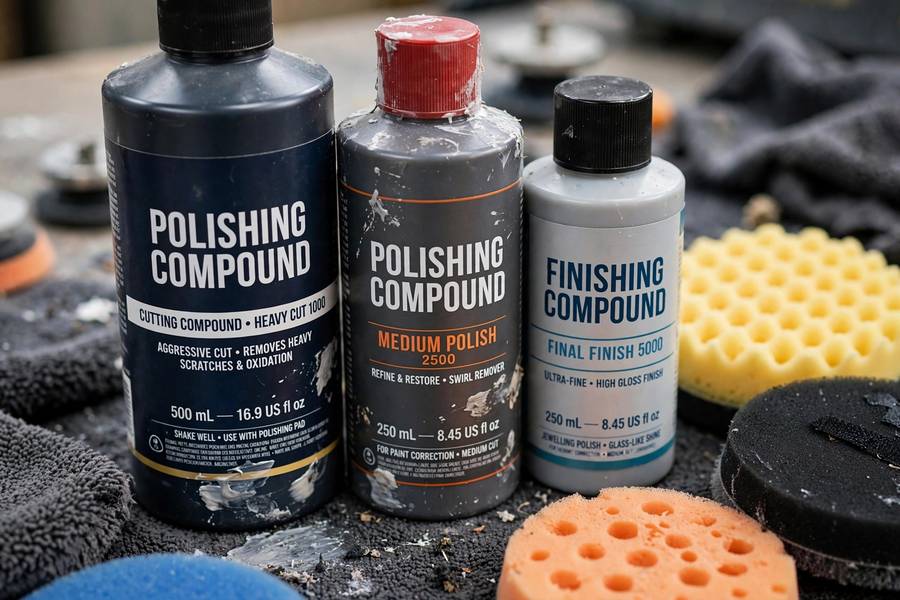
Cutting compounds. Heavy defect removal — oxidation, deep swirls, sanding marks. Modern diminishing-abrasive compounds cut fast and finish down well, reducing the old multi-step compound-then-polish-then-finish routine. For most work, one quality compound covers 80% of correction needs.
Finishing polishes. Refine compound haze to optical clarity. The final 10% of the job that creates 90% of the visual impact. Never skip the finishing step — customers see the difference even if they cannot name it.
One-step / all-in-one polishes. Medium cut with finishing ability in a single product. The efficiency choice for enhancement details and maintenance corrections. Pros doing volume work live on these.
What to look for: long working time (does not dust or dry out), easy wipe-off, and finish quality under inspection lighting. Test on a junkyard panel before committing — compound behavior varies with paint hardness, and your local market’s predominant paint types should drive your choice.
Pad pairing matters as much as the liquid. The same compound cuts differently on a cutting pad versus a finishing pad. Pros think in systems (compound + pad + machine + technique), not in bottles.
Protection: Waxes, Sealants, and Coatings
Spray waxes and drying aids. Quick application, 1–3 months of protection. The upsell-friendly option — “spray wax add-on, $25” takes five minutes and delights customers. Every pro should keep one on the shelf.
Paste and liquid waxes. Traditional carnauba or synthetic blends, 2–4 months of protection, beautiful warm gloss. Still relevant for show cars and customers who love the ritual. Being displaced by sealants for daily drivers.
Paint sealants. Synthetic polymers, 4–8 months of protection, excellent value. The smart default for customer cars — durable, affordable, easy to apply. Many pros have standardized on sealants for everything below the coating tier.
Ceramic coatings (consumer and professional). 1–7 years depending on tier. The premium service with premium product costs ($50–$300 per application). Coating choice should align with your certification and warranty offering — pick a line, master it, stand behind it.
The honest guidance for customers: coatings are not “never wax again” — they are “easier maintenance with real protection.” Set expectations correctly and you will have customers for life; oversell and you will have warranty claims.
Interior Chemicals
Interior all-purpose cleaner. pH-neutral, safe on all surfaces — your interior workhorse for dashboards, door panels, consoles. Dilute appropriately; interiors need gentler chemistry than exteriors.
Leather cleaner and conditioner (separate products). Cleaner first, conditioner after — the two-step matters. All-in-one leather products compromise both functions. For coated or delicate leathers, use the gentlest effective option.
Fabric and upholstery cleaner. For extractor machines — low-foam formulas that rinse clean. High-foam products leave residue that attracts dirt faster, undoing your work within weeks.
Odor eliminators (enzyme-based). Enzymes digest organic odor sources rather than masking them. Essential for smoke, milk spills, pet odors, and mystery smells. Pair with ozone deodorizing for severe cases — but ventilate thoroughly and never run ozone with people or pets present.
Glass cleaner (ammonia-free). Ammonia damages window tint. This is a small detail that prevents expensive mistakes — one ammonia cleaning on tinted windows can cause bubbling that costs hundreds to fix.
Dressings and protectants. Water-based for interiors (low gloss, natural look), solvent-based for exterior trim (durability). Match the finish to the surface — shiny dashboards look cheap and create windshield glare.
Specialty Problem-Solvers
Pet hair: rubber brushes and pumice stones beat chemicals. Mechanical removal first, then clean.
Tree sap: dedicated sap remover or isopropyl alcohol. Remove promptly — sap etches clear coat over time.
Overspray: clay usually handles it; severe cases need solvent or light polishing.
Headlight restoration: sanding discs plus polishing compound plus UV sealant. The sealant step is what separates lasting restoration from haze that returns in months.
Convertible top cleaner and protectant: fabric tops need dedicated products — never use paint chemicals on canvas.
Engine bay dressing: water-based dressing for a clean OEM look. Avoid tire-shine products under the hood — they attract dust and look wrong.
What to Skip
“Miracle” products. If it promises to replace an entire correction process in a spray bottle, it is lying. Chemistry has limits; marketing does not.
Duplicate overlapping products. Four brands of quick detailer, three wheel cleaners, two iron removers “to compare.” Pick one per category and master it. Shelf clutter is cash sitting idle.
Scented everything. Strong fragrances in chemicals transfer to customer cars. Unscented or mildly scented professional products are the standard — customers should smell clean, not perfume.
Single-use gadgets in chemical form. Most “specialty” cleaners are repackaged APC at 5x the price. Read SDS sheets — you will be amazed how many products share the same active ingredients.
The cheapest option. Ultra-cheap chemicals cost more per job (poor dilution, more product needed) and risk damage (inconsistent pH, harsh solvents). Professional mid-tier products are the value sweet spot.
Storage and Safety
Organize by pH and purpose. Acids separate from alkalines, interiors separate from exteriors, clearly labeled dilution bottles. A new employee should be able to find the right product without asking.
SDS sheets accessible. Safety Data Sheets for every product, in a binder or digital folder. This is an OSHA requirement with employees and basic professionalism without them.
PPE stocked. Nitrile gloves, eye protection, respirator for correction work and strong chemicals. Chemical exposure is cumulative — the pros who last decades protect themselves from day one.
Temperature control. Most chemicals specify storage temperatures. Freezing ruins many products; extreme heat degrades others. A climate-stable storage area protects your inventory.
Buy chemicals like the business input they are: tracked per job, bought in bulk, and chosen for performance per dollar. Your chemical shelf is a profit lever hiding in plain sight — and how to price car detailing packages shows how those per-job costs flow into pricing that protects your margins.
Frequently Asked Questions
Pros use a curated set: pH-neutral shampoo, alkaline pre-wash foam, concentrated APC, iron and tar removers, clay, cutting compounds and finishing polishes, sealants or ceramic coatings, pH-neutral interior cleaner, enzyme odor eliminators, and ammonia-free glass cleaner. Fewer products, bought as concentrates, mastered deeply.
Yes — concentrates that dilute 4:1 to 20:1 cut per-job chemical costs 30–50% versus ready-to-use retail products. A $35 gallon of concentrated APC making 10 gallons of usable product is the professional standard. Track chemical cost per job as a KPI.
Wash → iron remover → tar remover → clay → polish. Each step removes what the previous one couldn’t. Skipping decontamination before correction means polishing bonded contaminants into the paint — a fundamental professional error.
For durability, yes — coatings last 1–7 years versus 2–4 months for wax. But coatings aren’t “never maintain again”; they’re easier maintenance with real protection. Set customer expectations honestly: coatings need proper washing and periodic maintenance to perform.
Avoid “miracle” products promising correction in a spray bottle, duplicate overlapping products from multiple brands, strongly scented chemicals, ultra-cheap products with inconsistent chemistry, and ammonia-based glass cleaner (damages window tint). Master a small set of professional mid-tier products instead.