Every AI agent you’ve used — the coding assistant, the research helper, the customer support bot — is built from the same handful of components arranged in a loop. Once you see the architecture, the mystery evaporates: agents are not magic, they are engineering. Good engineering, increasingly, but engineering you can understand piece by piece.
I’ve built and broken enough agents to have opinions about which parts matter most. This guide walks through the standard architecture: the core components, how they connect, the major design patterns, and where the whole thing tends to fail. For the conceptual foundation, see what is an AI agent.
Table of Contents
- The Standard Architecture in One Diagram
- Component 1: The LLM (Reasoning Engine)
- Component 2: Tools (Action Layer)
- Component 3: Memory Systems
- Component 4: The Planner and Control Loop
- Component 5: Guardrails and Evaluation
- Single-Agent Patterns
- Multi-Agent Patterns
- Where Architectures Fail
- Frequently Asked Questions

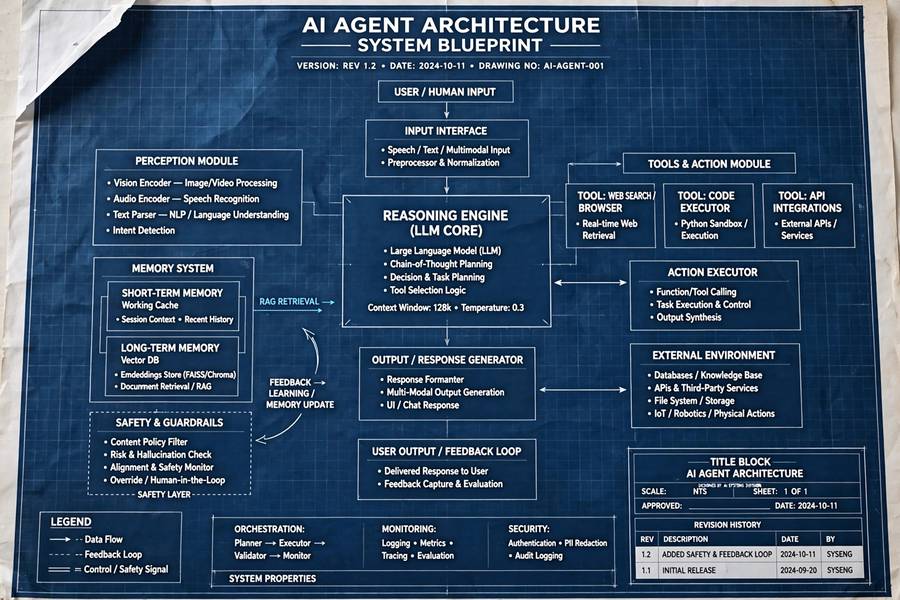
The Standard Architecture in One Diagram
Picture the agent as a loop with five stations:
┌─────────────────────────────────────────┐
│              CONTROL LOOP               │
│  ┌──────┐    ┌──────┐    ┌──────────┐   │
│  │ Plan │───▶│ Act  │───▶│ Observe  │   │
│  └──┬───┘    └──┬───┘    └────┬─────┘   │
│     │           │              │         │
│     ▼           ▼              ▼         │
│  ┌─────────────────────────────────┐    │
│  │         LLM (thinks)            │    │
│  └─────────────────────────────────┘    │
│     │           │              │         │
│     ▼           ▼              ▼         │
│  ┌────────┐ ┌────────┐ ┌──────────────┐  │
│  │ Memory │ │ Tools  │ │ Guardrails   │  │
│  └────────┘ └────────┘ └──────────────┘  │
└─────────────────────────────────────────┘
The LLM thinks. Tools act. Memory remembers. The control loop orchestrates. Guardrails constrain. Every production agent — from a simple support bot to a complex research system — implements some version of this. The types of AI agents differ mostly in how elaborate each station is.
Component 1: The LLM (Reasoning Engine)
The LLM is the agent’s brain — it does the reasoning, planning, and language understanding. Every decision the agent makes passes through the model:
Role in the loop. At each iteration, the LLM receives the current state (goal, history, observations) and produces the next step: a thought, a tool call, or a final answer. Frameworks format this differently — ReAct interleaves reasoning and acting, Plan-and-Execute separates them — but the model is always the decision-maker.
Model choice matters enormously. Stronger models plan better, use tools more reliably, recover from errors more gracefully, and hallucinate less. The performance gap between model tiers shows up more in agents than in chat, because errors compound across loop iterations. A 5% better model can mean a 30% better agent.
The prompt architecture. The LLM doesn’t see raw reality — it sees carefully constructed prompts: system instructions defining its role and constraints, tool descriptions telling it what’s available, formatted history showing what’s happened, and the current task. Designing these prompts is a major engineering discipline. Small changes here cause large behavior changes downstream.
Cost reality. The LLM is also the primary cost driver. Every loop iteration is at least one model call, often several (planning call, tool call formatting, result interpretation). A 20-step agent task on a frontier model can cost dollars, not cents. Architecture decisions — how many calls per loop, which model for which subtask — are budget decisions.
Component 2: Tools (Action Layer)
Tools are how the agent touches the world. Each tool is a function with a name, a description (so the LLM knows when to use it), and a schema defining its inputs:
Common tool categories: – Information retrieval — web search, database queries, document readers, API lookups – Computation — code interpreters, calculators, data analysis – Communication — email, messaging, calendar, notifications – Creation — file writing, image generation, code commits – Control — smart home APIs, robotic controls, system administration
Tool design is destiny. The tools you give an agent define what it can do more than any prompt does. Well-designed tools have narrow scopes, clear schemas, informative error messages, and safe defaults. Poorly designed tools — vague descriptions, overly broad permissions, cryptic errors — produce agents that misuse them creatively and destructively.
The permission principle. Every tool is a privilege. Production architectures scope tools to least privilege: read-only where possible, confirmation gates for irreversible actions, audit logging on everything. The most common architectural failure I see is giving a demo’s broad toolset to a production agent.
MCP and standardization. The Model Context Protocol (MCP) emerged as a standard for exposing tools to agents — like USB for AI capabilities. Standardized tool interfaces mean agents can use new capabilities without custom integration work, which is accelerating the whole ecosystem.
Component 3: Memory Systems
LLMs forget everything between calls, so agents need external memory. Production architectures typically implement three tiers:
Working memory (context window). The current conversation and recent actions, held in the prompt. Fast, immediate, but limited — and expensive, since every token in context is re-processed each call. Good architectures summarize aggressively to keep working memory lean.
Episodic memory (vector store). Past interactions, task results, and observations stored as embeddings in a vector database. The agent retrieves relevant memories by similarity when facing new situations. This is how agents “learn” across sessions — though it’s retrieval, not true learning.
Semantic memory (knowledge base). Stable facts: user preferences, domain knowledge, procedures, organizational context. Often stored in structured form (databases, knowledge graphs) rather than vectors, because precision matters more than similarity.
The memory hierarchy in action. A coding agent might keep the current file in working memory, retrieve similar past bug fixes from episodic memory, and consult the project’s coding standards from semantic memory — all in one loop iteration. Each tier serves a different need, and the art is in routing queries to the right tier.
What memory doesn’t do. It doesn’t make the model smarter, doesn’t fix reasoning errors, and can actively harm — retrieved irrelevant memories distract, and poisoned memories (via prompt injection into stored content) corrupt future behavior. Memory is powerful infrastructure with its own attack surface.
Component 4: The Planner and Control Loop
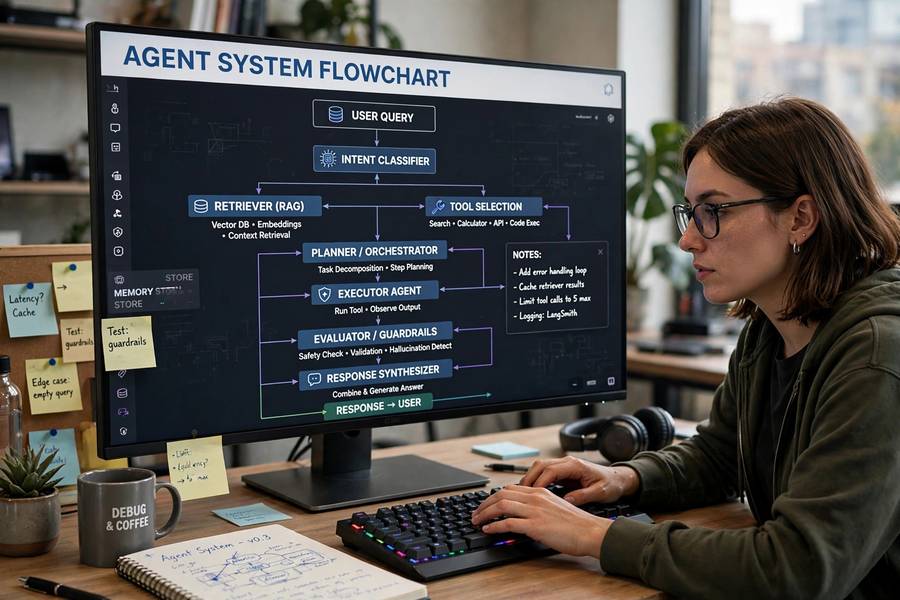
The control loop is the conductor — it decides what happens when. Major patterns:
ReAct (Reason + Act). The LLM alternates between thinking (“I need to find X”) and acting (calling the search tool), observing results, and repeating. Simple, robust, the default for most agents. Its weakness: no global plan, so it can wander.
Plan-and-Execute. The LLM first creates a full plan, then executes steps, replanning when reality diverges. Better for complex tasks with dependencies; worse when the environment is unpredictable (plans go stale fast).
Reflexion / self-correction loops. After acting, the agent evaluates its own work and iterates. “Did that actually work? No — let me try differently.” This meta-loop dramatically improves reliability on hard tasks at the cost of more model calls.
Hierarchical planning. A high-level planner decomposes the goal into subgoals; specialized sub-agents handle each. The planner doesn’t touch tools directly — it orchestrates. This is the architecture behind the most capable current systems.
The loop also handles the unglamorous essentials: stopping conditions (when is the task done?), error handling (what when a tool fails?), timeout management, and state persistence (surviving restarts). These boring parts determine production reliability more than the clever parts determine demo impressiveness.
Understanding how AI agents make decisions goes deeper into the decision mechanics inside each loop iteration.
Component 5: Guardrails and Evaluation
The component most demos skip and most production systems need most:
Input guardrails. Filtering and validating what goes into the agent — prompt injection detection, content safety checks, scope validation (“is this request within what I’m built to do?”).
Output guardrails. Checking what comes out — action review (is this tool call safe?), content filtering, confidence thresholds that trigger human escalation.
Runtime monitors. Watching the loop itself — detecting infinite loops, runaway tool use, cost overruns, and behavioral anomalies. The circuit breakers of agent architecture.
Evaluation harnesses. Continuous testing infrastructure: task evals run on every change, regression suites, red-teaming. Architecture without evaluation is hope with extra steps.
Single-Agent Patterns
The generalist. One agent with broad tools handling varied tasks. Simplest to build, hardest to make reliable — the jack-of-all-trades problem applies. Works for bounded domains (customer support for one product).
The specialist. One agent deeply optimized for one workflow — a code review agent, a research agent, a booking agent. Narrow tools, tuned prompts, deep evaluation. This is where most production value lives today.
The router. A thin agent that classifies requests and delegates to specialists (or to plain LLM calls for simple tasks). Efficient — you don’t pay agent costs for chatbot-shaped problems.
Multi-Agent Patterns
When tasks exceed what one agent handles well, architectures split the work:
Sequential pipeline. Agent A researches, Agent B writes, Agent C reviews. Each specializes; handoffs are structured. Simple to reason about, brittle at handoff points.
Hierarchical teams. A manager agent decomposes and delegates to worker agents, then synthesizes. Scales to complex tasks; the manager’s decomposition quality determines everything.
Collaborative debate. Multiple agents argue toward better answers — one proposes, another critiques, a judge decides. Expensive but effective for high-stakes reasoning where errors are costly.
Market/auction patterns. Agents bid on subtasks based on capability. Exotic, research-grade, but interesting for heterogeneous agent fleets.
Multi-agent systems multiply both capability and failure modes. Communication overhead, coordination failures, and cascading errors mean you should only go multi-agent when single-agent approaches demonstrably fail — which, for genuinely complex tasks, they increasingly do.
Where Architectures Fail
The failure patterns I see repeatedly:
Context bloat. Working memory fills with irrelevant history, the model gets confused, performance degrades. Fix: aggressive summarization and relevance filtering.
Tool sprawl. Too many tools with overlapping functions — the agent picks wrong ones or gets paralyzed by choice. Fix: fewer, better-designed tools.
No stopping condition. The loop runs until budget exhaustion. Fix: explicit done-detection and step limits.
Memory poisoning. Attackers plant instructions in content the agent stores and later retrieves. Fix: provenance tracking on memories, sanitization on retrieval.
Evaluation gaps. The architecture works on demo tasks and fails on real ones. Fix: evals built from real usage, run continuously.
Prompt brittleness. Small input variations cause large behavior changes. Fix: structured outputs, validation layers, and testing with input diversity.
Frequently Asked Questions
Five core components: the LLM (reasoning engine), tools (action layer for affecting the world), memory systems (working, episodic, and semantic), the planner/control loop (orchestrating the sense-plan-act cycle), and guardrails with evaluation (safety constraints and continuous testing).
The agentic loop is the iterative cycle agents run: assess the goal and current state, plan the next step, act (often via tools), observe the results, and repeat. Patterns include ReAct (interleaved reasoning and acting), Plan-and-Execute (plan first, then act), and hierarchical planning (planner delegates to sub-agents).
Single-agent architectures use one agent (generalist, specialist, or router pattern) for the whole task — simpler and more reliable. Multi-agent architectures split work across specialized agents (pipelines, hierarchies, debate patterns) — more capable for complex tasks but with multiplied failure modes and coordination overhead.
Three tiers: working memory (current context in the prompt — fast but limited), episodic memory (past interactions in a vector database, retrieved by similarity), and semantic memory (stable facts in structured stores). Together they let agents maintain continuity across and within sessions.
The Model Context Protocol (MCP) is an open standard for exposing tools and data sources to AI agents — like USB for AI capabilities. It lets agents use new tools without custom integration work, standardizing how models discover and call external functions.