
I’ve watched founders spend three weeks debating a name and I’ve watched others pick one in an afternoon over coffee. Here’s what surprised me: the speed of the decision had almost nothing to do with how well the name performed. What mattered was whether the name did a specific job — and most people never define that job before they start brainstorming.
If you’re working through the full process of naming, my guide on how to name a business covers the end-to-end sequence. This article zooms in on the one question that trips everyone up: how do you pick a name that actually stands out instead of blending into the noise?
The short answer: standout names are engineered, not discovered. They share five specific qualities, and there’s a repeatable method for generating them. Let me walk you through both.
Table of Contents
- Why Most Business Names Disappear Into the Noise
- The 5 Qualities of a Name That Stands Out
- My Standout-Name Brainstorming Method
- Name Styles That Cut Through (With Examples)
- The Domain and Trademark Reality Check
- How to Test Your Name Before You Commit
- What to Do When Your Perfect Name Is Taken
- Frequently Asked Questions

Why Most Business Names Disappear Into the Noise
Open any industry directory and you’ll see the pattern immediately. Twenty accounting firms with “Precision,” “Summit,” or “Apex” in the name. A dozen coffee shops called “The Daily Grind” or some variation of “Brew.” These names aren’t bad — they’re invisible.
The root cause is usually fear. Founders pick safe names because a safe name can’t embarrass them. But a name that can’t embarrass you also can’t excite anyone. Standing out requires a small, calculated risk: an unusual word, an unexpected combination, a name that makes someone pause for half a second.
There’s a second trap, which is the opposite: trying so hard to be unique that the name becomes unpronounceable, unspellable, or meaningless. I once saw a logistics startup call itself “Xyndiq.” Nobody could spell it, nobody could say it, and their word-of-mouth marketing was dead on arrival. Standing out is worthless if people can’t repeat the name to a friend.
The goal is the middle ground: distinctive enough to be remembered, simple enough to be shared. That tension is the whole game, and it’s why what good branding actually means starts with the name — it’s the first and most repeated brand asset you’ll ever create.
The 5 Qualities of a Name That Stands Out
After years of watching naming decisions play out, I’ve found that memorable names almost always share these five traits. Score your candidates against each one:
1. It’s easy to say out loud. If a customer can’t pronounce your name confidently, they won’t say it to anyone. Say every candidate out loud five times. If you stumble, kill it.
2. It’s easy to spell after hearing it once. The radio test: imagine someone hears your name on a podcast. Can they type it into Google and find you? If the spelling is ambiguous, you’ll bleed traffic to competitors and typo-squatters forever.
3. It carries a hint of meaning. The best names suggest something about what you do or how you do it — without being a literal description. “Stripe” suggests clean, fast movement. “Notion” suggests ideas captured. Neither name describes the product literally, but both feel right once you know the product.
4. It’s emotionally distinctive. Names that evoke a feeling beat names that describe a feature. Compare “QuickBooks” (descriptive, forgettable) with “Wave” (evocative, memorable) in the same category. One tells you what it does; the other makes you feel something.
5. It has room to grow. A name tied to one product (“Bob’s iPhone Repair”) becomes a cage when you expand. The standout names leave headroom — they describe a territory, not a single product.
Score each candidate 1-5 on every quality. Anything under 18 total goes in the bin. This simple filter eliminates about 80% of brainstorm output, which is exactly the point.
My Standout-Name Brainstorming Method
Here’s the process I recommend to founders. It takes about two hours and consistently produces better shortlists than weeks of casual debate.
Step 1: Write your positioning sentence (15 minutes). Fill in this template: “We help [specific customer] achieve [specific outcome] unlike [alternatives] because [differentiator].” Every name you generate must connect to something in this sentence.
Step 2: Build word banks (30 minutes). Create four lists of 20+ words each: words about your customer’s desired outcome, words about your differentiator, evocative/atmospheric words you like, and short punchy words (1-2 syllables). Don’t judge yet — volume matters more than quality at this stage.
Step 3: Combine aggressively (30 minutes). Mash words from different banks together. Try compounds (two words fused), phrases (two words separate), invented spellings of real words, and foreign-language words with relevant meanings. Aim for 100+ raw candidates. Most will be terrible. That’s fine — you’re mining, not sculpting.
Step 4: Filter with the five qualities (30 minutes). Run everything through the scoring system above. Keep the top 10-15.
Step 5: Sleep on it (overnight). This step is not optional. Names that excite you at midnight often embarrass you at noon. The overnight test kills more bad names than any other filter I know.
One more tip from experience: do this with one or two trusted people, not a committee. Committees produce compromise names, and compromise names are invisible names.
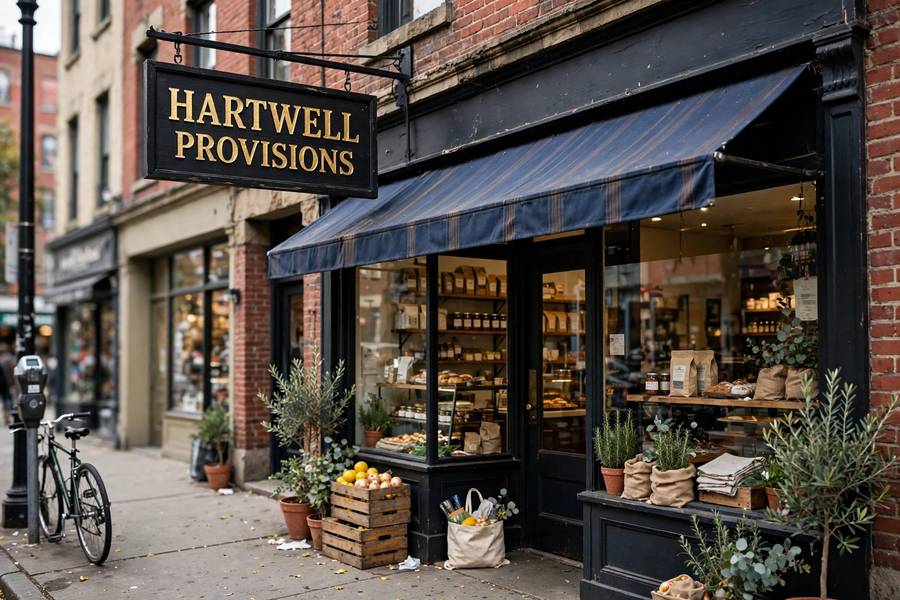
Name Styles That Cut Through (With Examples)
Different styles suit different businesses. Here are the ones I see working right now, with the trade-offs of each:
Invented words (e.g., Spotify, Etsy). Maximum distinctiveness, zero meaning at first. They work when you have marketing budget to teach people what the word means. Risky for bootstrapped businesses with no ad spend.
Real words, unexpected context (e.g., Apple, Stripe). A familiar word in an unfamiliar industry creates instant memorability. The word is easy to spell and say; the surprise is what makes it stick. This is my default recommendation for most small businesses.
Compound words (e.g., Facebook, Snapdeal-style fusions). Two meaningful halves fused into one. They communicate fast and are usually spellable. The downside: the obvious compounds in any industry are long gone.
Founder names (e.g., Ford, Dyson). They carry built-in story and trust. They work best for expertise-driven businesses — consulting, crafts, professional services. The risk is that the business becomes inseparable from you personally, which complicates what a startup is in the scaling sense if you ever want to sell.
Evocative abstracts (e.g., Nimbus, Ember). Words chosen for feeling rather than meaning. Great for lifestyle, hospitality, and creative businesses. Weak for technical B2B, where buyers want clarity.
Pick the style that matches your customer’s expectations, not your personal taste. A law firm named “Zyphr” will confuse people; a streetwear brand named “Smith & Associates Legal Counsel” will bore them.
The Domain and Trademark Reality Check
This is where standout-name dreams go to die — or get stronger. For each of your top 5 candidates, run these checks in order:
- Exact-match .com availability. It’s 2026 and the good .coms are taken, but check anyway. If it’s taken, check who owns it — a parked domain might be buyable; an active business in your industry is a dead end.
- Social handle availability. Check the major platforms for the exact handle. You don’t need all of them, but you need the one or two where your customers actually are.
- Trademark search. Search your country’s trademark database for the name in your business class. This is the check founders skip most often and regret most deeply. A cease-and-desist letter in year two is dramatically more expensive than a name change in week two.
- Linguistic check. If you plan to operate internationally, check what the name means — or sounds like — in your target markets’ languages. The classic cautionary tales exist for a reason.
If a name fails check 3, drop it immediately, no matter how much you love it. Legal problems compound; affection for a name fades.
How to Test Your Name Before You Commit
You’ve got 2-3 finalists that survived the checks. Now test them with real humans — not friends and family, who will be polite, but people who resemble your customers.
The bar test. Tell someone your name in a noisy environment, then ask them to spell it back to you an hour later. If they can’t, the name fails the memorability test.
The sentence test. Ask five people to use your business name in a sentence: “I bought this from ___.” Awkward phrasing (“I bought this from Xyndiq”) is a red flag. Natural phrasing (“I bought this from Ember”) is a green flag.
The Google test. Search the name plus your industry. If the first page is full of unrelated results, you’ll fight for visibility forever. If it’s empty, that’s actually good news — you can own it.
The gut test. After all the rational analysis, sit with each finalist for a day. Which one are you proud to say out loud? You’ll be saying this name thousands of times — in pitches, on calls, at events. Pick the one that gives you energy, not the one that just scored highest on a spreadsheet.
What to Do When Your Perfect Name Is Taken
It will happen. Your favorite name will be trademarked, domain-squatted, or already famous in another country. Don’t despair — this is normal, and the workaround options are well established:
Add a meaningful modifier. A word that adds positioning: “Ember Studio,” “Ember Supply,” “Ember & Oak.” The modifier can actually strengthen the name by adding context.
Change the TLD strategically. If the .com is taken by an unrelated business in another industry, a .co, .io, or country TLD can work — but only if your customers are tech-savvy enough to remember a non-.com. For mainstream consumer businesses, I’d still fight for the .com.
Invent a spelling variation. Dropping a vowel (like many startups do) or tweaking a letter can free up a taken name. This works, but it weakens the radio test — be honest with yourself about the trade-off.
Go back to the word banks. Often the second round of brainstorming produces better names than the first, because your brain has been working on the problem in the background. Some of my favorite client names came from round two.
The name matters, but let’s keep perspective: a great name with a mediocre business still fails, and a mediocre name with a great business can be overcome. Google is a weird name. So is Etsy. What made them work wasn’t the naming — it was everything after the naming. Pick a good name efficiently, then get back to building.

Frequently Asked Questions
Score candidates against five qualities: easy to say, easy to spell after hearing once, hints at meaning, emotionally distinctive, and room to grow. Then brainstorm from word banks tied to your positioning, filter ruthlessly, sleep on the shortlist, and test finalists with real potential customers before committing.
Not necessarily. Descriptive names are clear but forgettable and hard to trademark. Evocative or unexpected names (a real word in an unfamiliar context, or a well-chosen invented word) tend to stand out more and give you room to expand beyond your first product.
Check who owns it first — a parked domain may be buyable, but an active business in your industry means you should move on. Alternatives include adding a meaningful modifier word, using a different TLD (for tech-savvy audiences), or going back to your word banks for round two of brainstorming.
Critical. Search your country’s trademark database for the name in your business class before committing. A cease-and-desist letter in year two costs far more than a name change in week two. Drop any name that conflicts, no matter how much you love it.
Aim for 100+ raw candidates in your first session. Most will be bad — that’s the point. Filter them through the five-quality scorecard down to 10-15, then to 2-3 finalists for real-world testing. Volume at the start produces quality at the end.
Yes, but it gets expensive fast — new domain, rebranding, lost search equity, customer confusion. It’s far cheaper to spend two focused days choosing well now than to rebrand in year two. That said, a mediocre name with a great business beats a great name with no business, so don’t let naming paralysis stop you from launching.