
The most common question I get from people starting out is some version of: “I was bad at math in school — can I still learn AI?” And the most honest answer I can give you is: it depends on what you mean by “learn AI.” Using AI tools? Almost no math. Building models from scratch? Quite a lot. Most people live somewhere in between.
I’ve tested this personally. I’ve built machine learning projects with a solid math background, and I’ve also helped friends with zero math background ship working AI features. The difference math makes isn’t whether you can start — it’s how far you can go and how well you can debug when things break.
Table of Contents
- The Short Answer
- The Three Tracks of Learning AI
- The Math You Actually Need (By Topic)
- What Each Math Topic Is Really For
- If You’re Rusty: The Minimum Viable Math Plan
- What You Can Safely Skip (For Now)
- When Math Becomes Non-Negotiable
- My Practical Advice
- Frequently Asked Questions

The Short Answer
If you want to use AI tools — prompting chatbots, using AI features in products, automating workflows — you need no math at all. Zero. A marketing manager who has never seen a matrix can be highly effective with AI tools on day one.
If you want to build with AI — fine-tuning models, building apps on top of APIs, doing applied data science — you need basic math intuition. Probability, statistics, and a light grasp of linear algebra. You need to understand what the numbers mean, not derive them by hand.
If you want to invent AI — researching new architectures, writing papers, designing training algorithms — you need serious math. Multivariable calculus, linear algebra, probability theory, optimization. This is the one place where there’s no shortcut.
Most readers of this site are in the first two groups. And here’s the thing: you can start in group one today and work toward group two over months. That’s the normal path. I cover the full roadmap in my guide to learning AI — this article just answers the math question honestly.
The Three Tracks of Learning AI
Let me make this concrete, because “learn AI” is vague enough to be meaningless.
Track 1: The AI user. You use AI products and features. You write good prompts, you chain tools together, you evaluate outputs critically. Math required: none. Skills that matter: clear communication, domain knowledge, critical thinking. This is a completely legitimate relationship with AI, and plenty of high-value jobs live here.
Track 2: The AI builder. You integrate AI into software or analysis. You call model APIs, fine-tune existing models, train classifiers on your own data, build RAG systems. Math required: moderate. You need statistics and probability to evaluate models properly — is this 94% accuracy real or an artifact? You need basic linear algebra intuition — what are embeddings, why do dimensions matter? You don’t hand-derive backpropagation, but you understand what gradient descent is doing.
Track 3: The AI researcher. You design new models and training methods. Math required: heavy and continuous. This is a math-first career, and if that’s your goal, the math is the job, not a prerequisite.
Notice the pattern: as you move from using to building to inventing, math goes from irrelevant to important to essential. The question isn’t “do I need math” — it’s “which track am I on, and where do I want to go?”
The Math You Actually Need (By Topic)
Here are the topics that actually show up, ranked by importance for the builder track (the middle path most people take):
1. Statistics and probability — the most important. Everything in AI is evaluated with statistics. Accuracy, precision, recall, confidence intervals, distributions, p-values, overfitting detection. If you only learn one area, learn this. I’d argue that someone with strong statistics and no calculus is better equipped for applied AI than someone with strong calculus and no statistics.
2. Linear algebra — the language of models. Vectors, matrices, dot products, matrix multiplication. You don’t need to compute these by hand — libraries do that. You need to understand what they represent. An “embedding” is a vector. Attention involves matrix multiplication. When your model has “768 dimensions,” that’s linear algebra vocabulary. Learn the concepts and intuition; skip the proofs.
3. Calculus — mostly intuition, selectively deep. You need to understand derivatives as “rate of change” and gradients as “direction of steepest increase.” That’s the entire conceptual core of how models learn — gradient descent follows the gradient downhill. You don’t need to integrate by parts. You do need the intuition of what a gradient is and why it matters.
4. Discrete math and logic — occasionally useful. Some areas (algorithms, certain AI subfields) lean on it. For most builders, it’s background flavor rather than daily necessity.
5. Optimization theory — advanced. Relevant when you’re tuning training itself. Skip until you need it.
What Each Math Topic Is Really For
Abstract lists are forgettable, so here’s what each topic actually does in practice.
Statistics is how you know if your model works. I once watched someone celebrate a “95% accurate” classifier on a dataset where 95% of examples were negative — the model was just predicting “no” every time and looked brilliant. Basic statistics would have caught that in ten seconds. Statistics also tells you whether your A/B test means anything, whether your model’s improvement is real or noise, and whether your training data represents what you’ll see in production.
Linear algebra is how you talk about what models do. When someone says “we project the input into a 512-dimensional space,” they’re speaking linear algebra. The good news: you can learn the vocabulary and intuition in weeks. The bad news: without it, papers and documentation read like a foreign language. I’ve found that a visual, intuition-first approach — the kind popularized by creators who teach matrices geometrically — sticks far better than formula-heavy courses.
Calculus intuition is how you understand how AI models are trained. Training is, at its core, calculus running in a loop: compute how wrong the model is, find which direction reduces the error, step that way, repeat billions of times. Understanding that single loop — loss function, gradient, learning rate — demystifies most of training. You can understand it with pictures and analogies. You don’t need to solve differential equations.
If You’re Rusty: The Minimum Viable Math Plan
Here’s what I’d tell a friend who hasn’t done math since high school but wants to build with AI. This is a practical sequence, not a degree program.
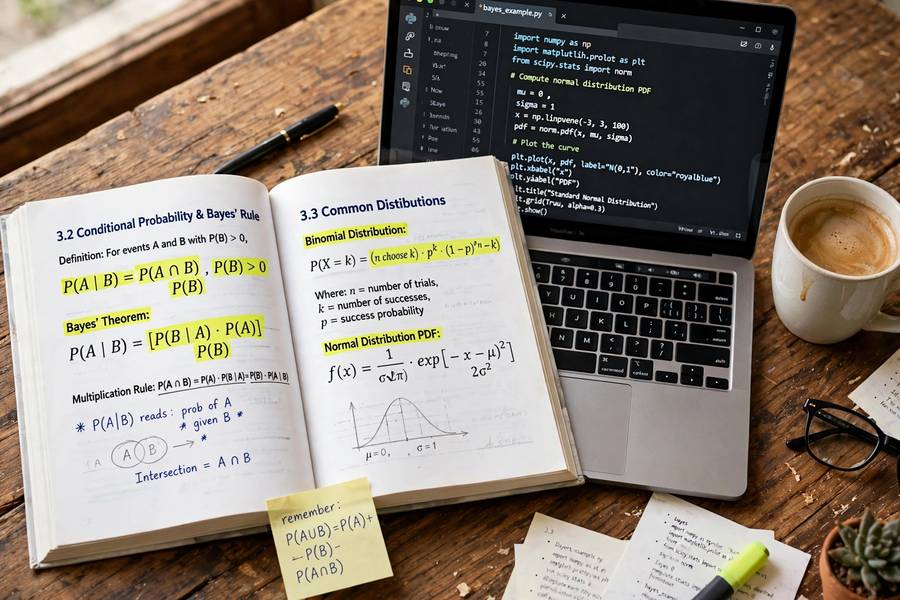
Weeks 1–3: Probability and statistics basics. Mean, median, variance, standard deviation, normal distribution, conditional probability, Bayes’ theorem (intuitively). Use a resource that teaches with examples and visualizations, not proofs. You want to feel what a distribution looks like before you calculate with it.
Weeks 4–6: Linear algebra intuition. Vectors, dot products, matrices as transformations, matrix multiplication conceptually. Watch visual explanations — this topic is dramatically easier when you see it geometrically. Aim for: “I understand what an embedding is and why dimensions matter.”
Weeks 7–8: Calculus intuition. Derivatives as rates of change, gradients as directions, the concept of optimization (finding minimums). You want the idea of gradient descent, not the mechanics of computing gradients by hand.
Ongoing: Learn math as it bites you. When you’re working on a project and hit a concept you don’t understand, go learn that specific thing. Math learned in service of a real problem sticks ten times better than math learned “just in case.” I’ve tested this repeatedly — context is the best teacher.
Total: roughly two months of part-time study to go from rusty to builder-ready math. That’s the honest number.
What You Can Safely Skip (For Now)
Permission to ignore these until you actually need them:
- Proofs and rigorous derivations. Understanding why something is true at a mathematical level is researcher territory. Intuition is enough for builders.
- Hand computation. Nobody computes matrix inverses by hand in 2026. Understanding what an inverse means is valuable; computing one manually is a party trick.
- Advanced calculus. Partial differential equations, contour integrals, measure theory. These belong to specific research niches.
- Abstract algebra and number theory. Fascinating, occasionally relevant to cryptography-adjacent work, not needed for mainstream AI building.
The principle: learn concepts and intuition first, mechanics only when your work demands it. You can always go deeper later. Most working AI engineers rarely touch anything beyond what I’ve listed above in their daily work.
When Math Becomes Non-Negotiable
Let me be straight about where the “no math needed” story ends.
If you’re training models from scratch — not fine-tuning, but designing architectures and training runs — you need real mathematical fluency. Debugging a training run that’s diverging, designing a novel loss function, or understanding why attention scales the way it does all require mathematical reasoning you can’t fake.
If you’re doing AI research — reading and writing papers, developing new methods — math is the medium. A paper on optimization or theory is mathematics with an AI application, not the other way around.
If you’re working in safety, alignment, or interpretability — fields that ask why models behave as they do — the math tends to be heavy because you’re analyzing systems at a fundamental level.
But here’s the honest truth about scale: these roles are a small fraction of AI jobs. The vast majority of people working with AI in 2026 are users and builders, not researchers. If your goal is to be effective in the AI economy rather than to publish papers, the builder-level math I described is genuinely enough. Don’t let math gatekeep you out of a field where you’d otherwise thrive — but also don’t pretend the gate doesn’t exist for the research track.
My Practical Advice
So: do you need math to learn AI? For using AI tools — not at all, and there’s a whole productive path in AI tools explained that proves it. For building with AI — you need statistics intuition, linear algebra vocabulary, and calculus intuition, learnable in about two months of focused part-time study. For inventing AI — yes, deeply, and that’s a feature, not a bug. Pick your track honestly, learn the math your track demands, and let real projects pull you deeper as you go.

Frequently Asked Questions
Not to start. Using AI tools requires no math at all. Building AI applications needs basic statistics, linear algebra intuition, and an understanding of gradients — all learnable in about two months of part-time study. Only AI research demands heavy, rigorous mathematics.
Statistics and probability come first — they are how you evaluate whether a model actually works. Linear algebra comes second, as the vocabulary models are described in (vectors, embeddings, dimensions). Calculus intuition (derivatives, gradients, optimization) comes third.
Yes. Most AI builders use math intuition and libraries rather than hand computation. Start with visual, intuition-first resources for statistics and linear algebra, and learn math in the context of real projects — concepts stick far better when you need them to solve something.
You need calculus intuition, not calculus computation. Understand derivatives as rates of change and gradients as directions of steepest increase — that is the conceptual core of gradient descent, which is how models learn. You do not need to solve integrals by hand.
For the builder track: roughly two months of part-time study covering probability and statistics basics, linear algebra intuition, and calculus intuition. Focus on concepts and visual understanding over proofs, and deepen your knowledge as real projects demand it.