


Every film set has a final day — the last shot, the last “that’s a wrap,” the moment months of controlled chaos — the kind of organized madness any honest list of filmmaking tips is written for — officially end. And then, tradition demands, everybody parties. I’ve been to a few of these, and they’re unlike any other celebration in any other industry. So what is a wrap party? It’s the celebration held when a film or TV production finishes shooting: the studio or producers throw a party for the cast and crew to mark the end of principal photography. Simple definition. Complicated reality.
Table of Contents
- What Is a Wrap Party, Exactly?
- A Brief History of the Wrap Party
- What Actually Happens at a Wrap Party
- Who’s Invited (and Who’s Not)
- Legendary Wrap Parties: The Stories That Survived
- Why Studios Pay for the Party
- The Other End: When Productions Skip It
- Frequently Asked Questions

What Is a Wrap Party, Exactly?
The term comes from the phrase called out on set when filming ends: “That’s a wrap!” (The folk etymology says WRAP stands for “Wind, Reel And Print” — charming, probably apocryphal, repeated on every set in America.) A wrap party is the celebration that follows the completion of principal photography — the main shooting phase of a film or TV season.
Timing matters: the party happens when shooting wraps, not when the project is finished. Months of editing, visual effects, and post-production still lie ahead. But the cast and crew — the people who lived together through the shoot — are done. Many will never work together again. The wrap party is their goodbye, compressed into one night.
Scale varies wildly. A micro-budget indie might do pizza and beer in the production office. A Marvel-sized production rents out a venue, flies in entertainment, and spends what a small film costs. TV shows do it per season — which means the cast of a long-running series might attend eight or ten wrap parties over the years, each one a little more emotional than the last.
And the emotional register is the thing outsiders miss. Yes, it’s a party. But it’s also a funeral for a temporary family. Film sets create intense, compressed bonds — twelve-hour days, shared crises, inside jokes that nobody else will ever understand. The wrap party is where that all gets acknowledged, usually through tears, toasts, and speeches that run too long.
A Brief History of the Wrap Party
The wrap party is as old as the studio system itself. In Hollywood’s golden age, the big studios treated them as extensions of the publicity machine — lavish affairs, sometimes with press invited, designed to keep the film in the conversation even as the cameras stopped. It was star power as marketing: the same logic that makes a celebrity endorsement work — famous faces convert attention into value.
The tradition evolved with the industry. In the New Hollywood era of the 70s, wrap parties got wilder and more private — the excess of the era, compressed into single nights that became legend. (Some of those legends are true. Most are exaggerated. All are entertaining.)
The modern wrap party really took shape with the blockbuster era: bigger productions, bigger crews, bigger budgets for the send-off. The party became a line item — expected, budgeted, and occasionally spectacular. Studios learned that a great wrap party was cheap morale insurance on productions where crew burnout was a genuine risk.
Television added its own wrinkle: the season wrap. Unlike a film, which ends definitively, a TV show wraps with uncertainty — will there be another season? Will everyone be back? The season wrap party carries a specific poignancy: it might be goodbye, or it might be see-you-in-three-months, and nobody quite knows which.
Through all of it, one constant: the wrap party belongs to the crew as much as the cast. In an industry with a rigid hierarchy, it’s one of the few nights where the grip and the movie star are, briefly, equals — both just people who survived the same shoot.
What Actually Happens at a Wrap Party
Every wrap party has the same skeleton, dressed in different clothes:
The arrivals. Cast and crew show up, many seeing each other out of costume and out of context for the first time. There’s always a moment of not recognizing someone — the actor who spent three months in prosthetics, the crew member you only ever saw in a headset.
The speeches. The director speaks. The producers speak. Sometimes the lead actor speaks. The good speeches are short, specific, and funny — naming the disasters survived and the people who saved the day. The bad speeches are long, generic, and political. Everyone has heard both.
The gag reel. If the production had a sense of humor about itself, someone cut together the bloopers, the blown takes, the on-set disasters. This is always the highlight — watching the polished cast dissolve into corpsing laughter at their own mistakes. Some productions guard these reels jealously; the best ones leak, and the internet loves them.
The gifts. Department heads give crew gifts. Producers give the cast something — traditionally, on long shoots, something personal and a little extravagant. Crew members trade signed call sheets, crew shirts, and the odd prop that “fell off a truck.”
The actual party. Music, dancing, drinking — the release valve. After months of 5am call times and impossible schedules, people cut loose. What happens here stays here; that’s the code, and it’s taken seriously. The stories that do escape become legend precisely because most don’t.
The goodbyes. The night ends with the part nobody plans: clusters of people who don’t want to leave, exchanging numbers, promising to work together again. Some of those promises are kept. Most aren’t. That’s the business.
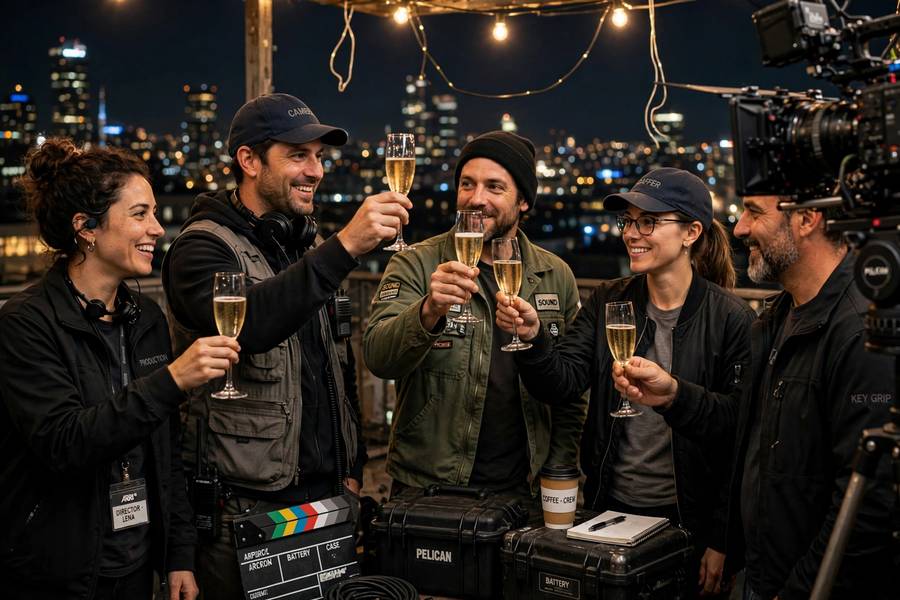
Who’s Invited (and Who’s Not)
The guest list is a small political document. Here’s the typical hierarchy:
Automatically in: Everyone who worked the shoot — cast (including day players, usually), all crew departments, producers, the director. If you were on set, you’re at the party. This is the iron rule, and violating it causes genuine resentment.
Usually in: Key post-production people (the editor, sometimes), studio executives who shepherded the project, significant plus-ones. Spouses and partners are generally welcome — after months of absence, the family reunion aspect matters.
Sometimes in: Press (rare for the real party; more common for a staged version), agents and managers (it depends on the production’s politics), the caterer who kept everyone alive (always deserved, not always invited).
Not in: People who were fired mid-shoot (awkward), rival productions, and — the unwritten rule — anyone who’s going to make it about themselves. The wrap party is a crew celebration; a guest who treats it as a networking event has misunderstood the assignment.
Legendary Wrap Parties: The Stories That Survived
The code of silence means most wrap party stories stay in the family. But a few have entered industry lore:
The ones that became films’ second premieres. Some productions throw wrap parties so spectacular they generate their own press — themed extravaganzas, surprise performances, venues transformed. These are the exceptions; most wrap parties are deliberately unglamorous.
The emotional series finales. When a long-running show ends — really ends — the final wrap party is less a party than a wake. Cast members who grew up together say goodbye to characters they’ve played for a decade. These are the ones where the speeches genuinely matter, and where even the hardened crew guys cry.
The disaster shoots. Paradoxically, the hardest productions often throw the best wrap parties — because survival itself is the achievement. When a shoot survived weather catastrophes, schedule collapses, and on-set chaos, the wrap party has the energy of a lifeboat reaching shore. The stories from these nights are the ones crews tell for years.
Why Studios Pay for the Party
A wrap party for a major production can cost anywhere from tens of thousands to well into six figures. Why does the studio — famously careful with money — happily pay?
Morale is a production asset. Film crews are freelance. They choose their next job partly on reputation: was the last production well-run? Did they treat people right? A generous wrap party is a signal to the entire crew community. Word travels fast in a small town.
It’s cheap retention. The crew members you want back for the sequel, the next season, the next project — the party is part of keeping them warm. In an industry with no permanent employment, goodwill is the closest thing to a contract.
The content. Gag reels, group photos, cast reunion posts — the wrap party generates social media content that keeps the project alive during the long post-production silence — one phase in the full pipeline of how movies are made. Studios have learned to see the party as a marketing beat, not just a celebration.
Tradition has force. Try canceling the wrap party on a big production and watch what happens. It’s expected — contractually, sometimes; culturally, always. The line item survives every budget cut because the cost of skipping it (in morale, in reputation) exceeds the cost of throwing it.
The Other End: When Productions Skip It
Not every production gets the party. And the absence is felt:
The troubled productions. When a shoot was genuinely miserable — abusive behavior, dangerous conditions, financial collapse — there’s sometimes no party, because nobody wants to celebrate. The missing wrap party is its own statement. Crews notice. The town notices.
The ultra-low-budget reality. Some indie productions simply can’t afford it. The good ones substitute sincerity for scale — a heartfelt gathering that costs nothing. The bad ones just… end. People drift away. It leaves a mark.
The pandemic era. COVID killed the wrap party for two years — no gatherings, no goodbyes, productions just stopping. Crews who worked through that period talk about it like a missing chapter. The parties came back, but the interruption reminded everyone what the ritual was for.
The throughline: the wrap party persists because it serves a real human need. As long as productions create temporary families, those families will need a goodbye. The form may change — smaller, stranger, virtual — but the function isn’t going anywhere.
Frequently Asked Questions
A wrap party is a celebration held when a film or TV production finishes principal photography. The studio or producers host the cast and crew for a party marking the end of the shoot — part celebration, part goodbye for the temporary family a production creates.
Everyone who worked on the shoot — cast and all crew departments — is traditionally invited, plus producers, the director, and usually plus-ones. If you were on set, you’re at the party; excluding working crew causes genuine resentment.
The studio or production company pays — it’s a budgeted line item. Costs range from pizza in the production office for indies to six-figure events for major productions. Studios see it as morale investment and crew-relations spending.
Right after principal photography ends — when shooting wraps, not when the project is fully finished. Months of editing and post-production still lie ahead, but the cast and crew’s work together is done.
Speeches from the director and producers, a gag reel of bloopers, crew gifts, and then the actual party — music, dancing, and goodbyes. What happens there traditionally stays there; the code of discretion is taken seriously.
Yes — TV productions typically throw a wrap party per season. For long-running shows these become increasingly emotional, especially for a final season, as cast members say goodbye to characters they’ve played for years.