How Do Swim Meets Work? A Beginner Parent’s Guide

Your kid just joined the swim team, and someone handed you a “heat sheet” that reads like a foreign language. Event 12, Heat 4, Lane 6. Session starts at 8 AM, warm-ups at 7. What is any of this? If you’ve been wondering how do swim meets work, you’re in good company — swim meets are wonderfully organized once you decode them, and completely bewildering until you do.
I’m Ryan, and I have a soft spot for sports with great systems hiding under confusing surfaces. Swim meets are exactly that. This guide is for the beginner swimmer and especially the new swim parent: how events are structured, how heats and lanes work, what the order of races looks like, and what to actually bring so you’re not the family borrowing goggles at 7:45 in the morning.
How Do Swim Meets Work? The Basic Structure
A swim meet is a series of races — called events — swum in a set order. Each event is one stroke and distance for one age group and gender: for example, “Girls 11–12, 50-yard freestyle.” A typical youth meet might run 60 to 80 events across a full day, split into morning and afternoon sessions.
Here’s the flow:
- Warm-ups: Swimmers get in the pool before the meet to loosen up — usually 30–60 minutes before the first race.
- Events in order: The meet runs down the event list numerically. Event 1 first, then Event 2, and so on.
- Heats within events: If 40 kids are entered in one event and the pool has 8 lanes, they swim in 5 heats of 8. Slowest seeds swim first; the fastest heat goes last.
- Results and scoring: Times are recorded for every swimmer, and team scores are tallied if it’s a scored meet.
The single most useful document at any meet is the heat sheet — the printed (or app-based) program listing every event, heat, lane, and swimmer. Find your swimmer’s events, highlight them, and you’ll always know when to pay attention.
Heats, Lanes, and Seeding Explained
Swimmers are grouped into heats by their seed times — their previous best times in that event. The standard arrangement is circle seeding: the fastest swimmers are placed in the final heat, spread across the middle lanes (lanes 3, 4, 5, 6 in an 8-lane pool), because the middle lanes have the least turbulence from the walls.
A few things that confuse newcomers:
- Your heat doesn’t determine your place. Final standings are based on times across all heats, not who touched first in your heat. A swimmer can win their heat and place 15th overall.
- “NT” means no time. Swimmers without a seed time in an event are listed as NT and usually swim in the earliest heats.
- Heats are not finals. In most youth and regular-season meets, everyone swims once and places are decided by time — no separate finals. Championship meets use prelims/finals formats.
- Scratches happen. If a swimmer doesn’t show for their event, the heat swims with an empty lane. It happens constantly; nobody panics.
The Order of Races at a Typical Meet
Most meets follow a traditional stroke order, cycling through it as distances change:
- Freestyle (usually the shortest sprint first)
- Backstroke
- Breaststroke
- Butterfly
- Individual medley (all four strokes in order: fly, back, breast, free)
- Relays (often at the start and end of sessions)
Distances vary by pool: American youth meets are usually swum in 25-yard pools (“short course yards”), while international and summer meets may use 50-meter pools (“long course”). Times don’t convert directly between them — long course is slower because there are fewer turns to push off the walls. If your swimmer’s times suddenly look worse at a long-course meet, that’s why.
Want your swimmer better prepared for race day? swimming workouts for beginners covers the workouts that build meet-ready conditioning.
How Scoring Works
In dual meets (two teams), scoring typically goes 9-4-3-2-1 for the top five individual finishers, with relays worth double. In bigger invitational meets, scoring extends deeper — often through 16th place. Only the top finishers from each team score, which is why coaches enter swimmers strategically across events.
Many youth meets don’t emphasize team scores at all — they’re about individual best times. And honestly, for beginners, best times are the whole game. Dropping two seconds in the 50 free is a triumph regardless of place. Track personal bests; celebrate those.
What to Bring: The Swim Parent Survival Kit
After watching enough meets, here’s the packing list that separates the veterans from the rookies:
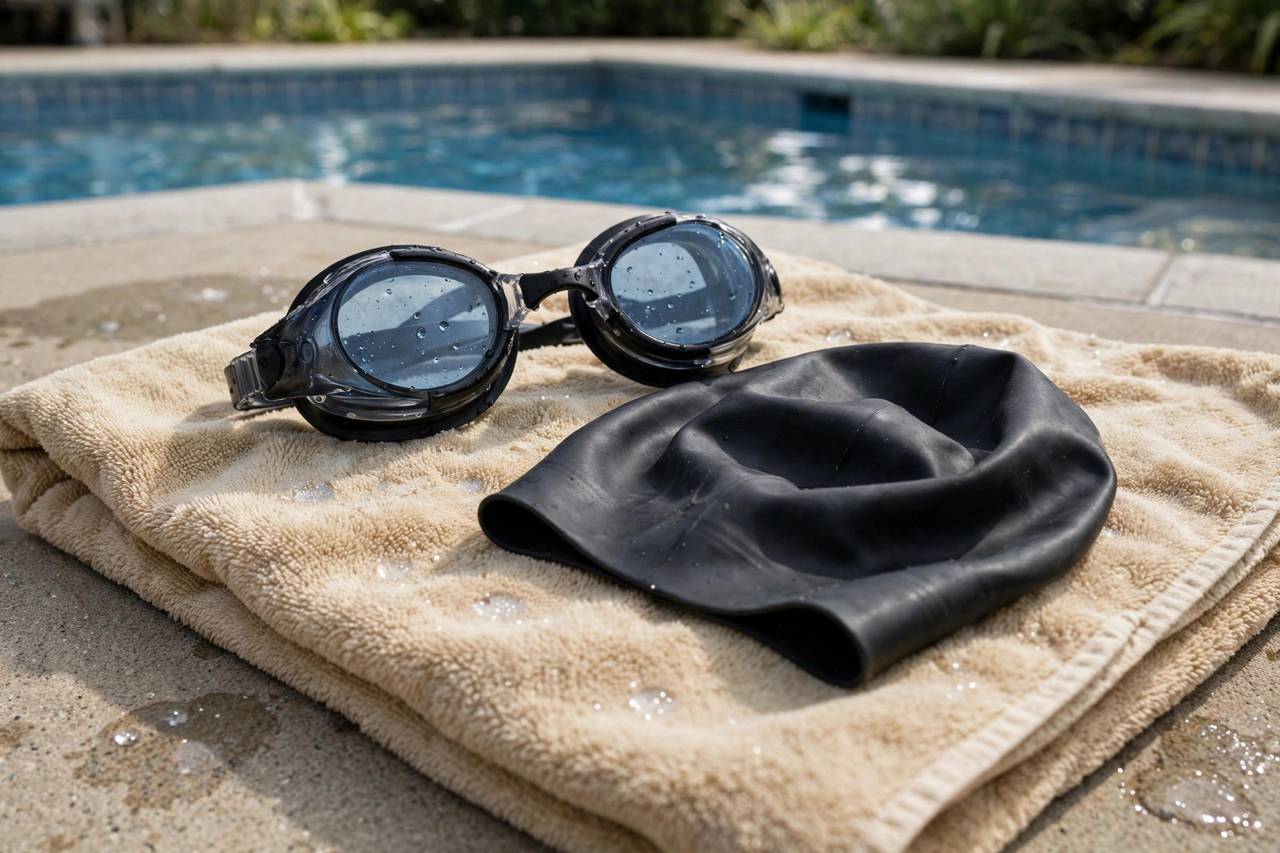
- Two pairs of goggles and a spare cap. Goggles break. Straps snap. Always have backups.
- Multiple towels. One per session minimum. Swimmers get in and out of the water all day.
- Warm clothes and blankets. Pool decks are cold, and there’s a lot of sitting between events. Parkas are standard issue in swim culture.
- Food and water. Meets run 4–6 hours. Pack real food — meets are marathons, and concession stands are unreliable.
- Entertainment. Cards, books, a charged tablet. Between-event downtime is real.
- Cash for heat sheets. Many meets sell printed programs; some use apps. Have both options covered.
- A sharpie. Swimmers write their events, heats, and lanes on their arms or legs. It’s tradition, and it works.
Meet Etiquette for New Families
A few unwritten rules: stay quiet at the start of each race (the starter needs silence), don’t walk behind the blocks during a race, and keep the area behind the starting end clear. Cheer loudly during the race — swimmers genuinely feed off it. And never, ever leave before your swimmer’s last event without telling the coach; relays get reshuffled when people vanish, and it ruins it for the kids left behind.
Relays: The Loudest Events at the Meet
Relays deserve their own section because they’re the emotional peak of every meet. Four swimmers each swim a leg — in freestyle relays everyone swims freestyle; in medley relays the order is backstroke, breaststroke, butterfly, freestyle. The exchange is the drama: the next swimmer dives as the incoming swimmer touches, and a perfect relay start can gain half a second.
Here’s what makes relays special: swimmers who are mid-pack individually become heroes on relays. The team energy is electric — the whole squad lines the lane, screaming. And there’s a technical wrinkle newcomers love: in relays, only the lead-off swimmer’s time counts as an official individual time, because relay starts (with a rolling dive) are faster than flat starts. Coaches use lead-off legs strategically to chase qualifying times.
If your swimmer gets put on a relay, treat it as an honor. It means the coach trusts them under pressure — and relay swims are often the memories kids keep longest.
Championship Meets: Prelims, Finals, and Time Cuts
Regular-season meets are simple: swim once, places by time. Championship meets add a second layer. Swimmers first compete in prelims (usually morning), and the fastest 8–16 advance to finals (evening). Finals are seeded slowest-to-fastest, building to the championship heat — the loudest, fastest race of the day.
Championships also use time cuts: qualifying standards your swimmer must have achieved to enter. “BB,” “A,” “AA,” and “AAA” cuts (or their local equivalents) tier the competition — a swimmer with an A cut in the 100 free enters the A championships. Chasing cuts gives the season its structure: every regular meet is a chance to earn the times that unlock the championship meet.
The prelims/finals format changes race strategy completely. In prelims, the goal is to qualify while saving energy — smart swimmers “swim easy speed,” going just fast enough to make the final. In finals, it’s everything-you-have. Learning this rhythm is part of becoming a competitive swimmer.
Volunteering: How Meets Actually Get Run
Here’s the open secret of swim meets: they’re run almost entirely by parent volunteers. The timers with stopwatches behind each lane? Parents. The officials in white making the DQ calls? Trained parent volunteers. The people running the timing computer, marshaling swimmers to the blocks, and selling heat sheets? All parents.
Most teams require each family to volunteer for a set number of sessions per season — and honestly, timing is the best seat in the house. You’re right at the water, you learn the sport fast, and your swimmer thinks it’s cool. If your team offers officials training, take it: certified stroke-and-turn judges are always in short supply, and understanding the rules from the inside makes you a much better swim parent.
FAQ
How long does a swim meet last?
Youth dual meets run 2–3 hours. Invitationals and championship meets can run 4–6 hours per session, sometimes across multiple days.
What does “DQ” mean in swimming?
Disqualification — usually for a stroke infraction like an illegal kick in breaststroke or a false start. Officials (stroke judges) watch every lane. DQs are a normal part of learning; even Olympians get them.
Can parents be on the pool deck?
Usually not during the meet — decks are restricted to swimmers, coaches, and officials. Spectators watch from designated seating. This is a safety and space rule, not rudeness.
What is the difference between short course and long course?
Short course is swum in 25-yard or 25-meter pools; long course is 50 meters. Times are faster in short course because swimmers get more wall push-offs. Records are kept separately.
How do I read a heat sheet?
Find the event number, then the heat number, then the lane. Your swimmer’s name appears once per event entered. Highlight each appearance and note the approximate time — events run roughly 10–20 minutes apart depending on the meet.
What should my swimmer eat during a long meet?
Small, familiar foods throughout the day: bananas, granola bars, sandwiches, pasta. Avoid trying anything new on meet day — race-day nutrition surprises are never the good kind. Keep it simple, keep it frequent, and keep the water bottle full.
Swim meets look chaotic from the bleachers, but they’re one of the most precisely run events in youth sports. Learn the heat sheet, pack the bag the night before, volunteer for a timing shift, and enjoy it — there’s nothing quite like watching your kid touch the wall, look up at the clock, and see a best time staring back.