How Long Is a Tennis Match? Why There’s No Clock in Tennis


How long is a tennis match? There is no good single answer, and that is the point. Tennis is one of the few major sports with no clock — a match ends when someone wins the required sets, whether that takes 50 minutes or 11 hours and 5 minutes. I have watched matches that felt like sprints and matches that felt like sieges, and the difference had nothing to do with the players’ talent. It had to do with format, surface, and the strange mathematics of a sport where you must win by two. Here is the full picture.
The averages first. A professional best-of-three match (the standard on the ATP and WTA tours) typically runs 1.5 to 2.5 hours. A best-of-five match (men’s Grand Slams) typically runs 2.5 to 4 hours. But “typically” hides the real story: the distribution has an enormously long tail, and the tail is where tennis history lives.
How Long Is a Tennis Match? Why There’s No Clock
Tennis measures its contests in sets and games, not minutes. Win six games (by two) to take a set; win two sets (best-of-three) or three sets (best-of-five) to take the match. The serve alternates every game, and the server’s advantage shapes everything: on fast surfaces, service games fly by; long baseline rallies stretch them. A routine straight-sets win can be over in 90 minutes. A five-set war with multiple tiebreaks can pass five hours without anyone being surprised.
The serve clock is the sport’s one concession to time: players get 25 seconds between points (enforced by the chair umpire, with time violations for exceeding it). But that governs pace, not duration. The match ends when the tennis ends. This is why tennis produces the longest contests in all of professional sport — there is no mechanism to stop them except victory.
The tiebreak is the great duration limiter. In most formats now, a set tied at 6-6 goes to a tiebreak (first to 7, win by 2) — including, since 2022, the deciding set at all four Grand Slams, which uses a 10-point tiebreak at 6-6. Before the final-set tiebreak era, deciding sets played on until someone led by two games — no ceiling, no mercy. That rule produced the longest match ever played.
The Isner-Mahut Record: 11 Hours, 5 Minutes
Wimbledon, 2010. First round. John Isner vs. Nicolas Mahut. The fifth set reached 59-59 before Isner finally won 70-68 — because in 2010, Wimbledon had no final-set tiebreak, and neither man would break. The match lasted 11 hours and 5 minutes across three days, with 183 games played. It broke every duration record in tennis history and most in all of sports.
The details remain staggering. The fifth set alone (8 hours, 11 minutes) was longer than the previous longest match in history. Isner served 113 aces; Mahut served 103. Both men were so exhausted they could barely walk, so dehydrated that officials worried about their health, playing on pure refusal to lose. The scoreboard malfunctioned — it was not programmed to display scores past 47-47. Spectators came back day after day like it was a pilgrimage.
Isner-Mahut is why the rules changed. Wimbledon introduced a final-set tiebreak (at 12-12) in 2019, and by 2022 all four Slams had standardized the 10-point tiebreak at 6-6 in the decider. The 11-hour match can never happen again — which is exactly the point. It was magnificent, and the sport decided once was enough.
Why Clay Runs Longest: Surface and Duration
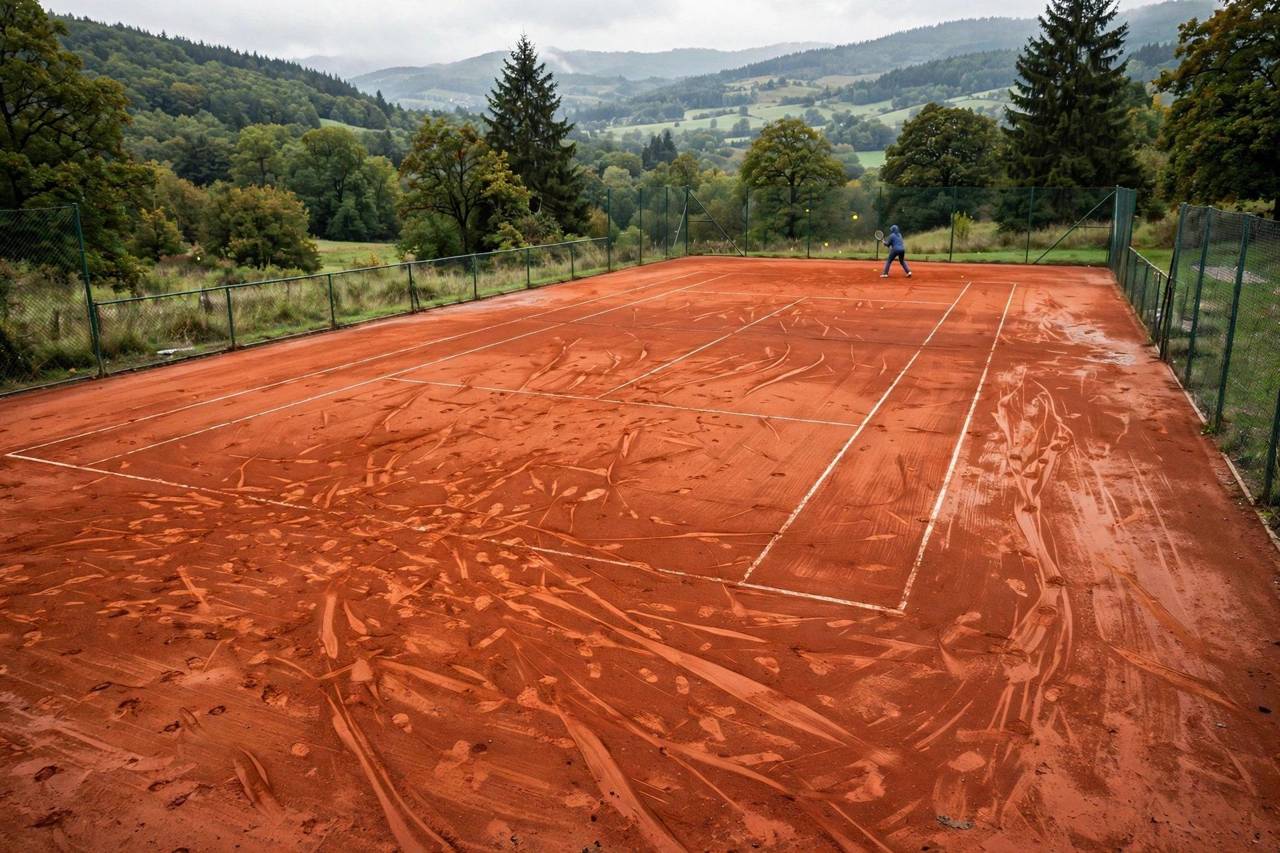
Surface is the hidden variable in match length. Clay (Roland Garros) produces the longest matches: the surface is slow, the ball bounces high, rallies extend to 15, 20, 30 shots, and service holds are never routine. A clay-court grinder’s match routinely passes three hours; five-set clay epics are the sport’s marathons. The French Open’s long rallies are not a style choice — they are physics.
Grass (Wimbledon) is the fastest: low skidding bounces, short points, service dominance. Grass matches are the shortest on average, though Isner-Mahut proved the format can override the surface. Hard courts (Australian Open, US Open) sit in the middle — medium pace, true bounce, the surface of the modern baseline game. If you want to predict a match’s length before it starts, check the surface first and the players’ styles second: two big servers on grass will be quick; two baseliners on clay will need lunch.
Playing style compounds it. Serve-and-volleyers and big servers compress time; defensive baseliners expand it. The longest rallies in tennis history — 29 minutes for a single point in the famous 1984 Virginia Slims rally is the lore, though official records vary — come from players who simply refuse to miss. Time in tennis is not measured. It is endured.
For the scoring mechanics behind all of this — love, deuce, advantage, and why the numbers sound so strange — tennis scoring explained covers the system that makes these durations possible. And the serve that starts every point has its own technique: how to serve a tennis ball breaks down the shot the whole clock-less edifice is built on.
Format Matters: Best-of-Three vs. Best-of-Five
The format split defines the professional game. The ATP and WTA tours play best-of-three almost everywhere — tighter, more predictable, television-friendly. Only the men’s Grand Slam singles (and Davis Cup) use best-of-five, and the difference is not just duration but kind: best-of-five allows comebacks from two sets down, rewards physical durability over three-plus hours, and produces the epics. The women’s game plays best-of-three at Slams too, which is why the longest women’s matches (around 3-4 hours) are shorter than the men’s extremes.
Amateur and junior tennis compresses further: pro sets (first to 8 games), short sets, match tiebreaks instead of third sets. Recreational players booking a court for an hour are playing a different sport, temporally, than the professionals — and that is fine. The no-clock principle scales: your match ends when someone wins, whether that takes 45 minutes or two hours.
The through-line: tennis time is elastic because tennis has no clock, and the sport’s greatest stories are the ones where the elastic stretched furthest. The averages tell you what to expect. The records tell you what is possible. In between is every match you will ever play or watch — each one exactly as long as it needs to be, and not a minute shorter.
The Longest Women’s Matches and Other Extremes
The women’s game, played best-of-three even at Slams, has its own duration records. The longest women’s singles match of the Open Era — Francesca Schiavone vs. Svetlana Kuznetsova at the 2011 Australian Open, 4 hours 44 minutes, with a 16-14 final set — stands as the epic of the best-of-three era. It was played before final-set tiebreaks arrived; under today’s 10-point tiebreak rule at 6-6, its like will not be seen again.
Doubles produces its own extremes: the 2013 Wimbledon men’s doubles semifinal ran 5 hours 2 minutes, and Olympic doubles matches — played best-of-three with match tiebreaks — compress the drama differently. Junior tennis uses shortened formats (short sets, match tiebreaks) precisely to bound duration for developing players. The sport scales its formats to its audiences: professionals get the epics, juniors get the education, and recreational players get whatever fits the court booking.
What This Means for Watching (and Playing)
For spectators, the no-clock rule is the best and worst thing about tennis. Best: a match can always come back — two sets down is not defeat in best-of-five, and the greatest comebacks in sports history happened because the clock could not save the leader. Worst: you cannot plan around it. A “quick” quarterfinal can become a five-hour epic that blows up the entire day’s schedule — broadcasters build tennis coverage around this uncertainty, and stadium crowds learn to settle in.
For players, the lesson is pacing as a skill. Professionals train for the possibility of five hours: hydration protocols, nutrition on changeovers (bananas, energy gels, the precise science of the changeover snack), and the mental discipline of resetting after every point regardless of the score. The players who survive the epics are not always the most talented — they are the best at forgetting the last point and playing the next one. In a sport with no clock, the only time that matters is now.
Tennis vs. Other Sports: The Time Comparison
Put tennis next to its peers and the no-clock philosophy stands out. Soccer: 90 minutes plus stoppage, done in two hours, every time. Basketball (NBA): 48 minutes of clock, about 2:15 real time, tightly bounded. American football: 60 minutes of clock, 3+ hours real. Golf: no clock either, but a round takes a predictable 4-5 hours. Tennis alone combines no clock with total unpredictability — the only major sport where “how long will this take” has no honest answer beyond “until someone wins.”
That unpredictability is the sport’s signature tension. Every other timed sport gives the leader a clock to hide behind; tennis gives them nothing. The trailing player always has a path — win the next set, then the next — and the match cannot be closed out by time management. It is why tennis comebacks feel different from comebacks in any other sport: they are never against the clock, only against the opponent. And it is why the question “how long is a tennis match” will never have a satisfying answer — the sport was designed that way.
Frequently Asked Questions
What is the average length of a tennis match?
Best-of-three professional matches average 1.5 to 2.5 hours; best-of-five (men’s Grand Slams) average 2.5 to 4 hours. Surface, playing style, and competitiveness create wide variation around those averages.
What is the longest tennis match ever played?
John Isner vs. Nicolas Mahut at Wimbledon 2010: 11 hours, 5 minutes over three days, with Isner winning the fifth set 70-68. Final-set tiebreaks (now standard at all Slams) make a repeat impossible.
Why is there no clock in tennis?
Tennis is scored in sets and games — the match ends when a player wins the required sets, regardless of time. The only time regulation is the 25-second serve clock between points, which governs pace rather than duration.
Why do clay court matches take longer?
Clay is slow with a high bounce, producing long baseline rallies and fewer easy service holds. Grass is fast with a low bounce (short points); hard courts are in between. Surface physics is the biggest predictor of match length.
How does a tiebreak work in tennis?
At 6-6 in a set, players contest a tiebreak — first to 7 points (win by 2). Deciding sets at Grand Slams now use a 10-point tiebreak at 6-6, standardized across all four majors since 2022.
How long is a set in tennis?
A routine set takes 30 to 45 minutes, but sets have no fixed length — a 6-0 set can take 20 minutes and a 7-6 tiebreak set over an hour. Like matches, sets end when the tennis ends.