How Many Pull-Ups Should You Be Able to Do? Honest Standards


“How many pull-ups should I be able to do?” is the question I get asked most after “how do I get abs.” And my answer always disappoints people at first: it depends on who you are, how much you weigh, and what you’re training for. A 150-pound climber knocking out 20 strict reps and a 240-pound powerlifter grinding out 6 are both strong — they’re just strong at different things. Pull-ups are a strength-to-bodyweight ratio test, which means the number only means something in context.
That said, standards exist for a reason. After fifteen years of coaching, I have clear benchmarks for what’s beginner, intermediate, advanced, and elite — for men and women, adjusted for bodyweight. This guide gives you those honest numbers, explains why they vary so much, and tells you exactly how to test yourself so the number means something.
Why the Number Varies So Much
Three variables move the number more than anything else. First, bodyweight — this is the big one. Every extra pound is a pound your lats have to lift. A 10-pound fat loss is functionally identical to adding 10 pounds of pulling strength, which is why lighter trainees almost always win at pull-ups. Second, training history — someone who’s done gymnastics or climbing for years has neurological efficiency that a beginner can’t match, rep for rep. Third, limb length — longer arms mean a longer range of motion per rep, which is a genuine mechanical disadvantage. Long-armed lifters: your 8 reps are worth someone else’s 12. Don’t let anyone tell you otherwise.
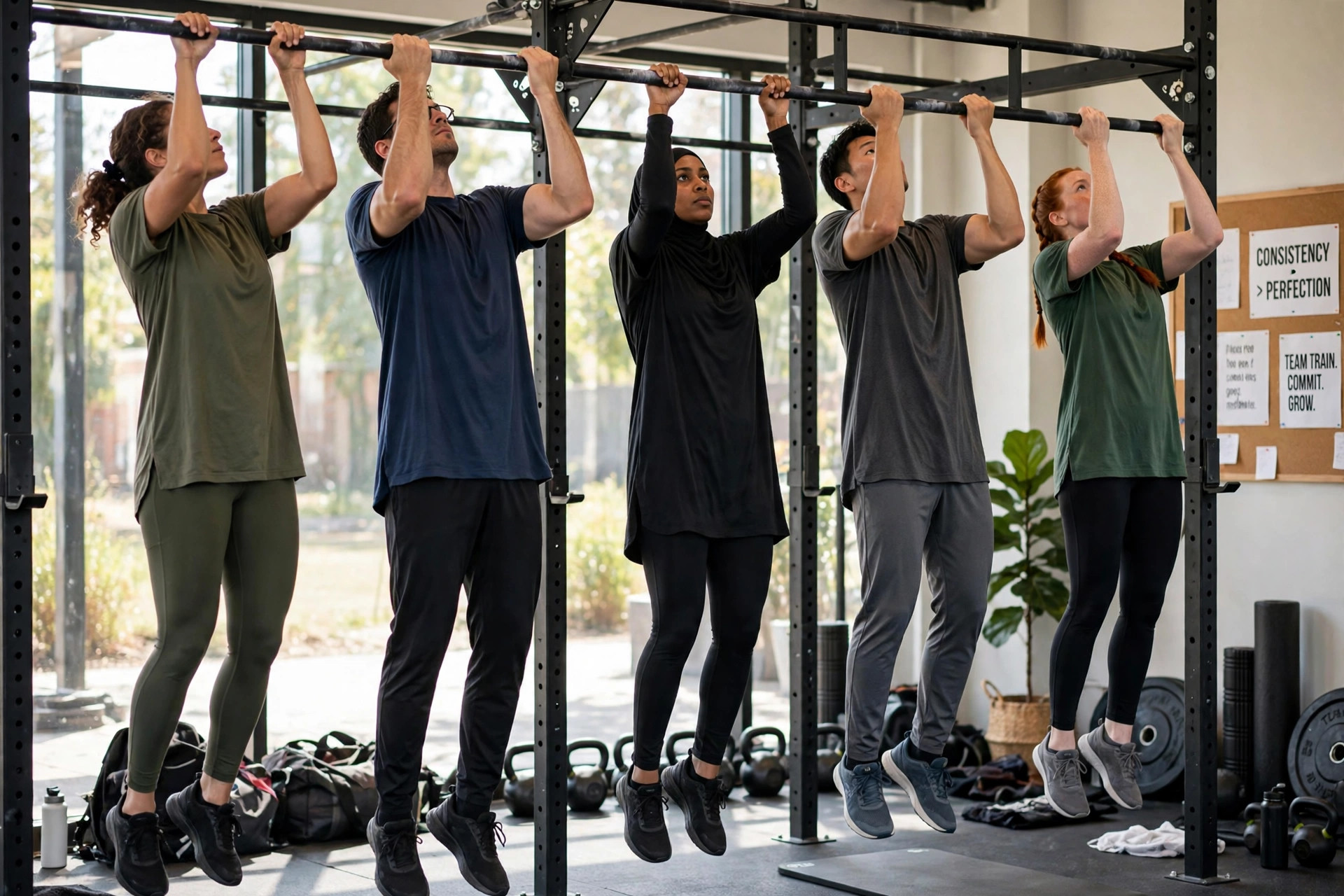
Age matters too, but less than people think. I’ve coached 55-year-olds doing 12 strict reps and 25-year-olds stuck at 3. Consistency beats youth. What doesn’t vary: the standard for a “real” rep. Dead hang start, chin clearly over the bar, controlled lower, no kip. If your numbers use a different standard, they’re not comparable to anything — which brings us to testing.
Strength Standards for Men
These assume strict, dead-hang pull-ups at a bodyweight between 150 and 200 pounds. Heavier guys: subtract roughly 1 rep per 15 pounds over 200. Lighter guys: add accordingly.
Beginner (0–4 reps): You’re building the foundation. Zero reps is completely normal starting out — most untrained men can’t do a single strict pull-up, and there’s no shame in it. Four reps means the pattern is grooved and you’re ready for structured programming.
Novice (5–8 reps): You’ve got real pulling strength. This is where most recreational lifters land after 6 to 12 months of consistent training. Respectable in any commercial gym — you’re stronger than roughly 80 percent of the men in the building.
Intermediate (9–14 reps): Solid. This takes deliberate programming, not just showing up. At this level your lats, grip, and core are all contributing, and you probably look like you train. Most military and law enforcement fitness standards sit somewhere in this range.
Advanced (15–20 reps): You’re in the top few percent of gym-goers. Getting here usually requires specific pull-up programming — grease-the-groove, weighted work, or high-frequency blocks — on top of a solid base. Your back development at this level is obvious.
Elite (20+ reps): Competitive territory. Twenty-five-plus strict reps puts you in the conversation with climbers, gymnasts, and military operators. Beyond 20, most people switch to weighted pull-ups for continued progress, because chasing 30 bodyweight reps has diminishing returns for strength.
Strength Standards for Women
Women face a real physiological headwind here: on average, less upper-body muscle mass relative to bodyweight and a higher essential body fat percentage. This isn’t an excuse — it’s context. A woman doing 8 strict pull-ups is displaying roughly the same relative achievement as a man doing 15. Judge accordingly.
Beginner (0–2 reps): The first pull-up is the hardest rep in all of strength training for most women. Getting from zero to one often takes 8 to 16 weeks of dedicated work. That first rep is a genuine achievement — treat it like one.
Novice (3–5 reps): Stronger than the vast majority of women in any gym. The jump from 1 to 5 is where the movement starts feeling natural instead of like a fight.
Intermediate (6–10 reps): Excellent. This level requires consistent programming and usually some body-composition management. You’ll have visible lat and arm development.
Advanced (11–15 reps): Elite-level relative strength. Women hitting these numbers are typically training pull-ups with real intent — weighted progressions, high frequency, or a background in climbing or gymnastics.
Elite (15+ reps): Exceptional. This is competitive athlete territory, full stop.
One note for the women reading: don’t let anyone tell you pull-ups “aren’t for” you or that you should stick to the assisted machine. The bar doesn’t care about your gender. The programming that works for men works for women — the timeline is just honest about the starting line. If arm development is part of your goal, my arm exercise guide pairs well with this work.

The Bodyweight Factor (Do the Math)
Here’s a useful way to think about it: your pull-up max is your strength divided by your bodyweight. Improve either side of the fraction and the number goes up. I make every client do this math when they stall, because half the time the “strength plateau” is actually a bodyweight problem.
Concrete example: you weigh 200 pounds and do 6 reps. You cut to 185 over four months while maintaining strength. You didn’t add a single pound of pulling force — but you’ll probably do 8 or 9 reps now, because each rep costs less. Conversely, the 160-pound guy doing 12 reps who bulks to 190 without adding pulling strength will watch his numbers crater. Neither got weaker or stronger in absolute terms. The ratio moved.
Practical takeaway: if you’re significantly over a lean bodyweight, the fastest path to more pull-ups is losing fat while maintaining strength — not adding more pull-up volume on top of an already-heavy frame. And if you’re lean and stuck, the answer is more pulling strength, usually through weighted work. Know which side of the fraction you’re on.
How to Test Yourself Properly
A max test done wrong tells you nothing. Here’s the protocol I use with clients:
Warm up, don’t fatigue. Two to three easy sets — scapular pulls, light band pulldowns, a few easy reps — then rest 5 full minutes. Testing cold risks injury; testing tired wastes the test.
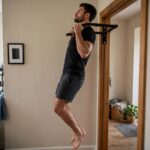
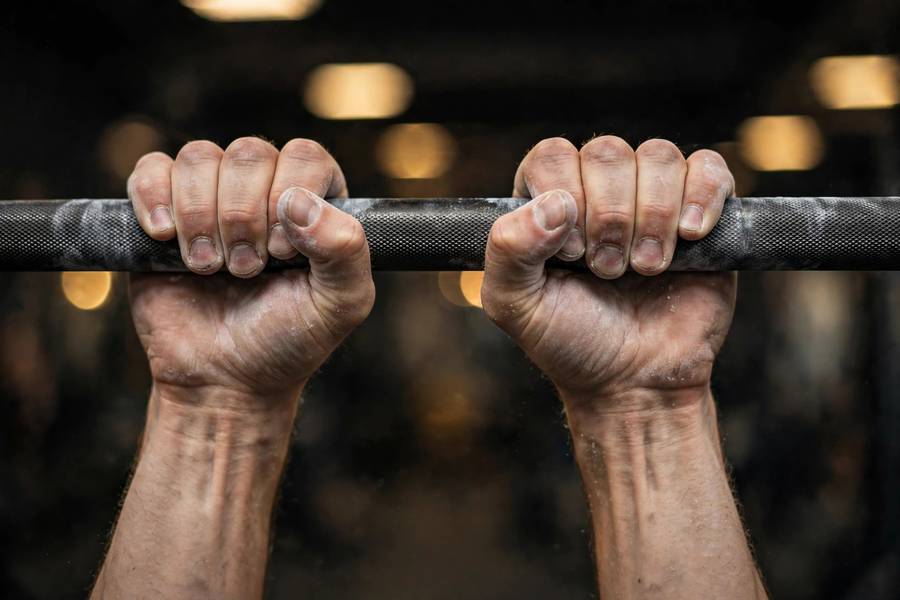
One max set, strict standard. Dead hang start. Chin over the bar on every rep. Controlled lower — no dropping. The set ends when you fail a rep or your form breaks (kip, half rep, neck crane). Count only clean reps. I don’t care if your buddy counts differently.
Film it. Prop your phone up and film from the side. You’ll be amazed how many “reps” don’t meet the standard when you watch them back. The camera is the most honest coach you’ll ever have.
Test every 6 to 8 weeks, not every week. Weekly maxing just accumulates fatigue and stalls progress. Train submaximally, test occasionally. If you want the full breakdown of proper execution to test against, my pull-up form guide is the reference standard I use.
What You Need for Your Goal
General fitness: 5 to 8 strict reps (men) or 2 to 4 (women) is plenty. At this level you have functional pulling strength for life — hauling yourself up, carrying things, healthy shoulders. Maintain with one session a week.
Military / law enforcement / fire: Check your specific test’s standard and train 20 percent above it, because test-day stress eats reps. Most tests want somewhere in the 8 to 15 range with strict form. Train the exact standard you’ll be tested on — if they allow a kip, practice the kip; if they demand dead hang, train dead hang.
Climbing: Climbers live on the bar. Intermediate climbers typically do 10 to 15; advanced climbers do 15 to 25 plus weighted reps. If climbing is your sport, fingerboard and hangboard work matter as much as pull-up numbers — grip is usually the limiter, not pulling strength.
Bodybuilding / physique: The number matters less than the muscular development. If your lats are growing, the rep count is secondary — but most well-developed backs can do 12 to 15 strict reps. If yours can’t, your back work probably lacks the heavy compound pulling it needs. Muscular endurance work in the 12 to 20 rep range has its place, but don’t confuse it with strength work.
Weighted pull-up goals: Build to 12 to 15 clean bodyweight reps before adding weight. Adding load to a shaky 6-rep base is how elbows get wrecked. The base comes first, always.
Below the Standard? Here’s the Path Up
If you’re at zero reps, you’re not broken — you’re just at the start. The path is well-mapped: dead hangs for grip, scapular pulls for initiation, inverted rows for base pulling strength, eccentrics for the full range, and band-assisted work to bridge the gap. Three sessions a week, progressive overload, 8 to 12 weeks. It works for nearly everyone who actually follows it.
If you’re stuck at 3 to 5 reps and can’t break through, the usual culprits are: training to failure too often (back off, train submaximally), bodyweight creeping up (do the fraction math), or never training above your max with assistance (add one weighted or band-assisted session weekly to expose your nervous system to heavier loads). Plateaus in pull-ups are almost always programming problems, not talent problems.
Frequently Asked Questions
Yes — 10 strict, dead-hang pull-ups is solid intermediate strength for a man and advanced for a woman. It puts you ahead of roughly 90 percent of gym-goers. From there, progress slows and requires deliberate programming, but 10 clean reps is a genuine benchmark worth being proud of.
A beginner’s first goal should be one strict pull-up — that’s the milestone that matters. From there, aim for 5 consecutive clean reps, which typically takes 3 to 6 months of consistent training. Don’t chase numbers with bad form; 3 perfect reps build more strength than 8 sloppy ones.
Dramatically. Pull-ups are a strength-to-weight ratio exercise, so every pound lost is a pound you no longer have to lift — it’s functionally identical to gaining strength. Many people add 2 to 4 reps from a 10 to 15 pound fat loss alone, with no change in pulling strength. If you’re carrying extra weight, fat loss is the fastest lever for pull-up numbers.
The Navy SEAL PST minimum is 10 dead-hang pull-ups, with competitive candidates typically scoring 15 to 20+. Other military tests vary: the Marine Corps maxes the score at 23, and Army programs generally look for 10+. These are all strict, dead-hang standards — no kipping allowed in testing.
With consistent training, most people maintain pull-up numbers well into their 50s — strength declines far slower than people assume when training continues. What usually drops first is recovery capacity, not max strength. I’ve coached lifters in their 60s doing 8 to 10 strict reps. Use it or lose it is the whole story here.
Find your honest number, compare it to the right standard, and then get to work on the side of the fraction that needs it. The bar is the most honest measuring tool in the gym — it’ll tell you exactly where you stand, and exactly what to do about it.