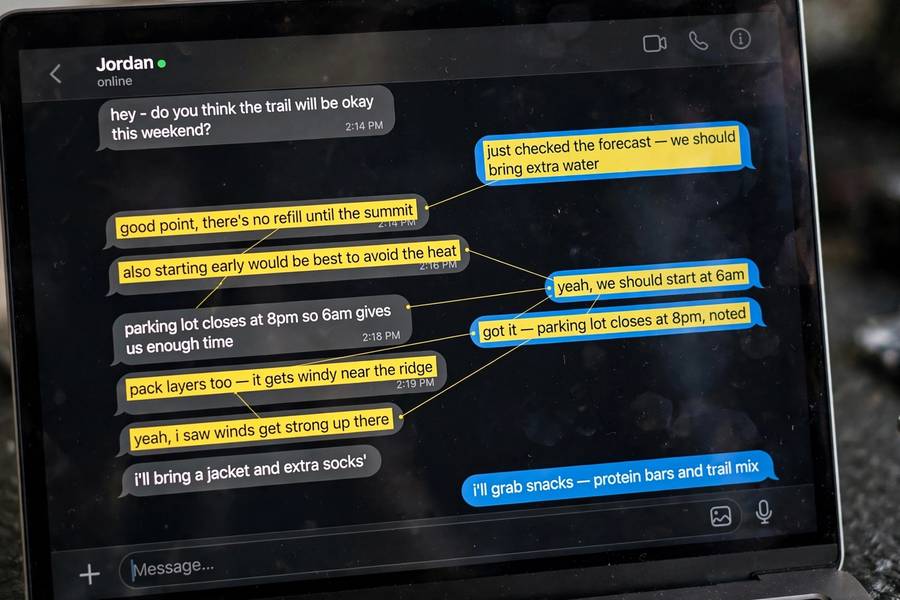
When you say “make it funnier” and ChatGPT knows exactly what “it” refers to — or when it maintains a consistent persona across a long conversation — it feels like genuine understanding. What’s actually happening is a mechanism called attention: the model’s way of connecting each new word to the relevant earlier words, learned from billions of examples.
Attention is the single most important idea in modern AI — it’s literally in the title of the paper (“Attention Is All You Need”) that launched the current era. Let me explain what it does, why it works so well, and where its limits are. For the full system picture, see my guide on how does ChatGPT work.
In This Guide
- What “Context” Means to ChatGPT
- The Attention Mechanism, Simply
- A Concrete Example
- Self-Attention vs. Cross-Attention
- Multi-Head Attention: Many Perspectives at Once
- What Attention Is Good At
- Where Context Understanding Breaks Down
- How to Give Better Context
- Frequently Asked Questions
What “Context” Means to ChatGPT
When humans say “context,” we mean a rich soup: the conversation history, shared background knowledge, social cues, what’s not being said. When engineers say “context” about ChatGPT, they mean something precise and much narrower: the sequence of tokens currently in the model’s context window.
That’s it. The model’s entire “understanding” of context is: here’s a sequence of tokens (your messages, its responses, system instructions, saved memories) — now predict the next token using patterns learned from training. There’s no separate comprehension step, no mental model of you, no awareness of the situation beyond the text.
This sounds limiting — and it is — but the text sequence turns out to carry enormous information. Conversation history encodes topic, tone, intent, constraints, and relationships implicitly. The model’s job is to extract what’s relevant from that sequence for each prediction. That extraction is what attention does.
The Attention Mechanism, Simply
Here’s the core idea without math:
When the model processes your latest message, each token gets to “look at” every other token in the context and decide how much each one matters for the current prediction. It’s like reading a paragraph where every word can ask: “which other words here are relevant to me?”
Technically, this works through three roles: – Queries: each token asks “what am I looking for?” – Keys: each token advertises “here’s what I contain” – Values: the actual information each token provides
Tokens match queries to keys (computing relevance scores), then pull weighted information from values. The result: each token’s representation gets enriched with precisely the context it needs.
The human analogy: when you read “The animal didn’t cross the street because it was too tired,” you instantly know “it” = the animal. You did attention — connecting “it” back to “animal” rather than “street.” The model does the same thing, but as matrix math learned from billions of sentences.
Why it’s powerful: older approaches (RNNs) processed text sequentially, like reading with a tiny memory — early information faded. Attention lets every token directly access every other token, regardless of distance. The first message and the latest message are equally reachable. That’s the breakthrough.
A Concrete Example
Watch attention work on a real exchange:
You: “I’m planning a birthday party for my 8-year-old daughter. She loves dinosaurs.” ChatGPT: [suggests dinosaur-themed party ideas] You: “Make it cheaper.”
To handle “Make it cheaper,” the model must connect: – “it” → the party plan it just generated – “cheaper” → modify the plan toward lower cost – The implicit constraint: keep it dinosaur-themed for an 8-year-old (from two messages ago)
Through attention, the tokens of “Make it cheaper” attend strongly to: the party plan tokens (what to modify), “dinosaur” and “8-year-old” tokens (constraints to preserve), and “birthday party” (the domain). The model then generates a revised plan — cheaper options, still dinosaur, still age-appropriate.
No one programmed “pronoun resolution” or “constraint preservation.” These behaviors emerged from training attention-based models on vast text. The mechanism is general; the behaviors are learned.
Self-Attention vs. Cross-Attention
Two flavors matter:
Self-attention (the main one in ChatGPT): tokens attend to other tokens within the same sequence. Your message’s tokens attend to each other and to conversation history. This is how the model builds understanding of what you’ve said.
Cross-attention (used in some architectures): one sequence attends to a different sequence — e.g., a translation model attending to the source sentence while generating the translation, or a vision model attending to image regions while generating descriptions. In multimodal ChatGPT, cross-attention-like mechanisms connect your image to your text question.
For pure ChatGPT conversation, self-attention does the heavy lifting. Every layer of the transformer (there are dozens) refines these attention connections, building increasingly sophisticated representations of how everything relates to everything.

Multi-Head Attention: Many Perspectives at Once
Here’s what makes it really work: the model doesn’t do attention once — it does it many times in parallel, with each “head” learning to track different kinds of relationships.
Think of it as a team of specialists reading the same text: – One head tracks pronoun references (“it” → “the party”) – Another tracks topic continuity (we’re still talking about birthdays) – Another tracks tone and style (casual, enthusiastic) – Another tracks logical structure (this is a request to modify, not a new topic) – Another tracks entity relationships (daughter → 8-year-old → age-appropriate)
With 96+ attention heads per layer across dozens of layers, the model builds an extraordinarily rich picture of how every element of the conversation relates. No single head “understands” — but the ensemble produces behavior that’s functionally close.
The emergent part: nobody programmed these specializations. They arose because tracking these relationships helped predict text better during training. The heads that tracked pronouns survived; the ones that didn’t, didn’t.
What Attention Is Good At
Attention-based context handling excels at:
- Coreference: knowing what “it,” “that,” “they” refer to
- Topic tracking: maintaining the subject across long exchanges
- Style matching: picking up your tone and mirroring it appropriately
- Constraint accumulation: remembering “keep it short,” “for beginners,” “no jargon” from earlier messages
- Implicit intent: inferring what you want from conversational patterns, not just literal words
These capabilities are why ChatGPT feels conversational rather than transactional. It’s not just answering questions — it’s tracking a discourse, the way a good conversationalist does.
Where Context Understanding Breaks Down
The limits are as instructive as the capabilities:
Distance decay. Attention is theoretically distance-independent, but in practice, very long contexts dilute focus. The model “attends” to everything but weights recent tokens more. Early instructions fade — not forgotten, just outvoted.
No true common ground. Humans build shared understanding incrementally, checking (“you know what I mean?”). The model never checks — it assumes. When its assumption is wrong, there’s no correction mechanism until you complain.
Literal text only. Sarcasm, implicature, cultural context — anything requiring knowledge beyond the text — works only insofar as similar patterns appeared in training. The model can’t ask clarifying questions about your situation because it has no model of your situation, only your words.
Conflicting context. When your messages contradict each other (or contradict pasted text containing instructions), attention has no principled way to resolve the conflict. It blends, guesses, or follows the most recent — unpredictably.
No memory of you. Beyond saved memories (a separate system), the model builds no persistent model of who you are. Each conversation’s “understanding” is rebuilt from scratch from the token sequence. It understands the conversation, not the conversant.
How to Give Better Context
Knowing the mechanism, you can feed it better:
- Front-load critical context. The most important constraints should appear early and be restated — early for establishment, late for attention weight.
- Be explicit about references. “Make the second paragraph funnier” beats “make it funnier” — you’re doing the coreference work for the attention heads.
- One topic per conversation. Mixed topics dilute attention across competing contexts. Fresh chats for fresh topics.
- Restate constraints that matter. “Remember: keep responses under 100 words” needs periodic restating in long chats — attention fades, restatement refreshes.
- Provide context, not just questions. The model can only attend to what you give it. “I’m a beginner learning Python for data analysis” as context transforms every subsequent answer.
These aren’t just tips — they’re working with the architecture instead of against it. My guide on how to get better answers from ChatGPT builds an entire prompting methodology on these principles.
For the architectural foundations, my explainer on what a large language model is covers transformers — the structure attention lives in.
Attention lets every word consult every other word, across dozens of layers and hundreds of parallel perspectives — and from that mechanical process emerges something that handles context with near-human grace. It’s not understanding as we experience it. But as an engineering solution to “keep track of what’s going on,” it’s the most successful idea in AI history. “Attention Is All You Need” turned out to be barely an exaggeration.

Frequently Asked Questions
Through the attention mechanism: each token in your conversation can “attend to” every other token, learning which earlier words are relevant for each prediction. Multiple attention heads track different relationship types (pronouns, topics, tone) in parallel across dozens of layers.
A mechanism allowing model components to weigh the relevance of all other components when processing each element. Introduced in the 2017 paper “Attention Is All You Need,” it lets transformers connect distant words directly — the breakthrough enabling modern large language models.
The context window has a token limit — oldest content gets truncated when exceeded. Even within the window, attention weights recent tokens more heavily, so early instructions fade in influence. Restating key constraints refreshes their weight.
It processes your words’ relationships with remarkable sophistication via attention, producing behavior close to understanding. But there’s no separate comprehension step — no mental model of you or your situation beyond the text. It understands the conversation, not the conversant.
Front-load critical constraints and restate them periodically, use explicit references (“the second paragraph”) instead of vague ones (“it”), keep one topic per conversation, and provide background about yourself and your goals upfront. You’re feeding the attention mechanism directly.