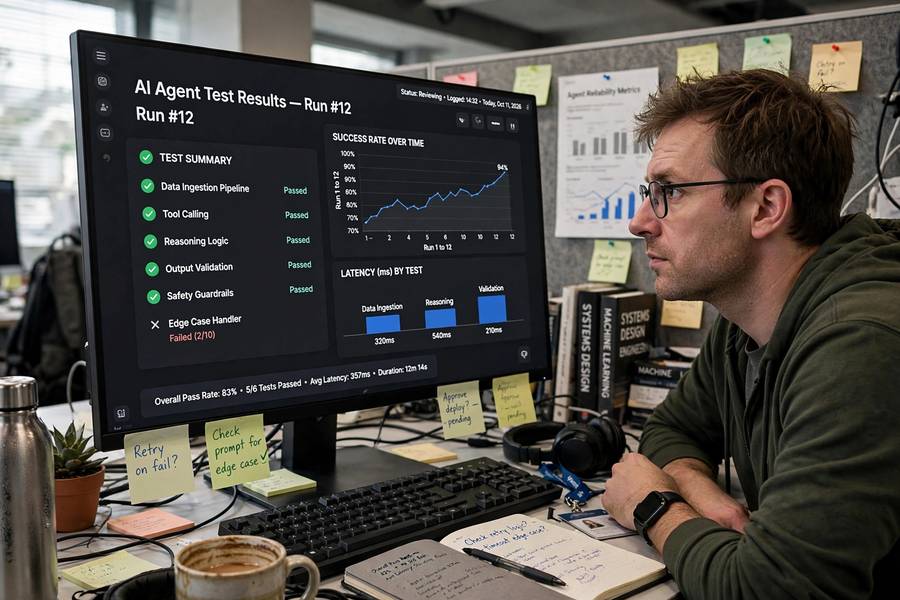
Traditional software testing has a comforting property: the same input produces the same output. You write a test, it passes, and it keeps passing. AI agents destroyed that comfort. The same prompt can produce different answers on different days. The agent might take a brilliant shortcut — or a catastrophic one — and both look like “working” until you look closely.
I learned this the embarrassing way, watching a demo agent ace every test I threw at it, then fail spectacularly the moment a real user phrased something slightly differently. That gap — between tested and trustworthy — is what AI agent testing tries to close. If you understand how AI agents work, you know why they need a fundamentally different testing discipline than the software most teams are used to.
This guide covers the testing methods that actually work for agents: evals, benchmarks, red-teaming, regression suites, and the operational habits that keep agents reliable after deployment.
Table of Contents
- Why Agents Break Traditional Testing
- The Three Layers of Agent Testing
- Task Evals: Measuring Whether It Works
- Behavioral Testing: Measuring How It Works
- Adversarial Testing and Red-Teaming
- Regression Suites for Nondeterministic Systems
- Testing in Production: Canaries and Shadow Mode
- Metrics That Matter
- Frequently Asked Questions

Why Agents Break Traditional Testing
Four properties of agents make them hostile to conventional QA:
Nondeterminism. Language models sample from probability distributions. Run the same agent twice and you can get different tool-call sequences, different phrasings, different outcomes. A test that passes 9 times out of 10 is not “passing” in any sense your release process understands.
Open-ended action spaces. A traditional function has defined inputs and outputs. An agent with a browser, a code interpreter, and an email tool has a near-infinite space of possible behaviors. You cannot enumerate the cases; you can only sample them.
Compounding errors. Agents work in chains: step 3 depends on step 2’s output. A small misread early on snowballs into a completely wrong final answer delivered with total confidence. Testing the final answer alone misses where the chain broke.
Environment dependence. An agent’s behavior depends on live data — search results, API responses, webpage layouts. The test that passed Tuesday fails Thursday because a website redesigned. Your tests are coupled to the outside world.
None of this means testing is futile — it means testing must be statistical, behavioral, and continuous rather than binary and one-time.
The Three Layers of Agent Testing
I think of agent testing in three layers, and skipping any one of them is how teams get surprised:
Layer 1: Component tests. Test the pieces — does the retriever return relevant documents, does the tool schema parse, does the planner produce valid plans. This is the most traditional layer and the most neglected. When the whole agent fails, the cause is usually a boring component failure.
Layer 2: Task evals. Give the agent realistic end-to-end tasks and score the outcomes. This is where most agent testing effort goes, and where the interesting methodology lives.
Layer 3: Behavioral and safety tests. Probe how the agent behaves under stress, ambiguity, and attack. Does it refuse harmful requests? Does it ask for clarification instead of guessing? Does it stay within its permissions? This layer catches the failures that task success rates miss.
Mature teams run all three continuously. Immature teams run a few task evals before launch and then learn about failures from customers.
Task Evals: Measuring Whether It Works
“Evals” — evaluation suites — are the core instrument. A good eval has:
Representative tasks. Not toy problems; actual tasks sampled from real usage. The best evals I have seen were built by logging the first month of beta usage and turning the hardest real queries into test cases. Synthetic tasks test what you imagined; real tasks test what users do.
Clear success criteria. “Book the cheapest flight” needs a rubric: correct dates, correct airports, price within range, booking actually completed. Vague criteria produce arguments, not measurements. For open-ended tasks, use model-graded rubrics — but validate the grader against human judgment first.
Difficulty stratification. Mix easy, medium, and hard tasks. An agent scoring 95% on easy tasks and 40% on hard ones tells you something actionable; a single blended score tells you nothing.
Multiple runs. Because of nondeterminism, run each task several times and report the distribution, not a single pass/fail — the gap between pass@k and all-tries consistency measures flakiness.
Trajectories, not just outcomes. Record the full sequence of thoughts and tool calls. Two agents can both succeed while one takes a reckless path — executing unreviewed code, say — that will eventually cause an incident. Outcome metrics hide process sins.
Behavioral Testing: Measuring How It Works
Task evals measure whether the agent got the right answer. Behavioral tests measure whether it behaved like a trustworthy professional getting there:
Clarification behavior. Give it ambiguous instructions. Does it ask a clarifying question, or does it charge ahead and guess? The best agents I have tested ask about 15% of the time on genuinely ambiguous tasks. Agents that never ask are agents that confidently do the wrong thing.
Tool discipline. Does it call tools in a sensible order? Does it verify results before acting on them? Does it respect rate limits and permissions? I have seen agents “succeed” by brute-forcing an API with a hundred calls — technically a pass, operationally a disaster.
Error recovery. Deliberately break things: return errors from tools, serve malformed data, change a webpage mid-task. Good agents notice, adapt, and either recover or report cleanly. Bad agents loop forever or hallucinate success.
Instruction hierarchy. Give it conflicting instructions from different sources — the user says one thing, a document says another. Does it prioritize correctly? This is the behavioral side of the prompt-injection problem, and it is testable.
Calibration. When the agent expresses confidence, is it right? Overconfident agents are dangerous because humans trust confident-sounding output. Measuring calibration — the match between stated confidence and actual accuracy — is one of the most underrated evals.
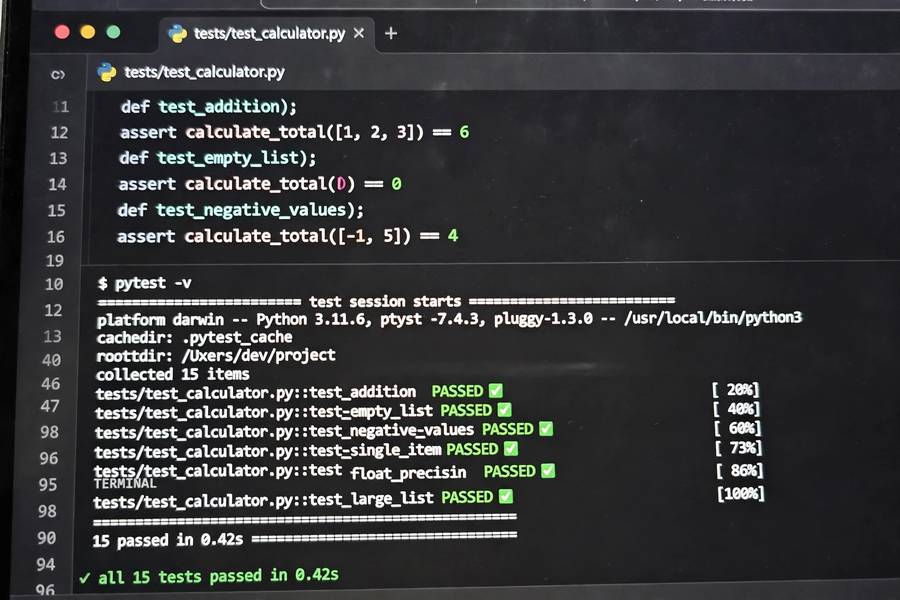
Adversarial Testing and Red-Teaming
If you only test the happy path, attackers will test the rest. Red-teaming an agent means actively trying to make it misbehave:
Jailbreak attempts. Try to get it to violate its instructions — directly and through indirect prompt injection. Test the realistic vector: poisoned documents and webpages, not just clever user prompts.
Permission probing. Ask it to do things just outside its authority and see if it complies, refuses, or asks. Then ask in ten different paraphrases. Agents that refuse the direct ask but comply with the rephrased one are not actually safe.
Data exfiltration attempts. Can you get it to reveal system instructions, other users’ data, or internal tooling details? Test with the agent’s actual tool access, not a sandboxed version — the permissions are part of what you are testing.
Multi-step attacks. The realistic attacks are not single prompts; they are sequences. Plant an instruction in step 2 that pays off in step 7. Most red-teaming I see is too shallow — one-shot prompts against a system designed to resist exactly those.
Have red-teaming done by people who didn’t build the agent — builders have blind spots shaped exactly like their assumptions.
Regression Suites for Nondeterministic Systems
“Did the new model version break anything?” is the question every agent team dreads, because model updates change behavior in ways no changelog captures. The answer is a regression suite with statistical thinking:
Golden trajectories. Keep a set of reference tasks with recorded good trajectories. After any change — model swap, prompt edit, tool update — rerun them and diff. You are looking for behavior changes, not just score changes: a task that still passes but now takes a riskier path is a regression.
Statistical thresholds. Define acceptable pass-rate bands per task difficulty, with enough runs to make the bands meaningful. A drop from 92% to 88% over 50 runs is noise; over 500 runs it is signal. Most teams under-run their evals and then argue about noise.
Version everything. Model version, prompt version, tool versions, eval version. When something changes, you need to know exactly what changed. I have seen teams spend weeks debugging a “model regression” that was actually a silently updated search API.
Canary on model updates. Never swap the underlying model for all traffic at once. Route a fraction of traffic to the new model, compare eval metrics and user outcomes, and roll back fast. The model providers’ evals do not cover your use case.
Testing in Production: Canaries and Shadow Mode
Some things can only be learned from real users, so production itself becomes a testing layer:
Shadow mode. Run the new agent version alongside the old one, on real traffic, but only the old version’s outputs reach users. Compare. This catches the failures your evals missed because your evals did not include reality.
Canary releases. Roll out to 1%, then 5%, then 25% of users, watching task success, error rates, cost per task, and user complaints at each step. Define rollback triggers in advance — “if the harmful-output rate exceeds X, we roll back” — not in the middle of an incident.
Human review sampling. Have humans review a random sample of agent trajectories weekly. Not just failures — successes too, because as I noted, successful outcomes can hide reckless processes. This is also how you discover the new failure modes to add to your evals.
User feedback as signal. Thumbs-down, corrections, “that’s not what I asked” — instrument all of it and feed it back into eval construction. Your users are running the largest eval suite you have; listen to it.
Metrics That Matter
If I had to pick a dashboard for an agent in production, it would show:
- Task success rate by difficulty tier, with confidence intervals
- Consistency — same task, multiple runs, how often identical outcomes
- Cost per successful task — tokens, tool calls, latency; agents fail economically before they fail technically
- Harmful/refusal rates — how often it refuses (too high means broken utility, too low means broken safety)
- Clarification rate on ambiguous tasks
- Human escalation rate — and whether escalations were justified
- Time to detect behavioral regressions after changes
Notice what is not on the list: vibes. “It feels smarter” is not a metric. Every agent upgrade I have seen justified by vibes has eventually been regretted.
Understanding how AI agents make decisions helps you design evals that probe the decision process, not just the outputs — and the distinction between AI agents vs AI assistants matters because assistants and agents need different test suites.

Frequently Asked Questions
AI agent testing is the discipline of evaluating autonomous AI systems before and after deployment. It combines task evals (can it complete realistic tasks), behavioral tests (does it act safely and sensibly), adversarial red-teaming (can it be manipulated), and continuous production monitoring — because agents are nondeterministic and can’t be tested like traditional software.
Evals are structured evaluation suites: sets of realistic tasks with clear success criteria, run repeatedly to measure an agent’s performance statistically. Good evals use real user tasks, difficulty tiers, multiple runs per task, and record full action trajectories — not just final outcomes.
With statistics instead of binary pass/fail: run each test multiple times, report pass rates with confidence intervals, track consistency across runs, and define regression thresholds based on distributions. Golden trajectory comparisons catch behavior changes that raw scores miss.
Red-teaming means having independent testers actively try to make the agent misbehave — jailbreaks, prompt injection via poisoned documents, permission probing, and data exfiltration attempts. It should be done by people who didn’t build the agent, testing multi-step realistic attacks.
Continuously. Re-run regression suites on every model, prompt, or tool change; canary new versions on a fraction of traffic; and have humans review sampled production trajectories weekly. Agent behavior drifts with model updates and changing environments, so one-time testing is never enough.