
“Should I name my plumbing company ‘Austin Emergency Plumber 24/7’ so I rank on Google?” I get some version of this question monthly. The short answer: keyword-stuffed business names are a 2012 tactic running on fumes — but keywords in names aren’t dead either. The truth is in the middle, and it’s more interesting than either extreme.
This is a strategic slice of the bigger naming decision I cover in how to name a business. Here, we settle the keyword question with how Google actually works in 2026 — not how it worked when your cousin’s SEO blog was written.
Table of Contents
- The Short Answer It Depends on Three Things
- When Keyword Names Actually Help SEO
- When Keyword Names Hurt Your Brand
- What Google Really Rewards in 2026
- The Smart Middle Ground Descriptive Modifiers
- Local SEO Without Keyword Stuffing
- Real-World Decision Framework
- Frequently Asked Questions
The Short Answer It Depends on Three Things
Whether keywords belong in your business name depends on:
1. Your primary acquisition channel. If 80% of customers find you via Google local search, keyword relevance matters more. If they come from referrals, social, or foot traffic, brand memorability matters more.
2. Your industry’s trust level. High-trust services (legal, medical, financial) are punished harder for spammy names. Low-trust-commodity services (junk removal, locksmiths) have historically gotten away with more — though Google is closing that gap.
3. Your ambition. Keyword names cap your brand ceiling. “Austin Cheap Plumbers” can never go premium, expand cities, or sell merch. Brand names can do all three. The keyword question is really a question about how big you’re playing.
Keep those three in mind — every section below maps back to them.
When Keyword Names Actually Help SEO
Let’s be honest about where keywords in the business name still move the needle:
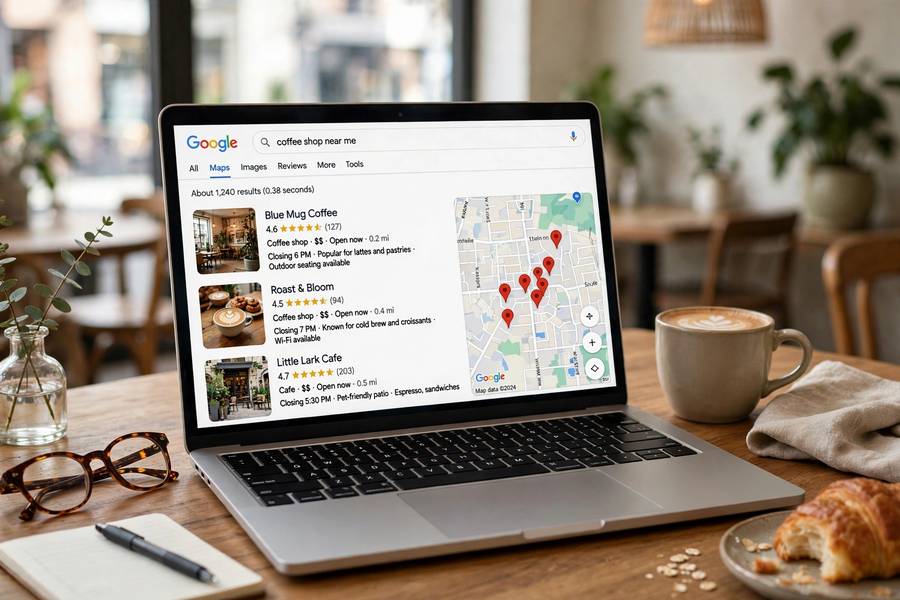
Google Business Profile relevance. Google’s local algorithm still weighs business name relevance for “near me” and service queries. A profile named “SparkleSquad Cleaning Services” has a small relevance edge over “SparkleSquad” alone for “cleaning services” searches. Small — but in competitive local packs, small edges compound.
User click-through clarity. When someone searches “emergency plumber” and sees “RapidFlow Emergency Plumbing” vs “RapidFlow,” the keyword version earns the click because it confirms relevance instantly. CTR is a ranking factor, so clarity converts to visibility.
Low-competition niches. In small towns or obscure niches with weak competition, a descriptive name plus basic local SEO can dominate. When nobody else is trying, the fundamentals win fast.
The honest math: I’d estimate the direct ranking benefit of keywords in the name at 5-15% of your local SEO picture — meaningful, but dwarfed by reviews, proximity, and website authority. It’s a tiebreaker, not a strategy. And that tiebreaker comes with brand costs we’ll cover next.
When Keyword Names Hurt Your Brand
Here’s what the keyword-maximalists don’t tell you:
You sound like spam. “Best Cheap Austin Plumbers 24/7 LLC” reads like a popup ad from 2009. In any industry where trust matters — and that’s most of them — a keyword-stuffed name actively repels the premium customers you want. I break down why perception is infrastructure in what branding actually means: your name is the first trust signal, and spammy names signal spammy service.
You can’t expand. “Austin Plumbers” is trapped in Austin and in plumbing. The day you add HVAC or open in Dallas, your name fights you. Every keyword you embed is a future pivot you have to rebrand around.
You can’t go premium. Nobody pays luxury prices to a “discount” or “cheap” branded company. Keyword names almost always skew downmarket because they’re built for search volume, not positioning.
Google penalizes the extreme. Google has explicitly targeted keyword stuffing in business names — profiles named “Locksmith Cheap 24 Hour Emergency Best Price” get flagged, suspended, or filtered. The algorithm that once rewarded this now punishes the obvious versions. You’re optimizing for a loophole that’s actively closing.
Word-of-mouth dies. Nobody recommends “Austin Emergency Plumber 24/7” at a dinner party. They recommend “the plumber guy — RapidFlow, I think?” Keyword names are unmemorable by design; they’re built for algorithms, not humans. And humans still drive the referrals that build real businesses.
What Google Really Rewards in 2026
If keywords in the name are a 5-15% factor, what’s the other 85%? Google’s local ranking in 2026 runs on:
Reviews — quantity, velocity, and responses. Businesses with 100+ recent reviews and owner responses to every review dominate local packs. A memorable brand name EARNS more reviews because customers remember it and feel good recommending it. This is the flywheel keyword names can’t access.
Proximity and service area accuracy. Google knows where the searcher is. Being the closest relevant option beats being the most keyword-optimized distant one.
Website authority and relevance. Your website’s content — service pages, location pages, helpful articles — carries the keyword weight your name doesn’t need to. A brand-named business with 20 excellent service pages outranks a keyword-named business with a thin site every time.
Behavioral signals. Click-through rate, direction requests, calls, and “time on listing” tell Google which results satisfy searchers. A trusted brand name earns more clicks and calls than a spammy keyword name — and Google measures all of it.
The strategic conclusion: Google rewards businesses that humans love. Humans love memorable brands, not keyword strings. Optimizing your NAME for Google while neglecting what makes humans click is optimizing for 2012.
The Smart Middle Ground Descriptive Modifiers
You don’t have to choose between “SparkleSquad” (pure brand) and “Austin House Cleaning Services” (pure keyword). The pros use descriptive modifiers:
Brand + category: “SparkleSquad Cleaning Co.” / “RapidFlow Plumbing” / “Ironwood Fitness.” The brand leads (memorable, ownable), the category follows (clear, searchable). This is the format I’d recommend to 80% of local businesses.
Brand + category + location (for GBP): Your legal/brand name stays clean, but your Google Business Profile can include a natural descriptor where Google allows it. “SparkleSquad” on the truck; “SparkleSquad — House Cleaning Austin” as the practical listing. (Stay within Google’s guidelines — descriptors must reflect reality, not keyword lists.)
Category in the tagline, not the name: “SparkleSquad — Austin’s detail-obsessed home cleaners.” The tagline does SEO and clarity work; the name stays brandable. Taglines can change; names shouldn’t have to.
The rule: the name should be brand-first, with exactly ONE clarifying element — a category word, not a keyword paragraph. “RapidFlow Plumbing” yes. “RapidFlow Emergency Plumber Austin 24 Hour” absolutely not.
Local SEO Without Keyword Stuffing
Here’s how a brand-named business wins local search without stuffing keywords into its name:
1. Service pages per offering. One dedicated page per service per area: “Drain Cleaning in Austin,” “Water Heater Repair in Round Rock.” Each page targets its keywords properly — in titles, headers, and content where they belong.
2. Review velocity with keyword-rich responses. When you respond to reviews, naturally include service and location terms: “Thanks, Sarah! Glad our team could sort the drain cleaning in Austin quickly.” Google reads review responses.
3. Google Business Profile optimization. Complete every field: services list, service areas, attributes, hours, photos with descriptive filenames. The profile has dozens of keyword fields — the business NAME field doesn’t need to carry the load.
4. Local content. Neighborhood guides, “cost of X in [city]” articles, before-and-after galleries with location tags. Content builds the topical authority that a keyword name pretends to provide.
5. Citations and NAP consistency. Your brand name, spelled identically, across every directory. Consistency beats keywords in citation value.
A brand-named business executing these five beats a keyword-named business doing none of them — every single time. The name is one field in a fifty-field game.
This is the same systems thinking I apply in what a startup actually is: durable advantages come from doing the unglamorous work across the whole system, not from one clever hack.
Real-World Decision Framework
Answer these five questions in order:
1. Where will most customers come from in year one? Mostly Google → lean toward brand + category modifier. Mostly referrals/social/foot traffic → pure brand name, no keywords needed.
2. What’s the trust level of your industry? High trust (legal, medical, financial, childcare) → avoid keyword names entirely; they read as spam in high-trust contexts. Lower trust/commodity → a category modifier is fine.
3. Will you expand services or geography in 5 years? Yes → keep the name broad and brand-led. No → a descriptive name is acceptable.
4. Are you competing on price or quality? Price → descriptive names are tolerable (your customers are searching for deals). Quality/premium → brand name mandatory; keyword names cap your pricing power.
5. Can you commit to real local SEO? Yes → take the brand name and win with content, reviews, and optimization. No → a mild category modifier gives you a small head start, but understand it’s a crutch, not a strategy.
My default recommendation: brand name + one category word. “SparkleSquad Cleaning Co.” It gives you 90% of the SEO benefit with 0% of the brand damage. The keyword-stuffed name is a tactic; the brand name is an asset. Build assets.

Frequently Asked Questions
Usually a brand name plus one category word (like “SparkleSquad Cleaning Co.”) is the sweet spot. It captures most SEO benefit without the brand damage of keyword stuffing. Pure keyword names help marginally but cap your brand’s growth and trust.
Yes. Google actively targets keyword stuffing in Google Business Profile names — listings like “Best Cheap Locksmith 24/7” risk flags, suspension, or filtering from local results. Natural brand-plus-category names are safe.
They provide a small relevance boost (roughly 5-15% of local ranking factors), but reviews, proximity, website authority, and behavioral signals matter far more. Keywords in the name are a tiebreaker, not a ranking strategy.
Google allows natural descriptors that reflect your real business, but prohibits keyword stuffing in the business name field. Use the services, categories, and description fields for keywords instead — that’s what they’re designed for.
For most businesses, brandable wins long-term: it’s memorable, ownable, expandable, and earns more reviews and referrals. Descriptive names only win when nearly all customers come from search in low-competition markets — and even then, brand + category modifier beats pure keywords.
Out-execute them on the bigger factors: get more reviews, publish better service pages, earn more clicks with a trustworthy brand. A keyword-named competitor with thin content and few reviews is beatable — and Google increasingly penalizes their exact tactic.