
I’ll be straight with you: business name generators are useful, but not in the way most people use them. Founders type in a keyword, stare at 200 auto-generated suggestions, pick the least-bad one, and call it a day. That’s not naming — that’s settling, with extra steps.
Used correctly, a name generator with a built-in domain check is a brainstorming accelerator. It produces raw material fast and tells you instantly whether the .com is available, which saves you the heartbreak of falling in love with a taken name. But the generator is the beginning of the process, not the end of it. If you want the full naming sequence, start with my guide on how to name a business — then use this article to get the most out of the tools.
Table of Contents
- What These Generators Actually Do
- Why the Built-In Domain Check Matters So Much
- How to Use a Name Generator the Right Way
- What Generators Are Bad At (Do This Yourself)
- Beyond the Generator: Checks No Tool Does for You
- Turning Generator Output Into a Real Shortlist
- Frequently Asked Questions
What These Generators Actually Do
Under the hood, most business name generators do the same three things. You enter a seed keyword — say “hike” for an outdoor gear shop — and the tool combines it with prefixes, suffixes, synonyms, and rhyming words from its dictionary. “Hike” becomes Hikeo, HikeHub, TrailHike, Hike & Co, and a few hundred variations you’d never think of on your own.
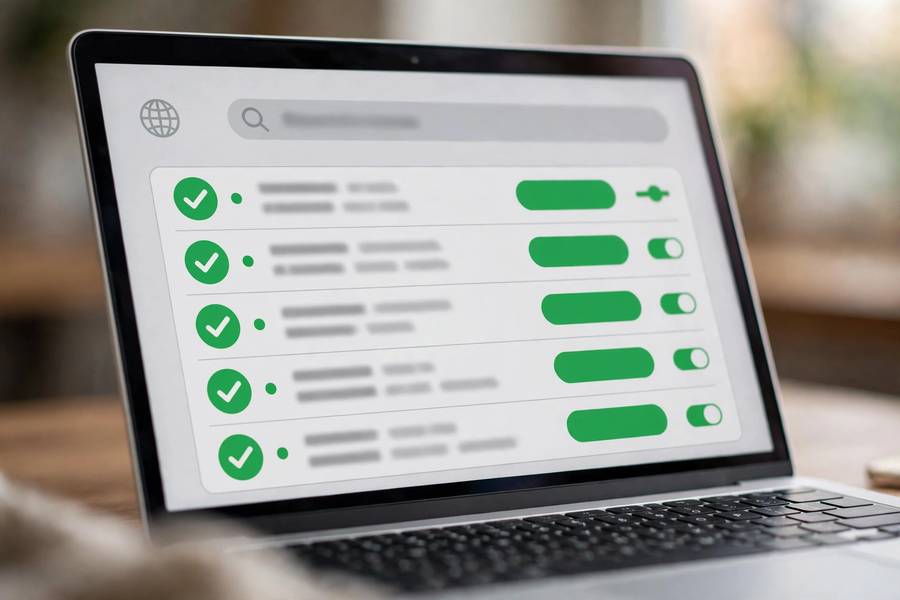
The better ones add filters: name length, style (brandable vs. keyword-rich), industry, and sometimes a “vibe” setting. The best ones — the ones worth your time — check domain availability in real time as they generate, so every suggestion comes with a green “available” or red “taken” indicator next to it.
What they’re really selling is speed. A human brainstorming session produces maybe 50 candidates in an hour. A generator produces 500 in ten seconds. That volume advantage is real, and it’s the only reason to use them. Everything else about naming — taste, judgment, strategy — still has to come from you.
Why the Built-In Domain Check Matters So Much
Here’s the painful pattern generators with domain checks were built to prevent: you spend a week falling in love with a name, tell your friends, sketch a logo in your head — then discover the .com is owned by a domain squatter asking $25,000.
The integrated domain check collapses that timeline. You see availability at the moment of inspiration, which trains your brain to only get attached to names you can actually own. It’s a small psychological shift with a big practical payoff.
A few things to know about how these checks work:
They usually check .com first, then alternatives. Most tools default to .com availability and show other TLDs (.co, .io, .net) as fallbacks. Pay attention to which TLD the green checkmark refers to — an “available” badge on a .xyz means nothing if you need the .com.
Availability isn’t ownership. A domain showing as available means it’s currently unregistered, not that it’s problem-free. It could have a bad history (spam, penalties) or a confusingly similar trademark. The generator won’t tell you that.
Check the price, not just availability. Some “available” domains are premium — registered by the registry itself at $2,000+ per year. If the tool shows a price, read it. A $3,000/year domain is not really available for a bootstrapped startup.
The domain check is a filter, not a verdict. It answers “can I register this?” — it doesn’t answer “should I?”
How to Use a Name Generator the Right Way
Here’s the workflow I recommend. It takes about 45 minutes and produces dramatically better results than passive scrolling:
1. Feed it the right seeds. Don’t enter your industry (“plumbing”). Enter the outcome you deliver (“flow,” “clear,” “rush”) or the feeling you want (“calm,” “bold,” “swift”). Generators are only as creative as your inputs — generic seeds produce generic names.
2. Run 5-10 different seeds. One seed gives you variations on one idea. Ten seeds give you ten different directions. The best name usually comes from the seed you almost didn’t try.
3. Harvest, don’t shop. Your job is not to find “the one” in the results. Your job is to collect 30-40 interesting fragments — words, syllables, combinations that catch your eye. Copy them into a separate list. You’re building raw material, not making a decision.
4. Filter by availability immediately. Delete everything without an available .com (or your target TLD). This is the generator’s superpower — use it ruthlessly. A list of 40 available names beats a list of 200 mostly-taken ones.
5. Then go manual. Take your surviving fragments and start combining them by hand, the way you’d brainstorm without the tool. The generator gave you ingredients; now you cook. Some of the best names I’ve seen came from mashing two generator suggestions together into something the tool never produced.
This is also where what good branding actually means becomes relevant — the name has to work as the foundation of a brand, not just as an available domain. A generator can find you an available string of letters. Only you can decide if it’s a brand.

What Generators Are Bad At (Do This Yourself)
Generators have blind spots, and knowing them saves you from their most common failure modes:
Taste. A generator will happily suggest “BestPlumbingServices2026.com” because it matches your keywords and the domain is available. It has no concept of elegance, wit, or restraint. Every suggestion needs a human taste filter.
Cultural meaning. Generators don’t know that your clever name means something unfortunate in another language, resembles a controversial term, or abbreviates badly. I once saw a generated name whose initials spelled something no founder wants on a business card. Check everything yourself.
Trademark conflicts. No generator I’m aware of does a real trademark search. A name can have an available .com and still infringe an existing trademark in your business class. This check is on you, and skipping it is the most expensive mistake in naming.
Strategic fit. The generator doesn’t know your positioning, your customer, or your five-year plan. It can’t tell you that a playful name undermines a serious B2B offer, or that a hyper-specific name will box you in when you expand. Strategy is human work.
Pronunciation and memorability. Generators optimize for keyword matching and availability, not for the human qualities that make names stick. Run every finalist through the say-it-out-loud and spell-it-back tests yourself.
Think of the generator as an intern with infinite energy and zero judgment. Give it volume tasks. Keep all judgment tasks for yourself.
Beyond the Generator: Checks No Tool Does for You
Once you have 3-5 finalists from the generator, run the checks that no automated tool covers:
Social handles. Search the exact name on the platforms where your customers are. A generator’s domain check doesn’t cover Instagram, TikTok, or X — and an inconsistent social presence confuses customers.
Search engine reality. Google each finalist plus your industry. If page one is dominated by an established company with a similar name, you’ll fight for visibility for years. If it’s empty, you can own the term — which is a genuine advantage.
The human test. Tell the name to five people who resemble your customers. Watch their faces. Confusion, requests to repeat, or polite blank stares are data — the most honest data you’ll get in the whole process.
The longevity test. Imagine the name on a much bigger company than yours. Does it still work? Names that only make sense for a tiny startup (“Dave’s Basement Web Design”) become liabilities at scale. If you have ambitions — and understanding what a startup is usually means you do — pick a name with headroom.
Turning Generator Output Into a Real Shortlist
Let me give you the endgame. After the generator session and the manual checks, you should have:
- 3 finalists, each with an available domain you’ve actually priced
- Trademark searches run on all three (your country’s database, your business class)
- Social handles checked on your key platforms
- Human testing done — at least five real reactions per name
- One name you’d be proud to say out loud a thousand times
Then sleep on it. I know I keep saying this, but the overnight test has killed more bad names than every other filter combined. The name that still excites you in the morning is your answer.
And remember the bigger picture: generators are fantastic at preventing the two classic naming failures — picking something unownable, and running out of ideas. They’re terrible at the actual decision. Use them for what they’re good at, do the judgment work yourself, and you’ll end up with a name that’s both available and worth owning.
Frequently Asked Questions
Yes, as brainstorming accelerators. They generate hundreds of candidates in seconds and show domain availability instantly, which prevents you from falling in love with taken names. But they’re only the starting point — taste, trademark checks, and strategic judgment are still human work.
No — and this is their biggest blind spot. A name can have an available .com and still infringe an existing trademark in your business class. Always search your country’s trademark database yourself before committing to a name, no matter what the generator says.
Enter the outcome you deliver or the feeling you want, not your industry. “Flow,” “calm,” or “swift” produce more interesting names than “plumbing.” Run 5-10 different seeds — the best name usually comes from the seed you almost didn’t try.
No. Availability only means the domain is unregistered — it says nothing about trademarks, the domain’s history, or social handle availability. Check the price (some “available” domains are premium), search trademarks, and check social platforms separately.
Harvest 30-40 interesting fragments rather than shopping for “the one,” filter by domain availability, then combine ideas manually. Test 3 finalists with real people (say-it-out-loud and spell-it-back tests), run trademark searches, check social handles, and sleep on the decision before committing.
Treating the generator’s output as the decision instead of raw material. Picking the least-bad suggestion from 200 auto-generated names is settling, not naming. The generator’s job is volume and availability filtering; your job is taste, strategy, and verification.