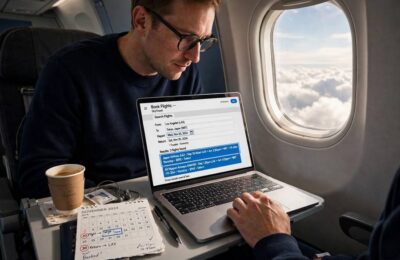


In eleven years of travel writing, I’ve flown somewhere around 400 times, and I’ve paid everything from $2,800 for a last-minute transatlantic ticket to $11 for a cross-Europe hop. The difference wasn’t luck — it was a handful of repeatable habits I use every single time I book.
For a deeper dive, see our guide to the best time to book flights.
This isn’t “book on Tuesdays” folklore. What follows is what actually works — the setup that saves me hundreds of dollars a year, and the mistakes I paid real money to learn.
Table of Contents
- The Booking Window That Actually Matters
- Set Price Alerts and Forget Them
- Be Flexible With Dates (Even By One Day)
- Search Flexible Destinations, Not Just Dates
- The “Cheapest Month” View Is Your Best Friend
- One-Way Tickets Often Beat Round-Trips
- Check Alternate and Nearby Airports
- Budget Airlines: Read the Fine Print First
- Book Direct With the Airline When You Can
- Don’t Pay for Seats and Bags You Don’t Need
- The Myths You Can Stop Believing
- My $600 Mistake (So You Don’t Make It)
- Frequently Asked Questions
The Booking Window That Actually Matters
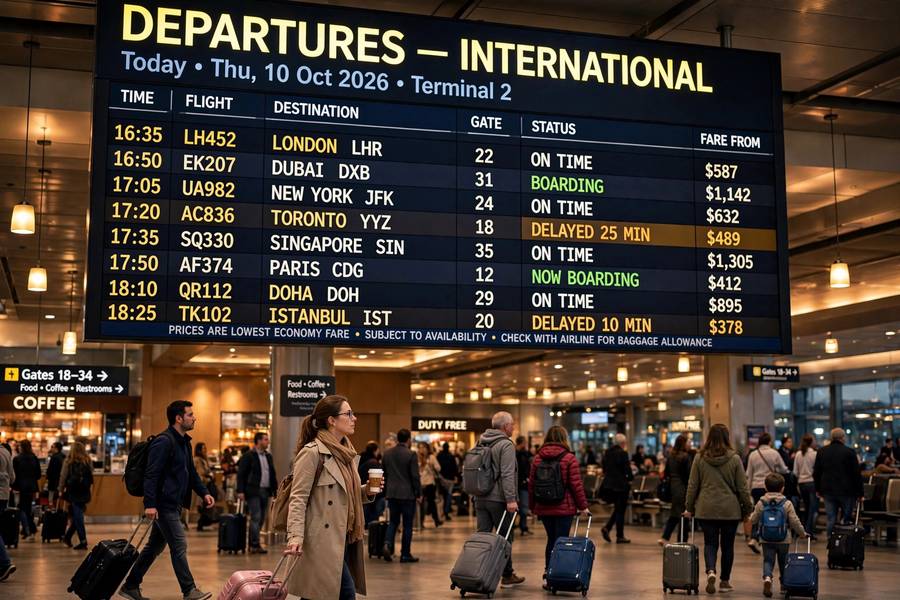
For domestic flights within the US, the sweet spot is generally 1–3 months before departure. For international flights, it’s 2–8 months. Inside that window, prices bounce around — the exact day matters less than being inside the window with alerts running.
What genuinely doesn’t work: booking a year out “to lock in the price.” Airlines typically release seats 11 months ahead at standard fares that rarely go down. The deals appear when the revenue-management algorithms start fiddling, usually a few months out.
The exception that will burn you: booking last-minute. I once had to fly New York to London on three days’ notice for a family emergency and paid $2,800 in economy. Same route booked two months ahead runs $400–$600. That single ticket taught me more about fare dynamics than any blog post.
Set Price Alerts and Forget Them
This is the single highest-leverage habit in this entire article. When I know a trip is coming — even roughly — I set a price alert on Google Flights for the route and dates (or month). It takes ninety seconds. Then I stop thinking about it until the alert pings me.
Google Flights lets you track specific dates or “any dates” within a month, and its price graph shows you at a glance whether the current fare is low, typical, or high for that route. The key is to set alerts early — an alert you set three months out can catch a fare dip you’ll never see if you only start searching the week before.
Be Flexible With Dates (Even By One Day)
Airline pricing is violently sensitive to the day of week. Flying Thursday instead of Friday, or returning Tuesday instead of Sunday, routinely saves 20–40%.
When searching, always look at the full date grid or the “flexible dates” view rather than one fixed itinerary. Google Flights shows a calendar with prices per day; Skyscanner has a “cheapest month” view. Five extra minutes of clicking around here beats any discount code I’ve ever used.
A real example: Last spring I searched New York–Rome for a fixed Saturday-to-Saturday week and found $890. Shifting departure to Thursday and return to Wednesday — same length trip — dropped it to $562. Same airline, same seats, $328 saved by moving dates 48 hours.
Search Flexible Destinations, Not Just Dates
If your goal is a trip rather than a specific city, flip the search around. Google Flights lets you search a departure city to “Europe” or a region, and shows a map of fares everywhere. This is how I ended up spending a week in Portugal when I started out looking for cheap flights to “somewhere warm in March.”
It’s especially powerful for bucket-list wandering: type your home airport, pick a continent, and see where the deals actually are. Sometimes the universe hands you a $420 fare to Lisbon when Barcelona is $780, and honestly, you weren’t that attached to Barcelona.
The “Cheapest Month” View Is Your Best Friend
Every comparison site has some version of a fare calendar or price graph. Use it religiously. It shows you which weeks are cheap for your route, which lets you either time your trip to the cheap window or at least know you’re buying during an expensive one (so you can set alerts and wait).
This matters most for international travel, where a one-week shift can mean a 30–50% difference. Flying to Southeast Asia in July vs. August vs. October is three completely different price tiers. The calendar view turns that invisible variation into something you can actually plan around.
One-Way Tickets Often Beat Round-Trips
Most travelers default to round-trip search. But piecing together two one-way tickets — sometimes on different airlines, sometimes through different cities — frequently undercuts the round-trip price, especially on international routes.
Last year I flew Boston to Madrid on one airline for $310 and came home Lisbon to Boston on another for $290 — $600 total. The cheapest round-trip on the same dates was $840. That’s a $240 gap for ten extra minutes of searching.

Check Alternate and Nearby Airports
If you’re flying into or out of a city with multiple airports, check all of them. New York (JFK/EWR/LGA), London (Heathrow/Gatwick/Stansted), Paris (CDG/Orly/Beauvais), the Bay Area (SFO/OAK/SJC) — the price difference between airports in the same metro area can be $100+.
Beauvais is an hour outside Paris but budget carriers use it, and the fare difference often covers the bus into the city with money left over. Same story with London Stansted. Just factor in the transfer time and cost honestly — a $60 cheaper fare that costs $40 and two hours to reach downtown is really a $20 saving, and it might not be worth it.
Budget Airlines: Read the Fine Print First
Ryanair, Spirit, Frontier, AirAsia and their cousins can genuinely fly you across a continent for the price of a pizza — but only if you play by their rules. The base fare excludes everything: seat selection, checked bags, sometimes even carry-on beyond a small personal item.
Do the real math. A $39 Spirit fare with a $65 checked bag and $40 seat selection is $144 — possibly still cheaper than the legacy carrier, but often not once you add the bag fees. And budget airlines fly at odd hours to secondary airports, so weigh the total trip cost.
My rules for budget carriers: never pay for seat selection (you’ll get one free at check-in), measure your bag against their sizer mentally before booking, and never book a budget airline for a trip where a cancellation would strand you — their recovery options are thin.
Book Direct With the Airline When You Can
Third-party booking sites (the ones that aren’t the airline’s own website) sometimes show slightly lower fares, but when something goes wrong — a cancellation, a schedule change, a need to rebook — dealing with a middleman is miserable. The airline will tell you to talk to the agency; the agency’s phone queue is 90 minutes long.
My practice: use Google Flights or Skyscanner to find the fare, then book directly on the airline’s website for the same price (it’s almost always the same). The exception is when a third party is genuinely $30+ cheaper — then I’ll take the savings but only for simple, low-risk itineraries.
Don’t Pay for Seats and Bags You Don’t Need
Add-on fees are where airlines make their money, and they’re almost entirely optional. You don’t need to pay $25 to pick your seat on a two-hour flight — you’ll get assigned one at check-in for free. You don’t need priority boarding on most trips.
The one add-on I consistently buy: checked bags when I actually need them, purchased at booking rather than at the airport (airport bag fees are nearly double). And if you can get comfortable traveling with just a carry-on, you dodge the single biggest fee category entirely — my guide to what to pack for international travel covers exactly how I fit two weeks into one.
The Myths You Can Stop Believing
Let me save you some time on the advice that floats around but doesn’t hold up:
“Clear your cookies or use incognito mode.” Multiple studies have found no evidence that airlines raise prices based on your browsing history. Price changes between searches are the algorithm doing its normal dance, not personal targeting. Incognito doesn’t hurt, but it doesn’t help either.
“Book on Tuesday at midnight.” This was true-ish in 2012. Fare sales now drop whenever the airline decides. Set alerts instead of setting alarms.
“The earlier the better.” Covered above — too early locks in standard fares. The window matters more than the head start.
My $600 Mistake (So You Don’t Make It)
In 2019 I found a fare from Chicago to Bangkok for $620 round-trip — genuinely excellent. I didn’t book it because I “needed to check with my travel buddy first.” We talked for three days. On day four the fare was $1,220.
I’d violated my own rule: if a fare is in the “good” range for the route and your dates are firm, book it. Airlines let you cancel within 24 hours in the US for a full refund (DOT regulation), so you can sleep on it — after booking, not before.
Cheap flights aren’t about one magic trick. They’re about a system: alerts set early, flexible dates, honest math on budget carriers, and the discipline to book a good fare when you see it.

Frequently Asked Questions
For domestic flights, 1–3 months ahead is the sweet spot; for international, 2–8 months. Booking a year out rarely gets you the lowest fare, and booking within two weeks of departure is almost always the most expensive option.
No — studies have found no evidence that airlines raise prices based on your browsing history. Price changes between searches come from the airline’s normal fare algorithm, not personal tracking. Incognito mode won’t hurt, but it won’t save you money either.
Sometimes, but you have to do the real math: base fare plus checked bags, seat selection, and transport from secondary airports. A $39 fare can become $144 after fees — still cheaper than a legacy carrier on some routes, but not always.
Use comparison sites to find the fare, then book directly on the airline’s website — it’s usually the same price and makes cancellations and rebookings far easier. Only use a third party when it’s genuinely $30 or more cheaper.
Yes — Tuesdays, Wednesdays, and Saturdays are typically the cheapest days to fly, while Fridays and Sundays are the most expensive. Shifting your trip by even one day can save 20–40% on the fare.
Book it anyway if your dates are firm — in the US, DOT regulations give you 24 hours to cancel any flight for a full refund. Use that window to confirm with your travel companions instead of risking the fare doubling.