What Is an LLC Business? A Plain-English Guide


You keep hearing the advice: “form an LLC before you take your first payment.” But what is an LLC business, exactly? Strip away the jargon and an LLC is simply a way of organizing your business so that your personal life and your business life stay in separate buckets. The business can earn money, sign contracts, and take on debts — and if things go sideways, your house and savings stay out of reach.
The letters stand for “limited liability company,” and the name says almost everything. It’s a company that exists as its own legal entity, and it gives its owners limited liability, meaning their personal assets are generally protected from the company’s debts and lawsuits. Think of it as a fence between your personal wallet and your business wallet.
What “Limited Liability” Actually Means
Limited liability is the single biggest reason LLCs exist. Here’s the idea in plain terms: when you run a business as a sole proprietor with no formal structure, there’s no legal line between you and the business. If the business owes money or gets sued, creditors can come after everything you own — your bank account, your car, your home.
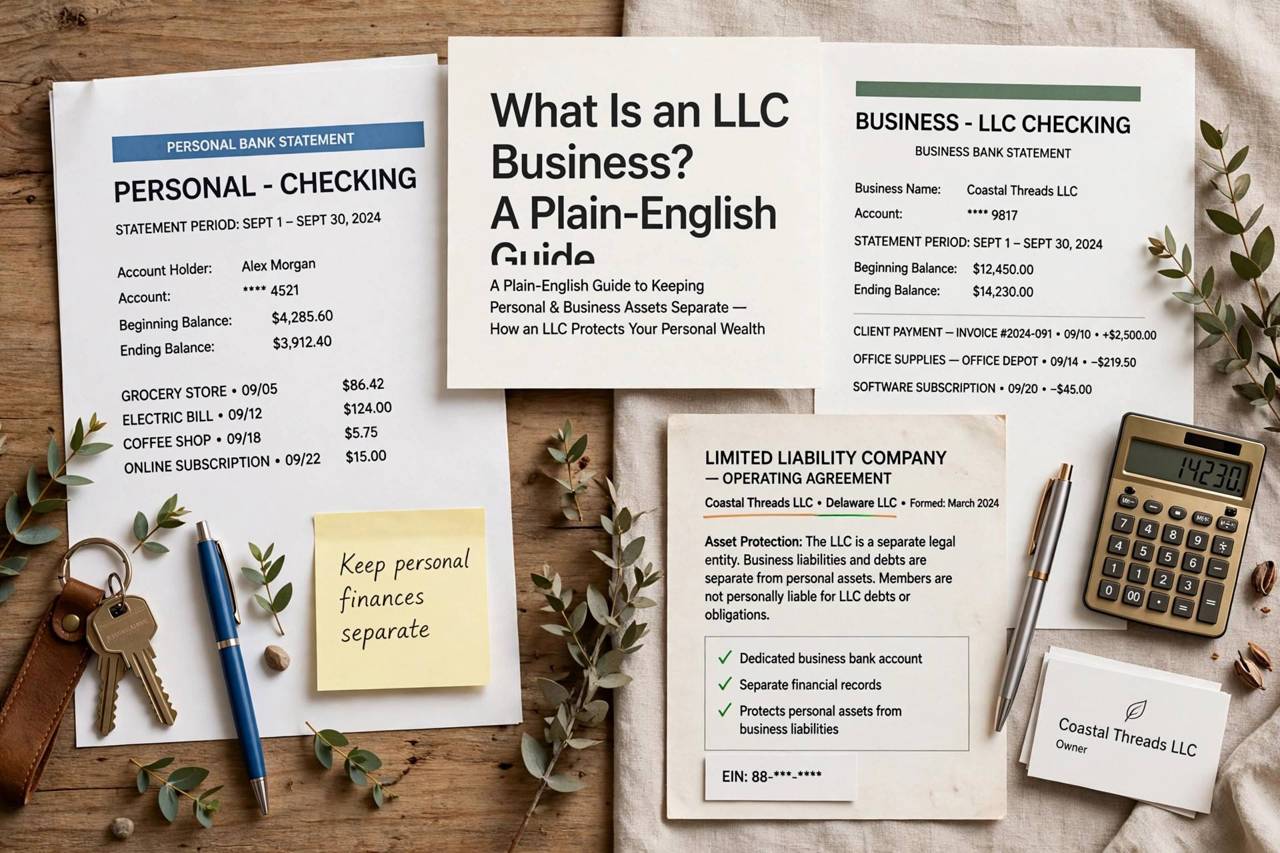
An LLC draws a legal line. The company becomes its own “person” in the eyes of the law. Debts belong to the company, not to you personally. If the LLC fails, creditors generally can’t chase your personal assets, as long as you’ve kept the company’s money separate from your own and followed basic formalities.
This matters most for businesses with any real risk: selling products people touch or eat, doing work on other people’s property, signing leases, or taking on partners. If your business is just you, a laptop, and freelance clients, the risk is smaller — but plenty of freelancers still choose the protection.
How an LLC Business Works Day to Day
Once formed, the LLC operates a lot like a normal business with a few extra habits. It gets its own tax ID (called an EIN), opens its own bank account, and signs contracts in the company’s name rather than the owner’s. Income flows into the LLC, expenses come out of it, and at the end of the year the profits pass through to the owners, who report them on their personal tax returns.
That last part is important. Unlike a traditional corporation, an LLC usually doesn’t pay its own income tax. Instead, profits and losses “pass through” to the owners. You avoid the double taxation problem that corporations face — where the company pays tax and then the owners pay tax again on dividends.
Day to day, running an LLC means keeping clean books, paying yourself from the company account rather than dipping into it casually, and keeping meeting notes or resolutions for big decisions. None of this is glamorous, but it’s the kind of record-keeping that keeps the liability shield intact.
Who Owns an LLC Business?
The owners of an LLC are called members. An LLC can have one member (you alone) or many. Members can be individuals, other businesses, or even trusts. There’s no board of directors, no mandatory annual meetings in most states, and no shares of stock — though a multi-member LLC can assign different ownership percentages to reflect who put in what.
How the LLC is managed matters too. In a member-managed LLC, the owners run the show directly. In a manager-managed LLC, the owners hire someone (who might also be an owner) to handle daily operations. Small businesses almost always choose member-managed — it’s simpler, and you’re the one doing the work anyway.
The rules of the road get written down in a document called the operating agreement. It covers ownership splits, how profits are divided, what happens when someone wants out, and how decisions get made. It’s the single most important piece of paper in a multi-member LLC, and smart owners write one even when they’re the only member.
The Main Advantages of an LLC
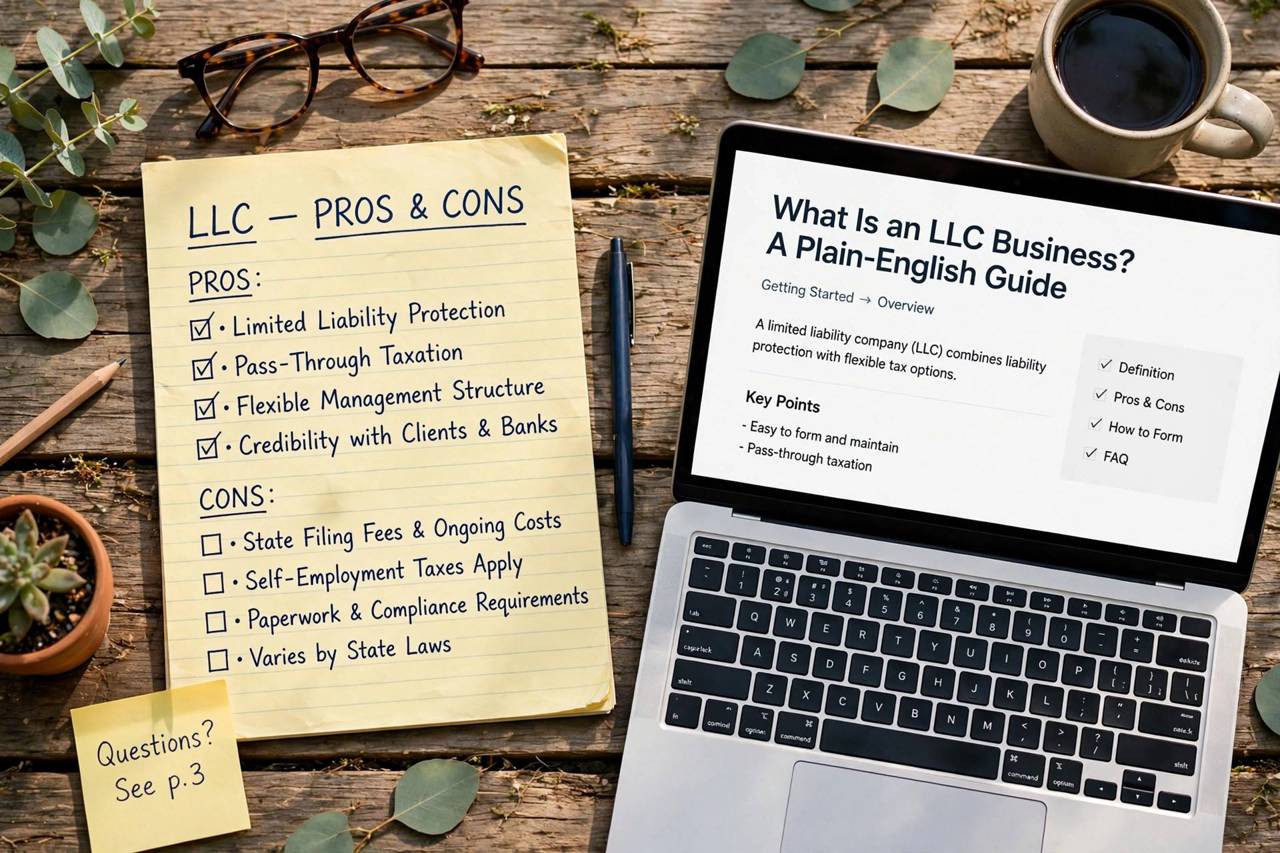
First is the liability protection described above — the fence between personal and business assets. Second is the tax flexibility. By default, the IRS treats a single-member LLC like a sole proprietorship and a multi-member LLC like a partnership for tax purposes, so profits pass through. But an LLC can also elect to be taxed as an S corporation if the numbers make sense, which can reduce self-employment tax at certain income levels.
Third is credibility. “Smith & Sons LLC” looks more established than just “John Smith,” and some clients and vendors genuinely care. Fourth is simplicity compared to a corporation: fewer formalities, less paperwork, and no requirement to issue stock or hold formal board meetings in most states.
Fifth is ownership flexibility. Unlike S corporations, which cap the number and type of shareholders, an LLC can have unlimited members, including other companies. That makes it easy to structure joint ventures and bring in new partners.
The Downsides Worth Knowing
An LLC isn’t free protection, and it isn’t right for everyone. Formation costs vary by state — some states charge under a hundred dollars, others charge several hundred, and some (looking at you, California) charge an annual minimum tax on top of the filing fee. There are also ongoing annual reports in most states, which means paperwork and fees every single year.
There’s another subtle cost: self-employment tax. By default, all of an LLC’s profit is subject to it, which can be higher than what a salaried employee pays. The S-corp election can help here, but it adds complexity and only makes sense once profits are high enough.
Finally, the liability shield isn’t magic. Courts can “pierce the veil” and hold owners personally responsible if they commingle funds, commit fraud, or never treated the LLC as separate in the first place. The protection only works if you actually run the business as a business.
LLC vs. Other Business Structures
Compared to a sole proprietorship, an LLC costs more and requires paperwork, but it gives you the liability protection a sole proprietorship completely lacks. For anyone doing work with real financial exposure, that’s usually worth the trade.
Compared to a partnership, an LLC gives each owner limited liability — whereas in a general partnership, each partner can be personally liable for the business’s debts and for mistakes made by the other partners. That’s a meaningful difference when trust is involved.
Compared to a corporation, an LLC is simpler and avoids double taxation by default. A corporation makes more sense when you plan to raise venture capital or go public, because investors prefer stock — but for most small businesses, the LLC wins on simplicity. If you’re weighing the details, our comparison of LLC vs. sole proprietorship breaks down the trade-offs, and single-member vs. multi-member LLC explains how ownership count changes the picture.
How to Form an LLC Business
Forming an LLC follows roughly the same steps everywhere, though fees and forms differ by state:
- Choose a name. It must include an LLC designator (LLC, L.L.C., or Limited Liability Company) and can’t conflict with an existing business in your state.
- Appoint a registered agent. This is the person or company that accepts legal documents on the LLC’s behalf. It needs a physical address in the state. You can serve as your own agent in many states, though many owners hire a service for privacy.
- File articles of organization. This is the core filing with your state’s business office — usually the Secretary of State. It lists the LLC’s name, address, agent, and sometimes its members.
- Write an operating agreement. Required in some states and wise everywhere. You can find guidance on LLC operating agreements to get started.
- Get an EIN. The IRS issues these tax IDs for free, and banks require one to open a business account.
- Open a separate bank account and get any needed licenses. Keep the money separate from day one — that’s the habit that protects you.
The whole process usually takes days to a few weeks depending on the state. Many owners do it themselves through the state’s website; others use a formation service for convenience.
Who Should — and Shouldn’t — Form an LLC
An LLC makes the most sense when there’s real risk or real ambition: you sell physical products, work on client property, sign contracts or leases, plan to hire, or want the tax flexibility. If you’re just starting out and want to understand the full picture, how to start a business covers the bigger journey.
It makes less sense when you’re testing a tiny side idea with no revenue and no risk — the fees buy protection you don’t need yet. And it makes no sense as a magic tax trick: forming an LLC doesn’t automatically save you money on taxes, and anyone who tells you otherwise is selling something.
What Is an LLC Business? A Quick Recap
If you skimmed everything above, here’s the short version: an LLC business is a company that exists separately from its owners, so the owners’ personal assets are generally protected from business debts. It passes profits through to the owners for tax purposes, it’s simpler than a corporation, and it works for one owner or many. The cost is some paperwork and state fees — a fair trade for most businesses with real exposure.

Frequently Asked Questions
What does LLC stand for?
LLC stands for “limited liability company.” The name describes its two defining features: it’s a company (a separate legal entity), and it limits the personal liability of its owners.
Is an LLC the same thing as a business license?
No. An LLC is a legal structure for your business; a business license is permission from a city, county, or state to operate. You may need both, and getting one doesn’t automatically get you the other.
Can one person own an LLC?
Yes. A single-member LLC is the most common kind. One person owns it, runs it, and reports its income on their personal tax return. The liability protection works the same as in a multi-member LLC.
Does an LLC protect me from all lawsuits?
No. It protects your personal assets from the company’s debts and from most business-related claims, but it doesn’t protect you from your own personal wrongdoing, fraud, or personal debts. And the shield only holds if you keep business and personal finances separate.
Do I need an LLC before I make my first sale?
Not necessarily. Many businesses start as sole proprietorships and convert later. The right time is when the business has real exposure — paying clients, contracts, inventory, or employees — and the cost of formation is small relative to the risk it covers.