
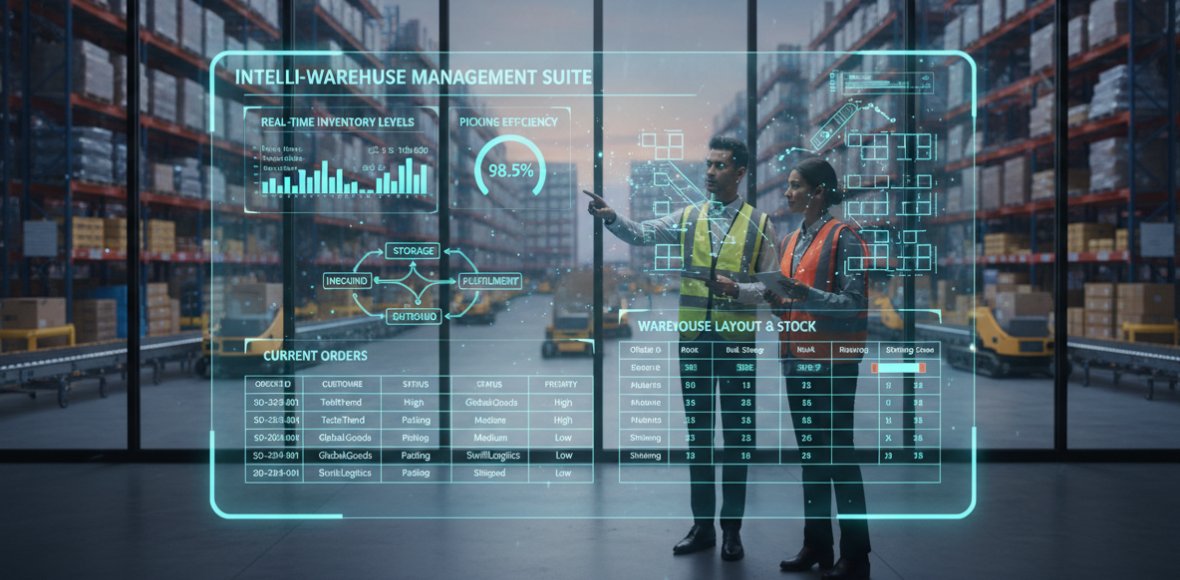


Running a warehouse without a proper system in 2026 is like navigating a city without GPS — possible, but painfully slow and full of costly wrong turns. A Warehouse Management System (WMS) has moved from a luxury to an absolute necessity for businesses that want to stay competitive, reduce errors, and deliver faster.
Whether you are a small e-commerce business managing a single stockroom or a large enterprise running multiple distribution centers, this complete warehouse management system guide will walk you through everything — what a WMS is, how it works, the types available, key features to look for, and how to choose the right one for your business in 2026.
Let us get straight into it.
What Is a Warehouse Management System (WMS)?
A Warehouse Management System (WMS) is a software solution designed to optimize and automate the day-to-day operations of a warehouse. It covers everything from the moment goods arrive at your receiving dock to the moment they leave your shipping bay — and everything in between.
At its core, a WMS gives you real-time visibility into your inventory, helps you manage storage locations, streamlines order picking and packing, and ensures products reach customers accurately and on time.
In 2026, modern WMS platforms go far beyond basic inventory tracking. They integrate with robotics, artificial intelligence (AI), Internet of Things (IoT) sensors, and enterprise resource planning (ERP) systems to create fully intelligent, data-driven warehouse environments.
According to a 2026 Gartner Magic Quadrant report on WMS, buyers are increasingly shifting from basic feature checklists to cloud-native platforms that emphasize usability, adaptability, and rapid time-to-value. This signals just how much the market has matured and how critical the right WMS choice has become.
Why Does Your Business Need a WMS in 2026?
The warehousing industry is under more pressure than ever. Labour shortages are persistent, customer expectations for fast and accurate delivery have reached new highs, and supply chain disruptions — from geopolitical tensions to trade tariffs — continue to create uncertainty.
Here is why investing in a WMS in 2026 makes clear business sense:
- Inventory Accuracy: Manual inventory management leads to errors. A WMS provides real-time stock visibility, reducing discrepancies by up to 99%.
- Faster Order Fulfillment: Automated picking workflows mean orders are processed significantly faster, directly improving customer satisfaction.
- Labour Optimization: WMS software intelligently assigns tasks to workers based on location and priority, reducing unnecessary movement and increasing productivity.
- Cost Reduction: Fewer errors, less overtime, optimized storage space — all of these directly cut operational costs.
- Scalability: As your business grows, a good WMS scales with you — handling more SKUs, more orders, and more warehouse locations without breaking a sweat.
- Data and Reporting: Real-time dashboards give managers actionable insights into performance, bottlenecks, and areas for improvement.
The bottom line is simple: businesses that run lean, automated, data-driven warehouses outperform those that rely on spreadsheets and guesswork. A WMS is the engine that powers that transformation.
Types of Warehouse Management Systems
Not all WMS solutions are created equal. Understanding the different types will help you choose the one that fits your business size, budget, and operational complexity.
1. Standalone WMS
A standalone WMS is a dedicated warehouse management software that operates independently. It is best suited for businesses that have a single warehouse and do not require deep integration with other enterprise systems. While powerful in its core WMS functions, it may lack the broader connectivity that growing businesses need.
2. Cloud-Based WMS
Cloud-based WMS platforms are the fastest-growing segment of the market in 2026. Hosted on the cloud, these systems require no expensive hardware installation and can be accessed from anywhere. They are subscription-based, making them affordable for small and medium businesses. They also receive automatic updates, ensuring you always have access to the latest features and security patches.
Key advantage: Cloud-native WMS platforms can handle distributed workloads and high-concurrency operations — making them ideal for businesses managing multiple warehouses or high order volumes.
3. ERP-Integrated WMS
Large enterprises often choose WMS modules that are integrated directly into their ERP systems such as SAP, Oracle, or Microsoft Dynamics. This provides seamless data flow between warehouse operations, finance, procurement, and sales — giving leadership a single unified view of the entire business.
4. Supply Chain Management (SCM) WMS
These systems go beyond the warehouse walls and integrate with the broader supply chain, connecting suppliers, manufacturers, warehouses, and distributors. They are best suited for businesses with complex, multi-tier supply chains.
Key Features to Look for in a WMS in 2026
With dozens of WMS vendors on the market, knowing what features truly matter is critical. Here are the most important capabilities your WMS should have in 2026:
1. Real-Time Inventory Tracking
This is the foundation of any good WMS. Real-time inventory tracking gives you SKU-level visibility across your entire warehouse, reducing stockouts, overstocking, and misplaced items. Look for systems that support barcode scanning, RFID, and IoT sensor integration.
2. Intelligent Order Picking
A modern WMS optimizes order picking using smart strategies like wave picking, batch picking, and zone picking. The best systems use AI to determine the most efficient picking route, cutting pick time dramatically and reducing picker fatigue.
3. Receiving and Put-Away Automation
When goods arrive, a WMS should automatically validate the shipment against purchase orders, generate put-away instructions, and direct workers or robots to the optimal storage location. This eliminates manual checking and reduces receiving errors.
4. Labour Management
Advanced WMS platforms include built-in labour management tools that track worker productivity, assign tasks intelligently, and identify performance gaps. This is especially valuable in 2026 where warehouse labour costs are high and skilled workers are scarce.
5. AI and Machine Learning Integration
AI-powered WMS systems can forecast demand, predict inventory needs, optimize slotting (the placement of items within the warehouse), and flag potential issues before they cause disruptions. According to Jalasoft’s 2026 WMS trends report, real-time operational intelligence is now a baseline expectation, not a premium feature.
6. Robotics and Automation Compatibility
In 2026, Autonomous Mobile Robots (AMRs), Automated Guided Vehicles (AGVs), and collaborative robots (cobots) are increasingly common in warehouses. Your WMS should be able to communicate with and direct these systems seamlessly.
7. Multi-Channel Fulfillment Support
Modern businesses sell across multiple channels — e-commerce, retail, wholesale. Your WMS should centralize inventory visibility and unify order processing across all channels to avoid overselling and fulfillment confusion.
8. Reporting and Analytics Dashboard
Data without insight is useless. A great WMS provides real-time dashboards with KPIs like order accuracy rate, pick rate, receiving speed, and inventory turnover. These metrics help you make informed decisions quickly.
9. Cloud-Native Architecture
As highlighted in the 2026 Gartner Magic Quadrant for WMS, cloud-native architecture is now a critical evaluation criterion. Ensure the system can scale without performance degradation as your operations grow.
10. Integration Capabilities
Your WMS should integrate seamlessly with your existing ERP, e-commerce platforms (Shopify, WooCommerce, Magento), shipping carriers, and supplier systems. Poor integration is one of the most common causes of WMS implementation failure.
How to Choose the Right WMS for Your Business
Choosing the right WMS is not just about picking the most feature-rich solution. It is about finding the right fit for your specific business needs, budget, and growth plans. Here is a step-by-step approach:
Step 1: Assess Your Current Pain Points
Before evaluating any software, document the specific problems you are trying to solve. Is it inventory accuracy? Slow order fulfillment? High labour costs? Your pain points should drive your requirements list.
Step 2: Define Your Budget
WMS pricing ranges from affordable cloud subscriptions (starting around $100–$300/month for small businesses) to enterprise-grade implementations that can cost hundreds of thousands of dollars. Be realistic about your budget and factor in implementation, training, and ongoing support costs.
Step 3: Evaluate Scalability
Will this system still work for you in three to five years? Choose a WMS that can grow with your business — handling more orders, more SKUs, and more warehouse locations without requiring a complete system overhaul.
Step 4: Check Integration Compatibility
Verify that the WMS integrates with all your existing tools — your ERP, your e-commerce platform, your shipping carriers, and any automation equipment you use or plan to use.
Step 5: Request a Demo and Trial
Never commit to a WMS without seeing it in action. Request a live demo tailored to your warehouse workflows, and if possible, run a pilot with a small team before full deployment.
Step 6: Evaluate Vendor Support
A WMS implementation is not a one-time event — it is an ongoing partnership. Choose a vendor with a strong track record of customer support, regular software updates, and a clear product roadmap.
WMS Implementation: Common Challenges and How to Overcome Them
Even the best WMS can fail if implementation is poorly managed. Here are the most common challenges and practical solutions:
- Data Migration Issues: Moving from manual systems or legacy software can lead to data errors. Solution: Conduct a thorough data audit and cleanse before migration. Use phased migration where possible.
- Staff Resistance: Workers comfortable with old processes often resist new systems. Solution: Involve warehouse staff early in the process, provide comprehensive training, and communicate the benefits clearly.
- Integration Complexity: Connecting WMS with existing ERP or e-commerce systems can be technically challenging. Solution: Work with a vendor that has proven integration experience with your specific tech stack.
- Underestimating Timelines: WMS implementations often take longer than expected. Solution: Build a realistic implementation roadmap with buffer time for unexpected issues.
The Future of Warehouse Management Systems
Looking beyond 2026, several trends are shaping where WMS technology is headed:
- Composable WMS Architecture: Businesses want flexible, modular systems they can customize without expensive custom development. Composable WMS platforms are gaining significant traction.
- Sustainability-Driven Warehousing: Environmental pressure is pushing warehouses to optimize energy usage, reduce packaging waste, and track carbon footprints — features that leading WMS platforms are beginning to incorporate.
- Autonomous Warehouses: The concept of fully automated, self-managing warehouses — where AI, robotics, and WMS work together with minimal human intervention — is moving from concept to reality in leading logistics operations.
- Voice and Wearable Technology: Voice-directed picking and wearable devices like smart glasses are being integrated with WMS to give workers hands-free access to real-time instructions.
Final Thoughts
A Warehouse Management System is no longer a nice-to-have — it is the operational backbone of any business serious about competing in 2026 and beyond. The right WMS eliminates waste, empowers your team, satisfies your customers, and gives you the data you need to make smarter decisions every single day.
Whether you are evaluating your first WMS or considering an upgrade from a legacy system, the key is to start with your business needs, evaluate vendors carefully, and treat implementation as a strategic investment — not just a software purchase.
The warehouses winning today are the ones that have made that investment. Now it is your turn.