Hollywood Walk of Fame Location Map & Visitor Guide

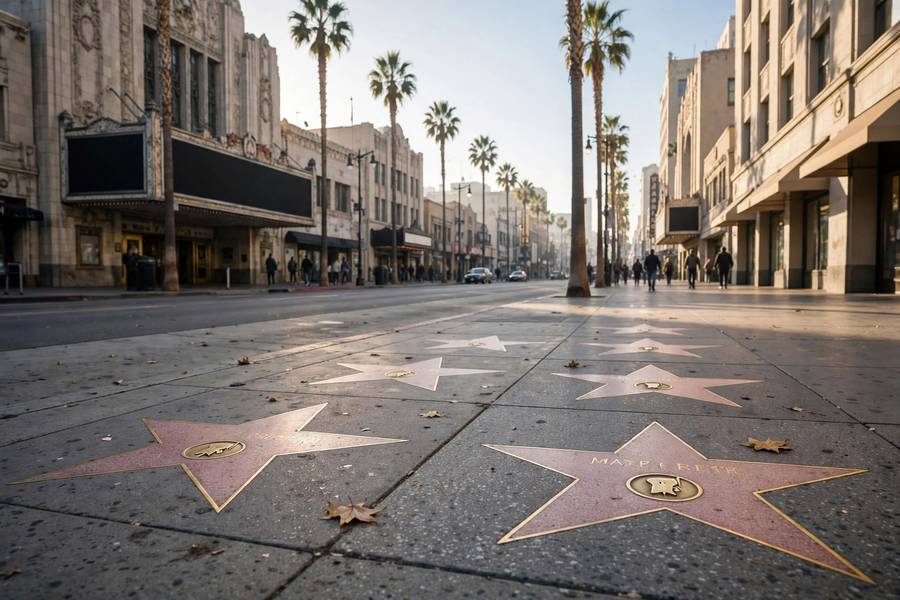
People search for a “Hollywood Walk of Fame location map” because they’re standing somewhere in Los Angeles, slightly lost, wondering if they’re close. So let me save you the trouble: here’s exactly where the Walk is, how it’s laid out, how to navigate it like someone who’s done it before, and how to get there without paying $40 for parking or getting fleeced by a guy in a Batman costume.
I’ve walked every block of this thing, in every direction, at every hour. This is the practical guide — the map in words, plus the logistics that actually matter.
In this guide:
- Where Exactly Is the Walk of Fame?
- The Layout: Boulevard, Blocks, and the Vine Street Stretch
- Getting There: Metro, Driving, and Parking
- A Sensible Walking Route
- What to Combine It With Nearby
- Street-Smart Tips (Read This Part)
- How Star Addresses Work
In this article
Where Exactly Is the Walk of Fame?
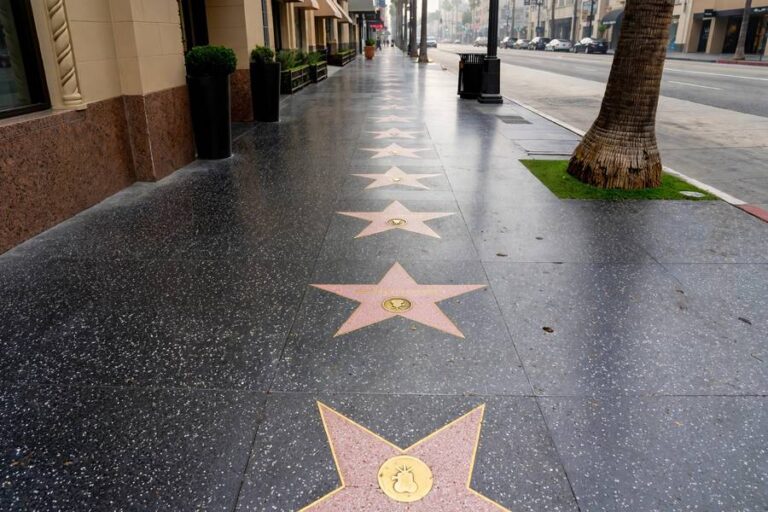
The Hollywood Walk of Fame runs along Hollywood Boulevard in the Hollywood district of Los Angeles, California, with an additional stretch down Vine Street. The main span covers fifteen blocks of Hollywood Boulevard — roughly from Gower Street in the east to La Brea Avenue in the west — plus three blocks of Vine Street, running south from Hollywood Boulevard toward Sunset.
The total length is about 1.3 miles. If you’re picturing a compact little tourist plaza, adjust your expectations: this is a working city sidewalk through a real, chaotic, magnificent neighborhood. The densest and most famous section sits around the intersection of Hollywood Boulevard and Highland Avenue, home to the TCL Chinese Theatre, the Dolby Theatre, and the Hollywood & Highland complex.
For navigation purposes, the address range runs roughly from 6200 to 7400 Hollywood Boulevard. The stars you’ll most want to see cluster between the 6700 and 7100 blocks — that’s the golden zone.
The Layout: Boulevard, Blocks, and the Vine Street Stretch
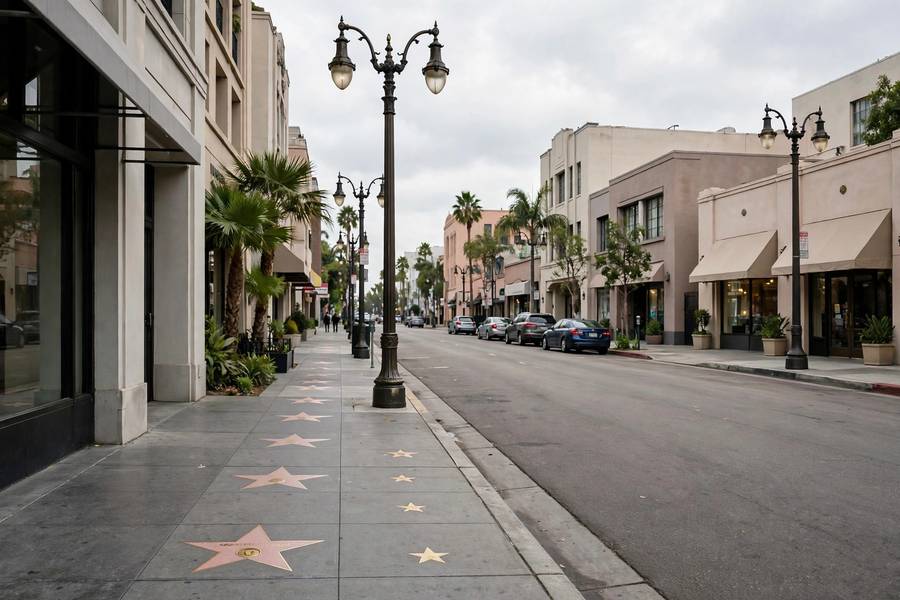
Think of the Walk as a long, slightly uneven line with a short tail. The boulevard section is the main event: stars line both sides of the street, and they face in both directions, so you’ll want to zigzag rather than sticking to one sidewalk. Some visitors walk one side going west and the other side coming back east. That’s the pro move.
The Vine Street section is shorter and quieter — three blocks running south from Hollywood Boulevard. It has its own character: fewer crowds, more classic radio and recording stars, and the four round Apollo 11 monuments at Hollywood and Vine, which mark the only non-entertainment honorees on the Walk. Most tourists never make it down Vine. Their loss.
One thing that confuses first-timers: the stars aren’t in any meaningful order. They’re not alphabetical, not chronological, not ranked by fame. Placement is essentially “wherever there was space when the star was installed,” which means Marilyn Monroe and a 1970s game show host can be neighbors. The randomness is part of the charm — every block is a mixtape.
Getting There: Metro, Driving, and Parking
Take the Metro (seriously)
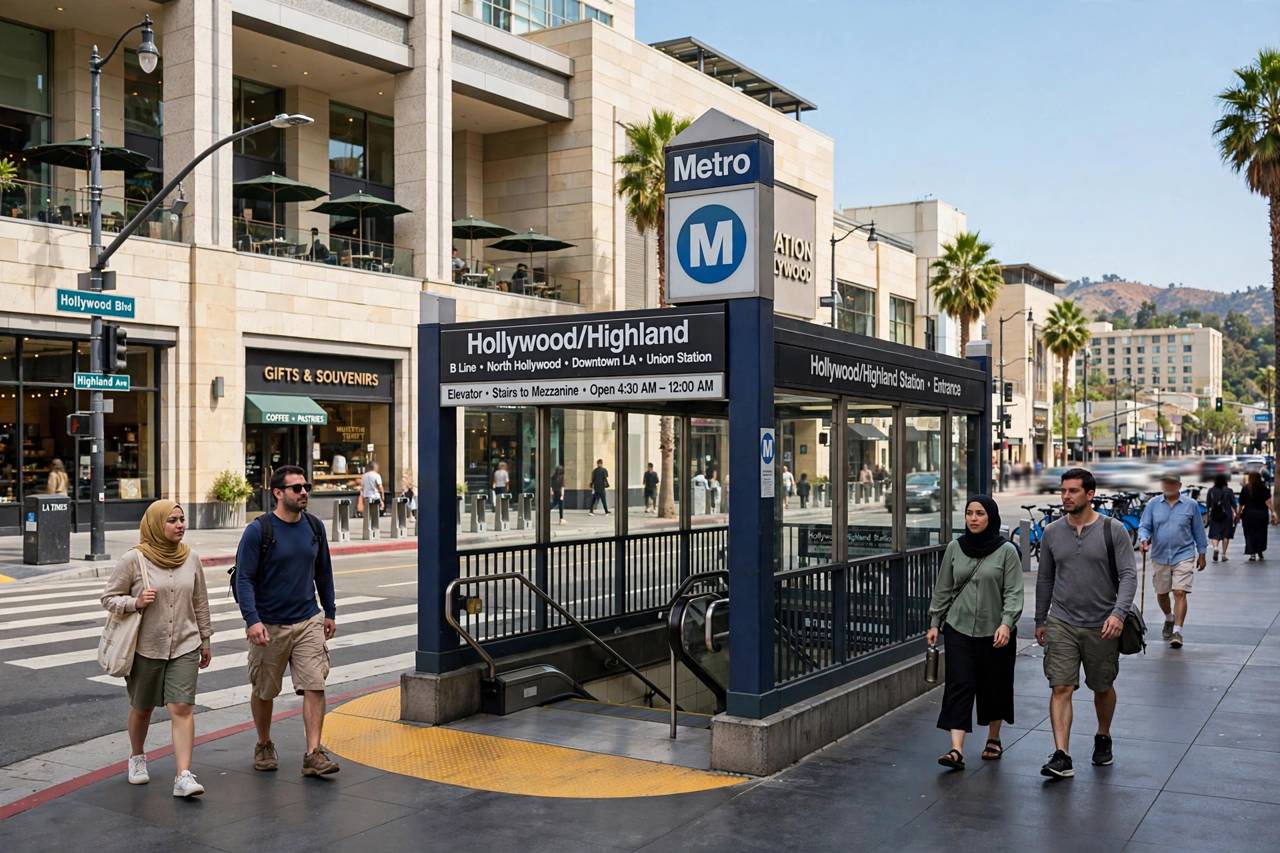
The Los Angeles Metro B Line (the Red Line) has two stations directly on the Walk: Hollywood/Highland and Hollywood/Vine. They drop you in the middle of the stars, no parking required, no traffic endured. If you’re staying anywhere near a Metro station, this is the obviously correct choice. I’ve done the drive-vs-train math many times. The train wins.
Driving and parking
If you must drive, aim for a parking garage, not street meters. The Hollywood & Highland complex has a large garage that’s expensive but predictable; there are cheaper lots a block or two off the boulevard. Street meters are aggressively enforced and time-limited — the classic tourist mistake is a $70 ticket earned while hunting for a free star. Don’t be that tourist.
Rideshare
Uber and Lyft work fine; get dropped at Hollywood & Highland and start walking from there. It’s the natural trailhead for the whole experience.
A Sensible Walking Route
Here’s the route I’d give a friend with two to three hours:
Start at Hollywood & Highland. See Muhammad Ali’s wall-mounted star inside the complex (the only one you look up at, not down at), then head east along Hollywood Boulevard toward the TCL Chinese Theatre. This is the densest, most star-packed stretch — Michael Jackson, Marilyn Monroe territory.
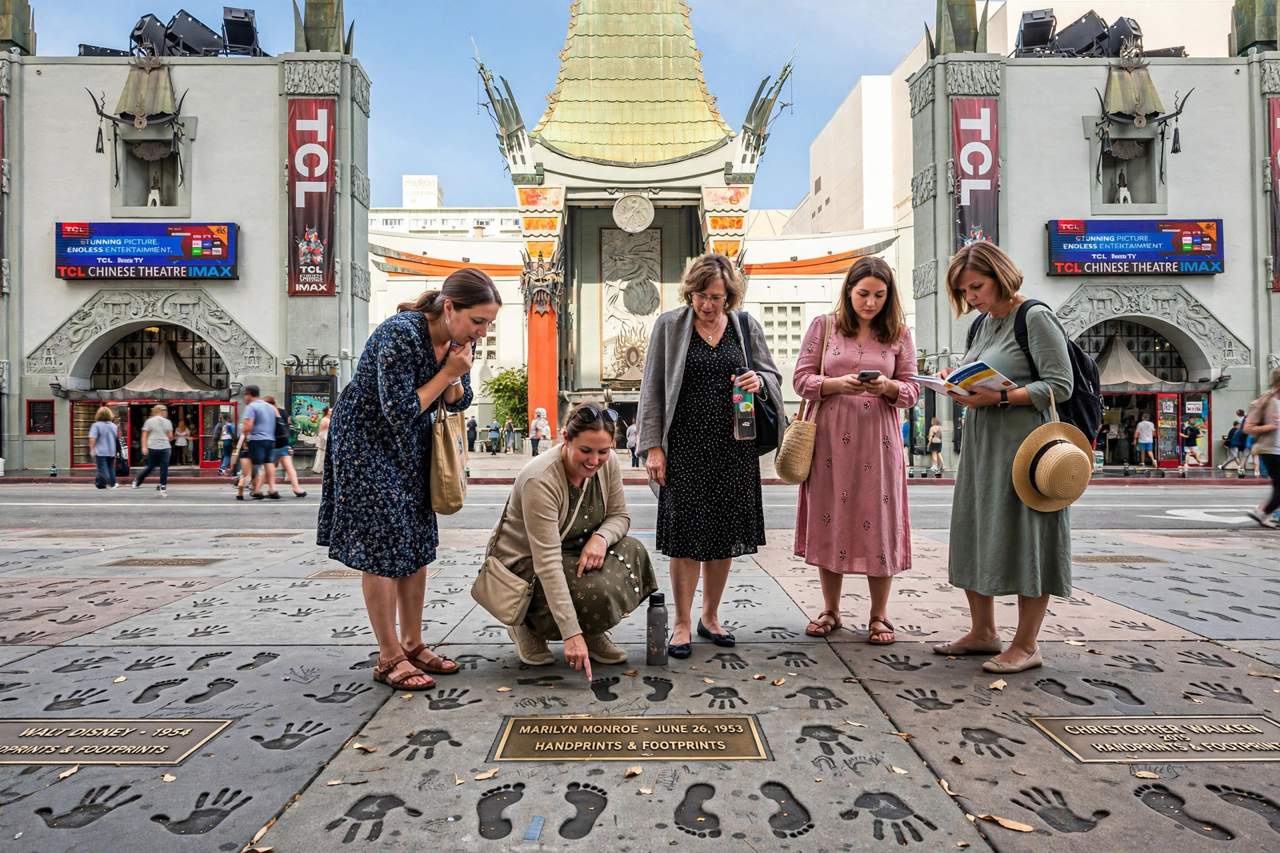
Pause at the Chinese Theatre forecourt. It’s technically separate from the Walk of Fame, but the handprints and footprints in cement are the natural companion attraction. Budget twenty minutes. It’s touristy and wonderful.
Continue east to the 6700 block. This is golden-age country — the 1960 originals, the legends. Then cross to the other side of the street and work your way back west. Zigzagging is the whole strategy; the stars face both directions and you’ll miss half of them if you stay on one sidewalk.
Head west to the 7000 block. Walt Disney, Tom Hanks, Meryl Streep — the 7000s are prestige territory. This stretch is slightly calmer and great for photos.
Finish down Vine Street. Walk south from Hollywood and Vine for the quieter three blocks: radio stars, recording legends, and the Apollo 11 circles. Then hop on the Metro at Hollywood/Vine and call it a day.
Total walking: about 1.3 miles of stars, plus whatever zigzagging you do. Wear real shoes. Bring water. The boulevard in summer is no joke.
What to Combine It With Nearby
The Walk is a half-day, not a full day. Pair it wisely:
TCL Chinese Theatre tours run regularly and take you inside one of the great movie palaces. The Dolby Theatre (home of the Oscars) offers tours too. The El Capitan, Disney’s flagship theater, still does the full showbiz treatment with organ performances before films.
Madame Tussauds Hollywood sits right on the boulevard for the wax-figure crowd. The Hollywood Museum, in the old Max Factor building, is the sleeper pick — genuinely great Hollywood history without the crowds.
And if you want the view, the Hollywood & Highland complex has a terrace with a straight-on sightline to the Hollywood Sign. It’s the best free Sign photo in the neighborhood, and hardly anyone knows about it.
Street-Smart Tips (Read This Part)
Go on a weekday morning. The boulevard before noon is a different place — thinner crowds, better light, visible stars. By Saturday afternoon it’s a contact sport.
The costumed characters charge for photos. The Spider-Men, Elmos, and Batmen on the boulevard are working for tips — agree on a price before the photo, not after. Or just smile and keep walking. The Walk itself is free; the characters are a separate economy.
Street “tour” sellers vary wildly. Some are fine; some are hustles. You don’t need one for the Walk — it’s a sidewalk, and this guide plus the official star search is all the navigation you need.
Keep your expectations about the neighborhood honest. Parts of the boulevard are gritty. That’s been true for fifty years and it’s part of what makes the place real. Stay aware, stay on the main stretch, and you’ll be fine.
Use the official star search. The Walk’s official site has a searchable directory of every star with addresses. Pick your must-sees in advance and hunt them down — it turns a wander into a treasure hunt.
For the full backstory on what you’re walking on — the history, the categories, the $85,000 fee — read what the Hollywood Walk of Fame is. To understand the neighborhood that built it, what Hollywood is fills in the rest. And if the celebrity homes you’ve seen on TV have you curious, celebrity houses covers where the stars go when they leave the boulevard.
How Star Addresses Work
A quick primer on the numbering, because it confuses everyone: Hollywood Boulevard addresses run east to west, roughly 6200 to 7400 across the Walk’s span. Even numbers on one side, odd on the other — standard Los Angeles grid. The stars face both directions, so a star “at” 6800 might be on either sidewalk.
What trips people up is that the addresses are approximate by nature. Stars get added where there’s space, so the numbering isn’t a perfect sequence — you might find 6927 next to 6925 with a gap where a storefront interrupts the run. Don’t navigate by counting doors. Navigate by block, then look down.
The most reliable tool is the official Walk of Fame star search on the Chamber’s website: type a name, get the address, walk to the block, and start scanning the sidewalk. For the mega-famous names, you’ll spot the crowd before you spot the star — a cluster of people taking photos is the boulevard’s most reliable landmark.
One more insider note: some stars sit directly in front of major landmarks (the Chinese Theatre forecourt area, the Dolby Theatre entrance), which makes them easy. Others are on quieter blocks where you can actually stand and look without being jostled. Both experiences are worth having. The famous ones give you the photo; the quiet ones give you the moment.
Frequently Asked Questions
It spans fifteen blocks of Hollywood Boulevard (roughly Gower Street to La Brea Avenue) plus three blocks of Vine Street, totaling about 1.3 miles. The most visited section is around Hollywood Boulevard and Highland Avenue.
The Metro B Line stops right on the Walk at Hollywood/Highland and Hollywood/Vine. It’s the easiest way to get there — no parking needed.
The full 1.3 miles takes 30-40 minutes at a steady pace, but plan two to three hours if you’re actually stopping to find stars, take photos, and zigzag between both sides of the street.
Yes — it’s a public sidewalk, open 24/7. You’ll pay for parking, food, and photos with costumed characters, but the stars themselves are free.
The official Walk of Fame website has a searchable star directory with addresses. Third-party walking-tour apps also map popular stars, but the official directory is the most reliable.