
LLC vs sole proprietorship — it’s the first structural decision most new business owners face, and I watch people overthink it constantly. After years advising small businesses, here’s my honest take: for most people, the answer is clear once you understand what each structure actually does. The confusion comes from treating it as a complicated legal question when it’s really a practical risk-and-cost question.
Let me lay out the real pros and cons — not the legal textbook version, the version that matters when it’s your money on the line.
Note: I’m a business advisor, not a lawyer. This is general information for decision-making, not legal advice. For your specific situation, talk to a business attorney — a one-hour consultation is cheap insurance.
Contents
- The One-Paragraph Difference
- Sole Proprietorship: Pros
- Sole Proprietorship: Cons
- LLC: Pros
- LLC: Cons
- Side-by-Side Comparison
- The Liability Question (The Real Decider)
- The Tax Question
- The Cost Question
- When Sole Proprietorship Makes Sense
- When LLC Makes Sense
- My Recommendation
The One-Paragraph Difference
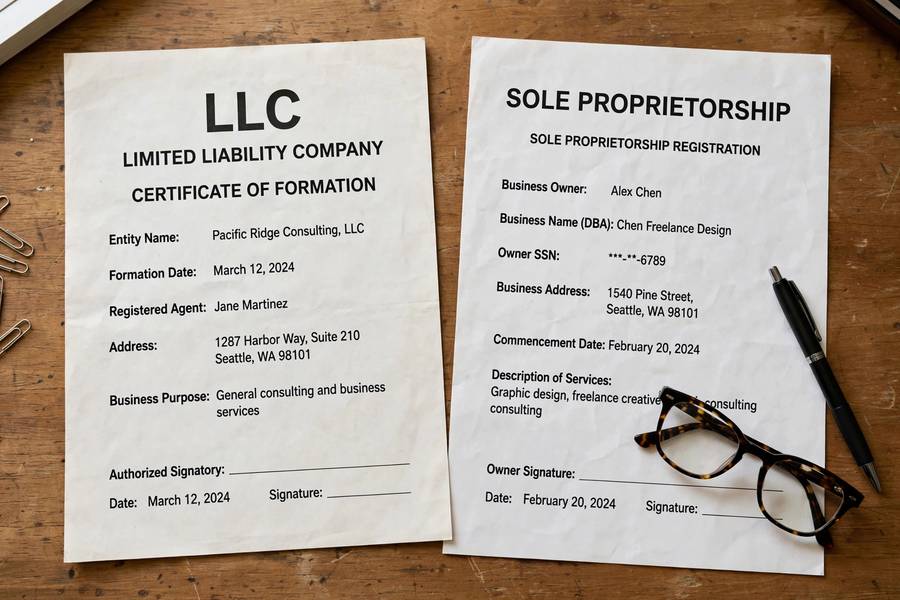
A sole proprietorship is the default: you are the business. No registration, no separation — your personal assets and business liabilities are the same pool. An LLC (Limited Liability Company) creates a legal entity separate from you. The business’s debts and lawsuits generally can’t touch your personal assets (house, savings, car), in exchange for some paperwork and ongoing costs.
That’s the whole game: separation costs money; non-separation costs risk.
Sole Proprietorship: Pros
1. Zero setup cost and effort. You don’t file anything (beyond local business licenses). Start today, no paperwork, no waiting, no fees. For testing an idea, this frictionless start has real value.
2. Simplest taxes. Business income goes on your personal return (Schedule C). No separate business tax return, no payroll requirements for yourself, no additional filings. Your accountant (if you even need one yet) charges less.
3. Total control, no formalities. No operating agreement, no annual meetings, no minutes, no state compliance calendar. You make every decision without documenting it.
4. Easy to close. Done with the business? Stop operating. No dissolution filings, no wind-down formalities.
5. Lowest ongoing cost. No annual state fees, no registered agent fees, no compliance costs. Your overhead is essentially zero beyond normal business expenses.
Sole Proprietorship: Cons
1. Unlimited personal liability. This is the big one. If the business is sued or can’t pay its debts, creditors can go after your personal assets — your house, your savings, your car. There’s no wall between business problems and personal life.
2. Harder to raise money or get credit. Banks and investors strongly prefer dealing with formal entities. Business loans are harder; business credit cards may require personal guarantees anyway (reducing the point).
3. Less credibility with some clients. Enterprise clients, government contracts, and larger partners often require vendors to be formal entities. “Sole proprietor” on a proposal can cost you deals — fairly or not, it signals “small.”
4. No continuity. The business legally ends if you stop, become incapacitated, or die. There’s no entity to sell, transfer, or continue.
5. All income subject to self-employment tax. Every dollar of profit gets hit with self-employment tax (Social Security + Medicare) on top of income tax. LLCs can elect S-Corp taxation later to reduce this; sole proprietors can’t without converting.
LLC: Pros
1. Limited liability protection. The headline benefit: the LLC is a separate legal entity. Business debts and lawsuits are generally contained within the LLC — your personal assets are protected. (With caveats — see below.)
2. Credibility. “LLC” after your business name signals legitimacy to clients, vendors, landlords, and banks. It opens doors that sole proprietorship doesn’t — commercial leases, business bank accounts, vendor terms.
3. Tax flexibility. By default, a single-member LLC is taxed like a sole proprietorship (pass-through, no double tax). But you can elect S-Corp or C-Corp taxation later if it benefits you — an option sole proprietors don’t have without restructuring.
4. Separation of finances. The LLC structure forces (and protects) the separation of business and personal money — which is better bookkeeping, cleaner taxes, and stronger liability protection.
5. Continuity and transferability. The LLC exists independently of you. You can sell it, bring in partners, transfer ownership, or continue it indefinitely. It’s a real asset, not just “you doing business.”
6. Easier to bring in partners or investors. Ownership interests (membership units) can be issued, transferred, and documented. Try doing that as a sole proprietor — you can’t, cleanly.
LLC: Cons
1. Formation costs. State filing fees range from $50 to $500+ depending on state. Some states (California’s $800 annual franchise tax, I’m looking at you) are expensive ongoing. Formation services add $50–$300+ if you don’t DIY.
2. Ongoing compliance. Annual reports, state fees, registered agent requirements (yourself or a paid service, $100–$300/year). Miss filings and the state can dissolve your LLC — losing the protection you paid for.
3. More paperwork. Operating agreement (strongly recommended even for single-member), separate bank accounts (mandatory for protection), annual minutes (good practice). None of it’s hard, but it’s real overhead.
4. Liability protection isn’t absolute. The “corporate veil” can be pierced if you commingle funds, commit fraud, or personally guarantee debts (which landlords and banks routinely require from small LLCs). Protection requires discipline.
5. Self-employment tax still applies by default. A single-member LLC doesn’t automatically save on taxes — it’s taxed like a sole proprietorship unless you elect otherwise. The S-Corp election that reduces self-employment tax comes with payroll requirements and complexity.
Side-by-Side Comparison
| Sole Proprietorship | LLC | |
|---|---|---|
| Setup cost | $0 | $50–$500+ |
| Setup time | Immediate | Days to weeks |
| Liability protection | None | Yes (with discipline) |
| Ongoing state fees | None | $0–$800+/year by state |
| Tax filings | Schedule C on personal return | Same by default (pass-through) |
| Tax flexibility | None | Can elect S-Corp/C-Corp |
| Credibility | Lower | Higher |
| Raising capital | Difficult | Easier |
| Formalities | None | Operating agreement, annual reports |
| Closing down | Just stop | Dissolution filing |

The Liability Question (The Real Decider)
Let me be blunt: liability is the reason to form an LLC, and for most businesses, it’s reason enough.
Ask yourself: could my business hurt someone or owe someone significant money?
- Customers on your premises? Slip-and-fall = lawsuit.
- Selling products? Defect or injury = lawsuit.
- Employees? Workplace injury, disputes = liability.
- Contracts with real money? Breach = damages.
- Professional advice? Bad advice = professional liability.
- Driving for business? Accident = liability.
If you answered yes to any of these, the LLC’s protection is worth far more than its cost. One lawsuit — even one you win — costs more in legal fees than a lifetime of LLC filing fees.
If you’re freelancing from your laptop with no employees, no premises, and no product liability — a writer, designer, consultant working remotely — the practical risk is lower. Many start as sole proprietors and convert when revenue or risk grows. That’s reasonable.
But understand the caveats: the LLC doesn’t protect you from your own negligence (if you personally cause harm, you’re personally liable regardless of structure), from debts you personally guarantee, or from tax obligations. And protection requires discipline — separate bank accounts, no commingling, proper records. An LLC you treat like a sole proprietorship won’t protect you like one.
The Tax Question
Here’s what surprises people: by default, there’s no tax difference. A single-member LLC is a “disregarded entity” for federal tax purposes — the IRS treats it exactly like a sole proprietorship. Same Schedule C, same self-employment tax, same pass-through.
The tax advantage of an LLC is optionality:
– S-Corp election: Once you’re consistently profitable (roughly $60,000+ in owner profit), electing S-Corp taxation lets you pay yourself a reasonable salary (subject to payroll tax) and take the rest as distributions (not subject to self-employment tax). The savings can be thousands per year — but it requires running payroll and filing a separate return.
– C-Corp election: Rare for small businesses, but available.
Don’t form an LLC for tax savings — form it for liability protection, and treat the future tax flexibility as a bonus. And talk to an accountant before making any tax election; the “reasonable salary” rules and payroll requirements have real compliance costs.
The Cost Question
Real numbers:
Sole proprietorship: $0 to start. $0/year ongoing (beyond normal business costs and local licenses).
LLC (DIY):
– Formation: $50–$500 (state filing fee)
– Registered agent: $0 (yourself) or $100–$300/year (service)
– Annual state fees: $0–$800/year (varies wildly by state)
– Operating agreement template: $0–$100
– Year 1 total: $50–$1,200. Ongoing: $0–$1,100/year.
LLC (formation service): Add $50–$300+ for the service. Worth it if you want it done right without researching your state’s quirks — see my best LLC formation services breakdown and the LLC formation services guide for the details.
The cost is trivial compared to the protection for any business with real risk. It’s not trivial if you’re testing a side hustle with $200 in revenue — in which case, start as a sole proprietor and convert when it’s real.
When Sole Proprietorship Makes Sense
- Testing a business idea (revenue under a few thousand, validating)
- Freelancing/consulting with no employees, no premises, minimal liability exposure
- Side hustle alongside a full-time job
- Very low revenue where LLC fees would be a meaningful percentage of income
- You’re planning to convert to LLC within the year once validated
When LLC Makes Sense
- Any business with customers on premises, products sold, or employees
- Revenue that’s real and growing (rule of thumb: $10,000+/year or any meaningful risk)
- Signing leases, large contracts, or taking on business debt
- Bringing in partners or planning to seek investment
- You want the credibility with clients and vendors
- Basically: any real business that’s past the “testing” phase
My Recommendation
Here’s my advisor’s default: start as a sole proprietor to validate, convert to LLC when it’s real. “Real” means consistent revenue, real customers, or any meaningful liability exposure — whichever comes first.
The mistake I see most isn’t choosing wrong — it’s never choosing. People operate as accidental sole proprietors for years, exposed, because forming an LLC felt like a big step. It’s not. It’s a few hundred dollars and an afternoon. If your business has survived validation, the LLC is the cheapest insurance you’ll ever buy.
And the second most common mistake: forming the LLC and then commingling funds — paying personal bills from the business account, skipping the operating agreement, ignoring annual filings. An LLC on paper with sole-proprietor habits gives you the costs of both and the protection of neither. If you form it, run it right: separate accounts from day one, document major decisions, file on time.
Start with the fundamentals in how to start a business if you’re still in the planning phase. When you’re ready to form, my best LLC formation services guide compares the options, and the LLC formation services guide walks through the process step by step.

Frequently Asked Questions
For most real businesses, LLC — the liability protection alone justifies the modest cost. Sole proprietorship works for testing ideas and very low-risk freelancing. The practical rule: validate as a sole proprietor, convert to LLC when revenue or risk becomes real.
By default, no — a single-member LLC is taxed identically to a sole proprietorship. The advantage is flexibility: an LLC can elect S-Corp taxation later (typically worthwhile above ~$60,000 in owner profit) to reduce self-employment taxes.
Sole proprietorship: $0. LLC: $50–$500 in state filing fees plus $0–$800/year in ongoing state fees depending on your state, plus optional registered agent service ($100–$300/year). First-year total is typically $50–$1,200.
Yes — and it’s the recommended path. Form the LLC, transfer business assets and contracts to it, get a new EIN, and update licenses and accounts. Many founders validate as sole proprietors and convert once the business is real.
Generally yes for business debts and lawsuits — but not for your own personal negligence, debts you personally guarantee, or tax obligations. Protection also requires discipline: separate bank accounts, no commingling, proper records. An LLC treated like a sole proprietorship won’t protect you.