
An LLC operating agreement template is the document most founders skip — and the one they most regret skipping. I’ve watched partnerships dissolve into five-figure legal disputes that a free template would have prevented. It’s your LLC’s rulebook: who owns what, who decides what, and what happens when things change.
This guide covers the 12 sections every agreement needs, where to find solid templates, and the mistakes that turn a good template into a useless one.
Note: I’m a business advisor, not a lawyer. This is general information — not legal advice, and not a substitute for attorney review in complex situations.
Contents
- What an Operating Agreement Is (and Is Not)
- Do You Legally Need One
- The 12 Sections Every Agreement Needs
- 1 Formation and Name
- 2 Ownership and Membership Interests
- 3 Capital Contributions
- 4 Profit and Loss Distribution
- 5 Management and Voting
- 6 Member Roles and Responsibilities
- 7 Adding New Members
- 8 Transferring Ownership
- 9 Dissolution and Exit
- 10 Dispute Resolution
- 11 Books Records and Tax Matters
- 12 Amendments and Miscellaneous
- Single-Member vs Multi-Member: What Changes
- Where to Find Templates
- Template Mistakes That Void the Value
- When to Pay for an Attorney
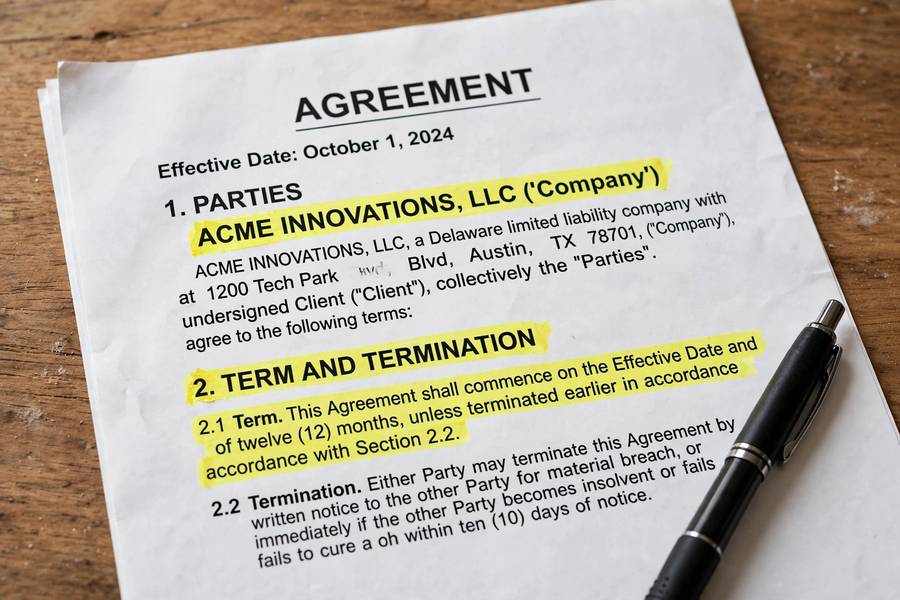
What an Operating Agreement Is (and Is Not)
It is: A binding internal contract between members governing how your LLC operates — ownership, management, finances, and procedures.
It is not: filed with the state (it stays internal, unlike the Articles of Organization); a public document (sensitive terms go here precisely because members-only); or set in stone (amend it as the business evolves).
Think of it this way: the Articles of Organization create the LLC; the operating agreement runs it.
Do You Legally Need One
Legally required in California, Delaware, Maine, Missouri, and New York (specifics vary). Everywhere else: not required, but strongly recommended — for two reasons. First, liability protection: the agreement evidences that your LLC is a real separate entity, which courts look for before “piercing the corporate veil.” Second, default rules are bad: without an agreement, generic state statutes govern — in some states splitting profits equally regardless of ownership percentage. Imagine owning 80% and splitting 50/50 because you skipped the paperwork.
My rule: Single-member? A template takes 30 minutes and strengthens your shield. Multi-member? Non-negotiable — before money moves.
The 12 Sections Every Agreement Needs
1 Formation and Name
The basics: the LLC’s legal name (exactly as filed with the state), formation date, state of formation, registered agent, principal address, and business purpose. Also specify duration (usually perpetual) and the agreement’s effective date.
2 Ownership and Membership Interests
Who owns what percentage — in writing, not verbally. “We’re 50/50 partners” said out loud has caused more disputes than any other sentence in small business. Specify each member’s name and ownership percentage (or units/shares), plus an initial membership ledger for multi-member LLCs.
Critical: Ownership percentage and profit distribution don’t have to match — but if they differ, say so explicitly (see section 4). Ambiguity here is where partnerships die.
3 Capital Contributions
What each member put in: cash, property, equipment, or services (“sweat equity”). Specify initial contributions per member (with property appraised), whether future capital calls can be required (and what happens if a member can’t pay), and whether contributions earn interest.
The sweat equity trap: If one partner contributes $50,000 cash and the other contributes “full-time work,” value that work explicitly — amount, timeline, and what happens if the work stops. Undefined sweat equity is the #1 founder dispute I see. Put a number on it.
4 Profit and Loss Distribution
How money gets split: pro-rata by ownership (simplest, most common) or custom splits (different from ownership — must be explicit). Also specify distribution timing (quarterly? annually? at managers’ discretion?) and loss allocation (usually mirrors profits).
Don’t skip the tax distribution clause: LLC members owe tax on profits whether distributed or not. If the LLC earns $200,000 but distributes nothing (reinvesting in growth), members still owe tax on their share. A tax distribution provision requires the LLC to distribute enough to cover members’ tax bills. Without it, members pay tax on money they never received — the clause founders forget and regret.
5 Management and Voting
Who runs the day-to-day, and who decides big things. Two structures: member-managed (all members participate — works for small LLCs where everyone is active) and manager-managed (members appoint managers to run the business — better for passive investors or larger LLCs).
Specify: the management structure; voting thresholds (simple majority vs. supermajority vs. unanimous consent — and which decisions require which); which decisions need member approval (selling major assets, debt above $X, admitting members, dissolving); and how managers are appointed, removed, and compensated.
My advice: Reserve unanimous consent for existential decisions (dissolution, selling the business, admitting members). Requiring unanimity for routine decisions gives every member veto power — one disagreeable member can paralyze the business.
6 Member Roles and Responsibilities
Who does what — critical when contributions or roles are uneven. Specify each member’s responsibilities, time commitment expectations (full-time? part-time?), compensation for services (salary, guaranteed payments, or sweat equity credit), and authority limits (who can sign contracts, spend above what threshold, hire and fire).
The “we’ll figure it out” fallacy: Every partnership starts with goodwill and vague roles. Then one person works 60-hour weeks while the other “handles strategy” from the golf course. Define roles now, while you’re friends.

7 Adding New Members
How new owners join: approval threshold (usually unanimous or supermajority), buy-in valuation method (pre-agreed formula, independent appraisal, or negotiation — decide now, not during the event), and vesting (immediate vs. over time — vesting protects existing members if the new person doesn’t work out). Without this section, adding a partner later means renegotiating everything under pressure.
8 Transferring Ownership
What happens when a member wants out (or has to leave): right of first refusal (remaining members get first dibs before external offers); valuation — how the buyout price is calculated (book value, earnings multiple, independent appraisal, or pre-agreed formula — pick the method now; this is the single most disputed term in LLC breakups); payment terms (lump sum or installments, timeline, interest); involuntary transfers (death, disability, divorce, bankruptcy — yes, divorce: without buyout provisions, a member’s ex-spouse can become a part-owner); and non-compete/non-solicitation terms for departing members (keep scope reasonable — courts won’t enforce overbroad restrictions).
This section is the agreement’s highest-value part. Most LLC disputes are exit disputes. A clear buyout formula turns a potential lawsuit into an arithmetic problem.
9 Dissolution and Exit
How the LLC ends: triggering events (unanimous vote, specific date, departure of key members), the wind-down process and debt-payment order, and the distribution waterfall (creditors first, then member capital accounts, then remaining profits per ownership). Nobody wants to think about this at formation — but it’s far easier to agree on the ending while you’re optimistic than while you’re angry.
10 Dispute Resolution
How disagreements get resolved: an escalation path (discussion → mediation → arbitration → litigation, each step more expensive than the last), binding arbitration preference (faster, cheaper, and private versus court), deadlock provisions for 50/50 splits (buy-sell clause, rotating decision authority, or third-party tiebreaker — pick one), and whether the loser pays the winner’s attorney’s fees.
The deadlock killer: 50/50 partnerships without a deadlock provision are the most dangerous structure in small business — one disagreement means total paralysis. If you’re 50/50, this section isn’t optional; it’s survival.
11 Books Records and Tax Matters
The administrative backbone: fiscal year and accounting method (cash vs. accrual), record-keeping requirements and member access rights, how tax elections are decided (S-Corp election requires member consent — specify the threshold), who serves as tax matters member for IRS correspondence, and financial reporting frequency to members.
Boring? Yes. Important? Enormously — especially the tax provisions, which have real financial consequences for every member.
12 Amendments and Miscellaneous
The catch-all: amendment procedure (usually supermajority or unanimous — don’t make the rules too easy to rewrite), entire-agreement clause (this document supersedes all prior discussions, killing “but you promised…” claims), severability (if one clause is invalid, the rest survives), governing law, and signatures with dates. Unsigned agreements are worthless — every member signs, and everyone keeps copies.
Single-Member vs Multi-Member: What Changes
Single-member: Still need it (liability protection and formalities), but simpler. Focus on formation details, 100% ownership, management, dissolution, and succession (what happens to the LLC if something happens to you — name a successor). Most formation services include a solid single-member template.
Multi-member: Everything above in full. The critical sections are ownership, capital contributions (especially sweat equity), profit distribution (especially tax distributions), management/voting, transfer restrictions, buyout formulas, and dispute resolution. This is where attorney review earns its fee.
Where to Find Templates
Free/cheap sources: Your formation service (most include a state-tailored template with formation packages — start here); SCORE (score.org) for free templates plus mentoring; state bar associations (some publish free LLC templates); low-cost providers like LawDepot or eForms ($30–$50) with state-specific options.
What to look for: State-specific (LLC law varies), recently updated, comprehensive (all 12 sections above), from a reputable source. Red flags: no tax distributions, no buyout formula, no dispute resolution, not state-specific. If it’s two pages long, it’s not an operating agreement — it’s a wish.
Template Mistakes That Void the Value
- Downloading but never customizing. Blanks unfilled or “[INSERT NAME]” still in the text is embarrassing in a dispute — and possibly unenforceable.
- Not signing it. The most common mistake. An unsigned agreement is a draft, not a contract.
- Filing it with the state. It’s internal — filing makes private terms public for no benefit.
- Never updating it. Ownership changed? New member? Update the agreement. Outdated agreements are liabilities.
- Contradicting the Articles. If the Articles say one thing and the agreement another, courts resolve the confusion against you. Keep them consistent.
- Verbal side agreements. “It’s really 60/40, not the 50/50 in writing” — the written agreement wins. Put everything in writing.
When to Pay for an Attorney
Template is fine: Single-member LLCs and simple equal two-member partnerships with straightforward contributions.
Pay for review ($500–$1,500): Multi-member LLCs with unequal ownership, sweat equity, outside investors, or complex profit splits.
Pay for custom drafting ($1,500–$3,000+): Multiple investor classes, vesting schedules, international members, or significant capital at stake.
The math: Attorney review costs less than one hour of litigation. If your LLC has more than two members or $50,000+ in contributions, professional review isn’t an expense — it’s the cheapest insurance in the agreement.
Bottom line: The operating agreement is the most important document most founders never read. Get a solid template, customize it completely, sign it, and update it as things change. The hour (or $1,000 for attorney review) you spend now prevents the $50,000 dispute later. I’ve never seen a founder regret having a thorough operating agreement — but I’ve seen many regret not having one.
For the full formation picture, see my best LLC formation services guide and the LLC formation services guide. For the broader starting point, how to start a business covers the fundamentals.

Frequently Asked Questions
A binding internal document governing how your LLC operates — ownership percentages, profit distribution, management, member roles, and procedures for adding members, transfers, and dissolution. It’s a contract between members, not filed with the state.
Legally required in only five states, but strongly recommended everywhere — it strengthens your liability protection by documenting the LLC as a separate entity, and overrides unfavorable state default rules. A template takes 30 minutes.
Most formation services include one with their packages; SCORE (score.org) offers free templates; state bar associations sometimes publish them. Ensure the template is state-specific, recently updated, and covers all key sections — generic two-page templates are inadequate.
The 12 essential sections: formation details, ownership interests, capital contributions, profit/loss distribution (including tax distributions), management and voting, member roles, adding members, ownership transfers and buyout formula, dissolution, dispute resolution, records/tax matters, and amendment procedures.
For simple single-member or equal two-member LLCs, a customized reputable template is fine. For multi-member LLCs with unequal ownership, sweat equity, investors, or complex terms, attorney review ($500–$1,500) is strongly recommended — it costs less than one hour of litigation.